Shostakovich 8
Rossen Milanov, conductor
Sandbox Percussion
| CUONG | Re(new)al I. Hydro II. Wind III. Solar Sandbox Percussion |
-- INTERMISSION -- | |
| SHOSTAKOVICH | Symphony No. 8 in C minor, op. 65 |
Sandbox Percussion
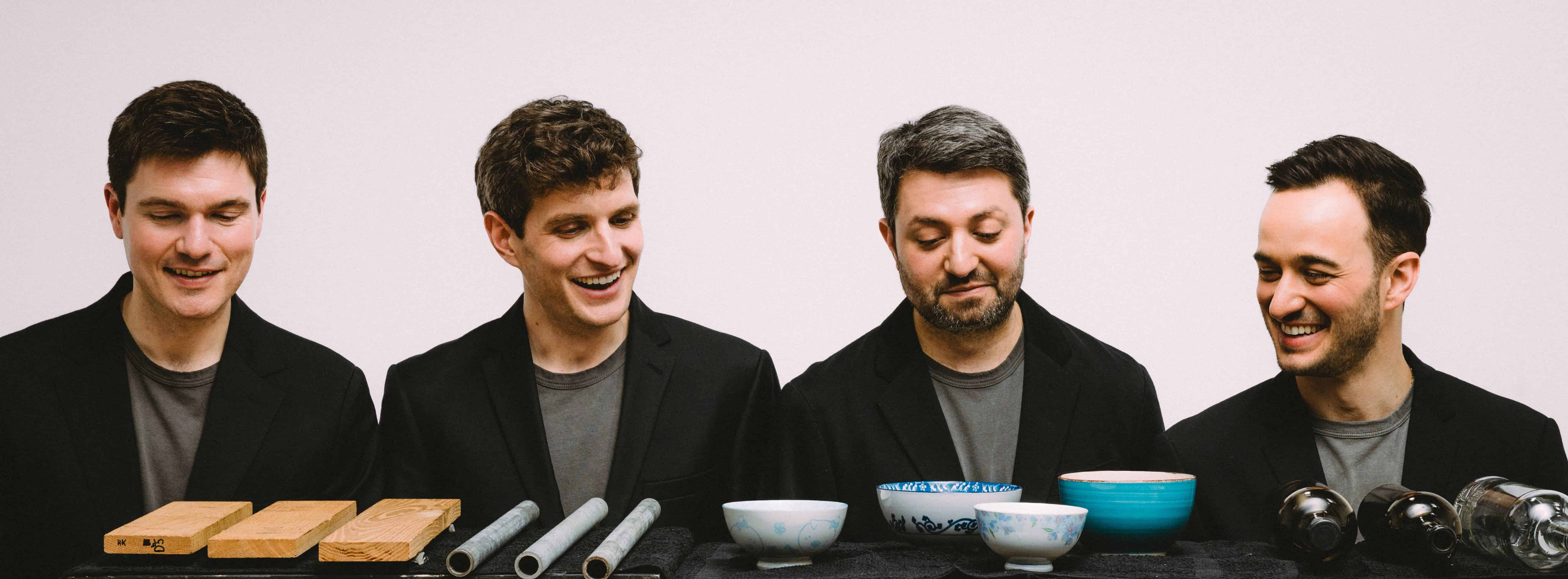
The “exhilarating” (The New York Times) and “utterly mesmerizing” (The Guardian) GRAMMY®- nominated Sandbox Percussion champions living composers through its unwavering dedication to contemporary chamber music. In 2011, Jonathan Allen, Victor Caccese, Ian Rosenbaum, and Terry Sweeney were brought together by their interest in expanding the percussion repertoire. Today, they are established leaders in contemporary music for percussion, engaging a wider audience for classical music through collaborations with leading composers and artists.
In 2025, Sandbox Percussion made its debut on NPR’s Tiny Desk with a genre-defying program of pieces by Andy Akiho and Viet Cuong; and, in 2024, they recorded percussion for the feature film The Wild Robot (DreamWorks). Sandbox Percussion is the first percussion ensemble to receive the prestigious Avery Fisher Career Grant; at the 2024 ceremony, they performed “Pillar V,” from Seven Pillars, Akiho’s 2021 suite for percussion quartet, which The New York Times called “as pure as music gets.” It was nominated for two GRAMMY® awards and was a Pulitzer Prize finalist.
Building on that success, Sandbox Percussion and Akiho embark on a project in 2025-26 to create a new work with Akiho joining on steelpan; “Pentalateral I,” the first completed movement, is available now as a single. Throughout the season, the quintet continues to create and record the rest of the piece, giving premieres of individual movements in select venues.
Sandbox Percussion also continues to champion Re(new)al, Cuong’s green energy and environment-themed 2017 concerto for percussion quartet. They reunite for the world premiere of a new work by Cuong to be performed with the Albany Symphony, which commissioned and premiered Re(new)al.
Another season highlight is the collaboration with violinist Kristin Lee, the founder and artistic director of Seattle’s Emerald City Music, where Sandbox Percussion is ensemble-in-residence this season. Together, they present a Vivian Fung world premiere, and the Pacific Northwest premiere of recent works by Joan Tower and Gabriella Smith. Lee joins Sandbox Percussion again at the Chamber Music Society of Lincoln Center for Sonic Spectrum IV, a program that includes Lou Harrison’s Concerto for Violin with Percussion Orchestra.
Over the season, Sandbox Percussion performs Simeon ten Holt’s minimalist work Canto Ostinato. The group’s arrangement for percussion quartet and two pianos was performed at Lincoln Center Summer for the City. A new recording by Sandbox Percussion, Erik Hall, and Metropolis Ensemble is scheduled for release in spring 2026 on the Western Vinyl label. At Duke University, Sandbox Percussion and the Tyshawn Sorey Trio present Max Roach at 100, a tribute to the influential jazz drummer. At Stanford Live, Sandbox Percussion joins the choir The Crossing for You Are Who I Love, the last work by the late Harold Meltzer, set to Aracelis Girmay’s poem about the undocumented immigrant experience in the U.S.
The group’s latest release is Don’t Look Down (PENTATONE, 2025), an album that “stretches and challenges the listeners’ ears” (BBC Music Magazine), featuring music by longtime collaborator Christopher Cerrone, with Hanick on piano and mezzo-soprano Elspeth Davis. The album received three GRAMMY® Award nominations, for Best Classical Compendium, Best Contemporary Classical Composition (the title piece), and Best Engineered Album, Classical.
Sandbox Percussion also recorded percussion music for its first feature film, The Wild Robot (DreamWorks, 2024), an animated science fiction film directed by Chris Sanders, with music by Kris Bowers. It received three Academy Award nominations, and a GRAMMY® Award nomination for the score.
Sandbox Percussion holds the positions of ensemble-in-residence and percussion faculty at the University of Missouri-Kansas City and The New School’s College of Performing Arts, where they have created a curriculum with entrepreneurship and chamber music at its core. The 2025-26 season is the group’s second year on faculty at the Peabody Institute of Johns Hopkins University. Sandbox Percussion endorses Pearl/Adams musical instruments, Zildjian cymbals, Vic Firth sticks and mallets, Remo drumheads, and Black Swamp accessories.
Sandbox Percussion is represented worldwide by BLU OCEAN ARTS. For more information please visit sandboxpercussion.com. Photo: Alex Lee 2024
Re(new)al (2019)
by Viet Cuong (b. Los Angeles, 1990)
This is the first Columbus Symphony performance.
Duration: 15’
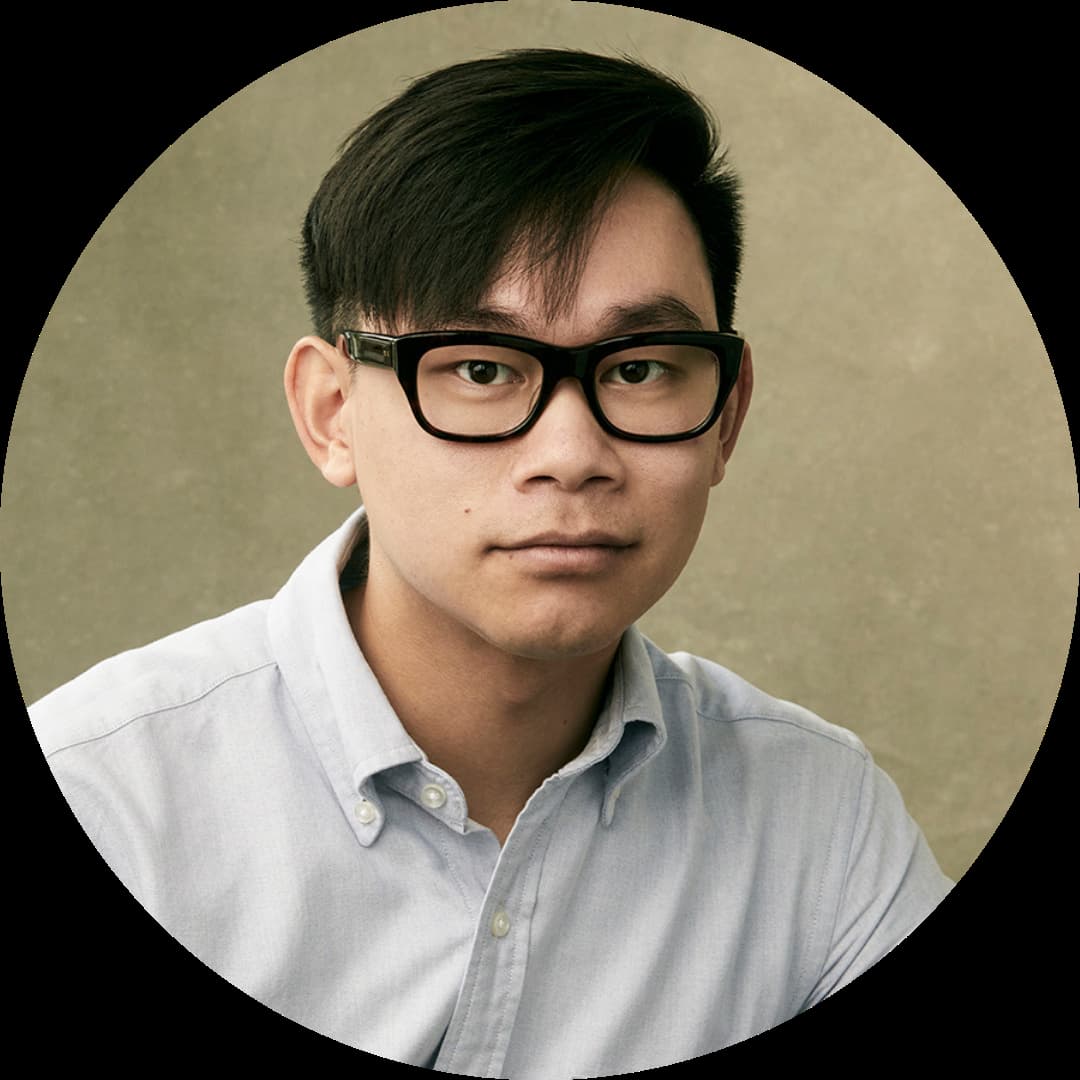
Vietnamese-American composer Viet Cuong is known for demonstrating an incredible range of imagination and inventiveness in his music, which has found audiences on six continents through performances by some of the world’s greatest orchestras, chamber groups and other ensembles. In an effort to “blend the whimsical and profound by finding new expressive possibilities through unexpected instrumental pairings and textures,” he has composed for such unusual groupings as double reed sextet, cello octet, and solo snare drum.
Re(new)al is a percussion concerto that frees both standard percussion and delightfully unconventional instruments from their usual positioning at the back of the stage. By placing them front and center, this section of the orchestra is able to garner the attention that it so rarely enjoys but so rightfully deserves, and Cuong’s inspiration from a range of sources is on full display. Having fallen in love with music as a teenage percussionist and clarinetist in Marietta, Georgia, Cuong credits his “big, bold, and dramatic” compositional style to his marching band background — notice the drum line feel and groovy brass in the second movement, “Wind.”
In addition to carefully planned mise en scène and complex choreography for the quartet of percussion soloists, Cuong challenges the rest of the orchestra with frequently shifting and uncommon meters. Extended techniques include harmonics and glissandos in the strings, the sounds of rushing air through wind instruments, and dramatic application of mutes in the brass. Performance directions range from “hypnotic” at the opening, to “mimic distant birds” as the first movement transitions into the second, to “majestic, organ-like” during the warm and radiant closing movement.
The composer offers the following program notes in the score:
I have tremendous respect for renewable energy initiatives and the commitment to creating a new, better reality for us all. Re(new)al is a percussion quartet concerto that is similarly devoted to finding unexpected ways to breathe new life into traditional ideas, and the solo quartet therefore performs on several “found” instruments, including crystal glasses and reusable compressed air cans. And while the piece also features more traditional instruments, such as snare drum and vibraphone, I looked for ways to either alter their sounds or find new ways to play them. For instance, a single snare drum is played by all four members of the quartet, and certain notes of the vibraphone are prepared with aluminum foil to recreate sounds found in electronic music. The entire piece was conceived in this way, and it was a blast to discover all of these unique sounds with the members of Sandbox Percussion.
Cooperation and synergy are also core themes of the piece, as I believe we all have to work together to move forward. All of the music played by the solo quartet is comprised of single musical ideas that are evenly distributed between the four soloists (for those interested, the fancy musical term for this is a hocket). The music would therefore be dysfunctional without the presence and dedication of all four members. For example, the quartet divvies up lightning-fast drum set beats in the second movement and later shares one glockenspiel in the last movement. But perhaps my favorite example of synergy in the piece is in the very opening, where the four soloists toast crystal glasses. We always toast glasses in the presence of others, and oftentimes to celebrate new beginnings. This is my simple way of celebrating everyone who is working together to create a cleaner, more efficient world.
Re(new)al is constructed of three continuous movements, each inspired by the power of hydro, wind, and solar energies. The hydro movement transforms tuned crystal glasses into ringing hand bells as the orchestra slowly submerges the soloists in their sound. The second movement turns each member of the quartet into a blade of a dizzying wind turbine, playing seemingly-impossible 90’s-inspired drum and bass patterns. The closing movement simulates a sunrise and evokes the brilliance of sunlight with metallic percussion instruments. This piece was originally written with a sinfonietta accompaniment, and in its original form was commissioned for the 2017 American Music Festival by David Alan Miller and the Albany Symphony’s Dogs of Desire in partnership with GE Renewable Energy. This full orchestra version was commissioned in 2018 by the Albany Symphony and is dedicated to Sandbox Percussion.
Note by David Hoyt
Symphony No. 8, Op. 65 (1943)
by Dmitri Shostakovich (St. Petersburg, 1906 - Moscow, 1975)
Most recent Columbus Symphony performance: May 7-8, 2005; Stefan Sanderling conducting.
Duration: 62’
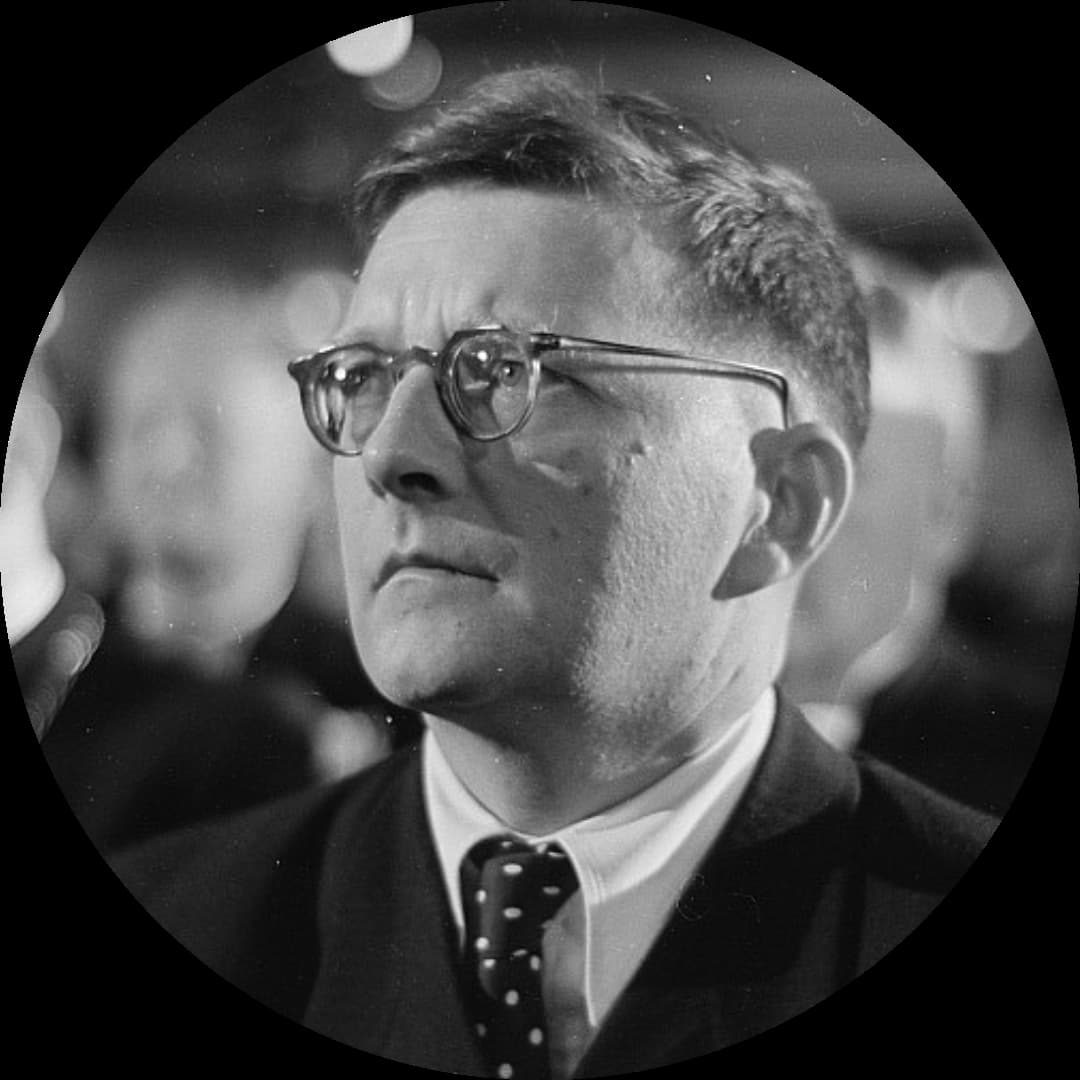
“I came home from the performance astounded: I had heard the voice of an ancient chorus from Greek tragedy. Music has a great advantage: without mentioning anything, it can say everything.”
These words by the author Ilya Ehrenburg, written after the first performance of Shostakovich’s Eighth Symphony (in Moscow on November 4, 1943), give eloquent testimony to the communicative power of music. Shostakovich needed no words to make his audience understand exactly what he had in mind. No one attending the premiere of the Eighth Symphony could have any doubt that it was a deeply tragic work, which caused considerable disappointment among officials who had expected the composer to continue in the vein of his Seventh (the “Leningrad Symphony”) and celebrate the heroism of the Soviets during World War II (the “Great Patriotic War,” as it was called in Russia). Yet the jarring dissonances, cruelly persistent march rhythms and brutal fortissimos of the Eighth told a different, and all-too-clear, story.
The first movement is a lament of gigantic proportions, essentially slow but interrupted by an extremely violent fast section. The opening theme, played by the strings in two-part imitation, projects great gravitas, further accentuated by the sharp dotted rhythms. This introduction resembles the opening of Shostakovich’s Fifth, but this time, the composer draws a different conclusion from a similar premise. Soon we hear a lyrical violin theme that shares its melodic outline with the famous war theme from the Seventh, combining it with the dotted rhythm of the first theme. Another melody, played first by the violins and then by the English horn, sounds like a song of mourning. But then, the previous violin theme returns with its character completely changed, now agitated almost to the point of hysteria, culminating in some harsh dissonances where the strings are instructed in the score to play their pizzicatos (plucked notes) “with such force that the string should hit the fingerboard after the attack.” It is only now, some fifteen minutes into the Symphony, that we reach the faster section and the earlier themes return with stronger rhythmic profiles. At the end of this development, there is what sounds like a blood-curdling scream—an almost graphic description of sheer horror. After this, the music unwinds with a long and quiet English horn solo, derived from the first measures of the Symphony. The movement ends in a mysterious pianissimo.
The second movement follows the traditional outline of the scherzo, a fast and typically lighthearted middle movement, without being the slightest bit humorous. The extreme simplicity of the themes and the unexpected sharp accents, characteristic of scherzos, are preserved, but here they seize the listener by the throat with an elementary dramatic force. This tension-filled music alternates with passages where the lighter tones of the piccolo and E-flat clarinet predominate. Still, the relentless chromaticism destabilizes our sense of the tonal center, and the unpredictable rhythmic patterns of these solos are unsettling. Before long, they turn into something positively menacing as the entire orchestra takes them over. This “trio,” or middle section, gradually merges into the recapitulation of the frantic scherzo; the melody formerly played by the piccolo is given to the strings in triple forte and marcatissimo, accompanied by harsh repeated notes in the brass and a persistent drumbeat. In the coda, the themes of the scherzo and the trio are combined as the dramatic tension reaches its high point.
The third, fourth, and fifth movements are played without a break. The third movement continues the macabre scherzo tone of the second, but sounds even more ferocious. The rhythm is reduced to an even stream of brutal quarter notes, and the melody to a single octave leap followed by a minor ninth. Through the obsessive use of such primitive devices, Shostakovich created a movement that seems to depict cruelty and inhumanity. The middle section with its frivolous trumpet solo brings no relief, and the quote of the “Sabre Dance” from Aram Khachaturian’s then-recent ballet Gayane—apparently a bitter parody—only reinforces our eerie feelings. The return of the main section culminates in another scream, similar to the one in the first movement.
The music gradually calms down, and the fourth movement begins. It is a passacaglia (variations on an unchanging ground bass) whose theme derives from the first movement. By including many notes outside the main key, Shostakovich extends traditional tonality and thereby maintains a high level of harmonic tension.
Eventually, the tension subsides and the fifth movement begins—the first in the Symphony to strike a more peaceful tone. It is not the kind of jubilant (or pseudo-jubilant) finale found in the Fifth and Seventh Symphonies; rather, it is a sort of meditation on the past crises. The form of the movement is based on the classical sonata-rondo in which a main theme keeps returning after various episodes (one of which also returns). The lyrical character of this theme never changes (with one notable exception), and this creates a sense of stability that has been missing from the Symphony so far. Only once, around the middle of the movement, does the music become more agitated as the main theme is taken over by the brass, and a dramatic climax, similar to those in the first and third movements, develops. But ultimately, peace and harmony prevail, and the Symphony fades away in a dream-like pianissimo. After so much turmoil, the music finds its long-awaited rest, affirming, perhaps, that all the suffering has not been in vain.
Note by Peter Laki
Columbus Symphony Musicians
VIOLIN BASS | FLUTE OBOE CLARINET HORN TRUMPET TUBA TIMPANI KEYBOARD |