Run Time: Approx. 42 minutes
Here in the United States, Antonín Dvořák is most famous for journeying across the Atlantic to aid the burgeoning American orchestral world in developing a voice of its very own. This voyage resulted in his famous Ninth Symphony, From the New World, which the ASO performed just last season.
While the idea of soliciting a European composer to help construct American identity may raise a few eyebrows, Dvořák was selected for this unique task precisely because he had already done just that for his own homeland of Bohemia—now Czechia.
The practice of injecting non-Western sounds into classical music was not exactly new, but prior to the 19th century, snippets of so-called exoticism were typically just that—novel characterizations of musical curiosities from far-off lands. Dvořák, by contrast, was among the first to draw on the tradition of his own homeland, introducing Czech folk melodies and rhythms into classical practice with true seriousness and authenticity. Perhaps the only one of Dvořák’s contemporaries to echo this approach was Tchaikovsky (born just one year before Dvořák), whose own unique style resulted from a masterful melding of Western convention with the folk traditions of Russia.
Both composers were met with mixed critical reviews, particularly in Europe, but theirs has proved a winning formula here in the United States, where we have shown a continued affection for music with open borders. In fact, one might draw a line straight from Dvořák through the jazz and Native-influenced American pioneers like Gershwin and Copland, to most of today’s most popular genres.
In the Eighth Symphony, Dvořák used the same tactics to conjure his own homeland as he later employed in the Ninth to reflect America. Both rely in equal measure on elements of folk melodies and practices alongside manifestations of the natural world. That the resulting symphonies sound so different is a tribute to his success.
What to listen for:
Major vs. Minor
This work is inscribed as “Symphony in G-Major.” It’s quite unusual, then, that the lyrical introduction in the low strings is written in G-minor. This major-minor swap continues to be a significant theme throughout the symphony, and Dvořák’s approach to the modulations is a key aspect of their character. Rather than journeying from major to minor through a complex sequence of chords, as is typical of classical practice, he switches between parallel majors and minors directly, such that the surprising transition is itself a part of the melody.
This can be heard most starkly in the opening of the second movement. Listen as the flute opens a phrase in major, and then a pair of clarinets takes over in an organization of the minor scale specific to many folk traditions. If that pair of clarinets sounds a bit Klezmer to your ears, you’re onto something. Klezmer, Slavic, Balkan, and even Turkish folk music all have a shared ancestry, and rely on this particular minor mode—Phrygian Dominant, for anyone who wants to spend an afternoon on Google—to create their unique sound.
It’s also important to note that while in Western classical practice, minor keys most often carry negative, even violent connotations, Dvořák’s minor-key sections possess as much joy as his major ones, reflecting their use as injections of Slavic sound rather than moments of tumult.
The Picardy Cadence
Dvořák’s transitions from minor back to major are just as purposeful as the reverse. Very often, he makes use of a chord known as the Picardy Cadence, which dates to the Renaissance period and is strongly associated with church music. In a Picardy Cadence, the final chord of a minor key phrase is altered to become major. Major chords were once considered more harmonically stable, making them the favored way to end a piece. You’ll likely recognize this sound from your hymnal, and it can be heard prominently in the opening of the work, where the introductory melody in G-minor concludes on an unexpected G-major chord. Frequently, Dvořák uses this technique to end lyrical and chorale-like phrases, giving these moments a reverence that perhaps expresses Dvořák’s affection for his homeland.
Traditional Dance
The third movement is heavily influenced by traditional Czech dance forms. While the typical classical-style third movement is also based on a dance in triple-meter like the minuet or waltz, Dvořák’s third movement includes small rhythmic disruptions characteristic of a Czech Furiant or Sousedská, which feature tricky injections of duple meter that throw off the waltz-like structure. To wrap the movement up, Dvořák switches to a lively polka for his coda—very unusual for a movement in triple-meter.
Sounds of Nature
Dvořák completed his Eighth Symphony while on retreat with his family at his country home outside of Prague. Like many composers, he drew particular inspiration from nature. There, he had a garden that he tended religiously, and was able to devote time to one of his favorite hobbies: raising pigeons. Given this, it’s difficult not to hear bird calls in fluttering flute solos, or rolling hills and streams in the flowing melodies.
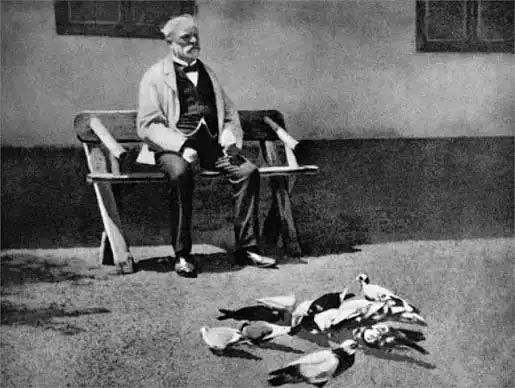
Dvořák and his pigeons.