Run Time: Approx. 20 minutes
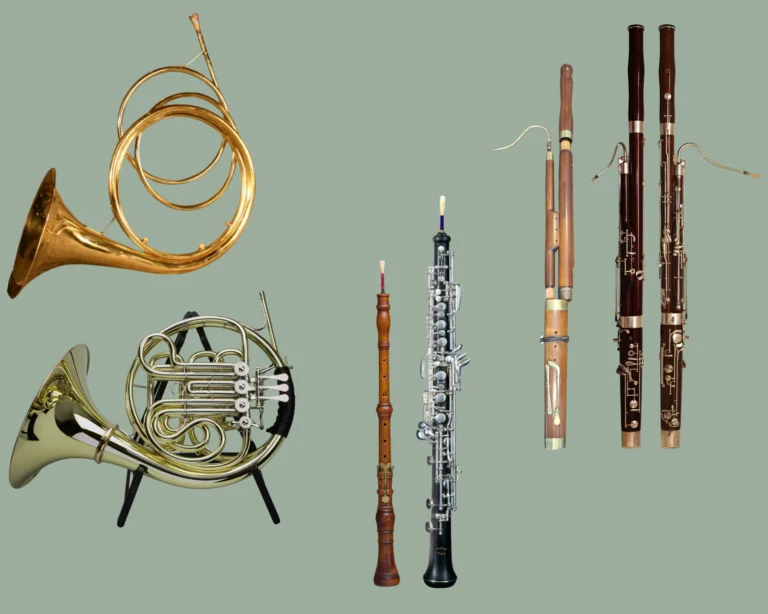
In this photo, you’ll find the 18th-century versions of the horn, oboe, and bassoon next to their modern counterparts. It’s not hard to see that these previous iterations were simpler in design than their descendants. For one thing, they have far fewer keys, and the horn has none at all. Over the years, improvements in materials have made instruments generally louder and more resonant, and today we favor rounder, darker sound colors than in years past. Modern oboes and bassoons, for example, are made of very hard woods like African blackwood or rosewood, while in Bach’s day, they were made from softer, less resonant materials. Without the extensive keywork of modern instruments, they were also lighter in weight, creating a brighter overall sound that I can’t help but describe as “honky.” ASO principal bassoonist Tariq Masri says that honkiness is also a function of the reeds, which have changed significantly in shape and size over the years. I feel compelled to note that, while reed-making may have evolved, modern professional oboists and bassoonists still make all their reeds by hand. Imagine having to whittle your own pencils before work everyday.
With fewer and less sophisticated keys, the Baroque instruments were much less timberally even between notes. On today’s wind instruments, every note, no matter how many valves or keys are depressed, produces the same sound, totally even across the instrument. In historical instruments, some key combinations were better or worse than others, creating a spectrum of sounds from bright and open to muted and covered. Horns, having no keys at all, relied on the manipulation of the hand in the bell to create some pitches, which drastically altered the sound between notes. Composers used this to their advantage, relying on these covered notes to produce a more solemn effect.
By contrast, string instruments had, for the most part, reached their mature form by this time. When Bach was born in 1685, Antonio Stradivari had already settled on his final design for the famous violins that are still played today. While changes in materials for bows and strings have contributed to shifts in color and resonance, string instruments themselves have remained largely unchanged.
The second factor influencing Bach’s approach was the historical role of wind instruments. Like the unruly puppies of the instrumental family, the comparatively unsophisticated winds of Bach’s day had only recently begun to be allowed indoors. The ancestry of wind instruments traces back to signaling practices, when they were used to announce everything from danger to the arrival of the post. Horns, in particular, were strongly associated with hunting, as seen in this depiction of a French fox hunt. Even after they were admitted into the concert hall, their rustic history remained hugely influential, tying them, perhaps permanently, to themes of nature.
Bach’s writing in the first Brandenburg Concerto shows a keen understanding of all these intricacies. Just in his choice of key we can see that he desired a bright, open sound from the oboes and bassoon. The horns, too, are situated in their upper register, where more uncovered notes are available. The musical material draws directly on courtly hunting practices, and the historian Bruce Lamott even suggested that the three instrumental choirs, strings, reeds, and horns, may represent different groups in the social hierarchy:
“The courtly Kapelle of strings, led by a soloist on the violino piccolo (as the name implies, a smaller violin tuned a minor third higher than the regular violin), the woodwind choir of three oboes and bassoon, played by the elite city band (Stadt-Pfeifer), and two French horns borrowed from the stables of the nobility. Rather than blending with the other instruments, however, the two horns brashly gallop through the opening ritornello playing hunting-calls in rhythmically incompatible triplets, seemingly oblivious to the rest of the band.”
We don’t know whether a social commentary was Bach’s intention, nor do we know for certain whether this concerto was written for an indoor or outdoor performance. It seems certain, however, that the work was meant to evoke the hunt and the celebratory practices surrounding it. If the brazen horns are not an outright joke, they are certainly meant to be conspicuous, and the oboes and bassoon play dual roles, joining the horns in their frolicking romp as readily as they perform their lyrical solos.
The final movement features a collection of dances that capture the essence of each instrumental choir: first, a French minuet played by the reed quartet; then, a stately Polish polonaise by the strings; and finally, a bawdy German trio featuring the horns that feels plucked straight from an Oktoberfest celebration.
For anyone interested in listening to this work performed on period instruments, I highly recommend checking out the Netherlands Bach Society.