Difficulty- Advanced
Length- 6:35
Number of Players- 18 Players
Instrumentation-
Onstage Ensemble:
5 Marimbas (4-4.3, 1-5.0)
Timpani (4)
Percussion 1: High Tom, Sizzle Cymbal, *Chimes (Bb and Db4), rute
Percussion 2: Medium Tom, High Brake Drum (lightly dampened), *Chime (C4), rute,
Percussion 3: Low Tom, Low Brake Drum (lightly dampened), *Chime (Ab3), rute
Percussion 4: Concert Bass Drum, Kick Drum, Sizzle Cymbal, *Chime (F3)
*Individual chimes can be suspended at each performer’s setup, or a single set of chimes located at Percussion 1’s setup can be shared with 2 performers in the front and rear of the chimes.
Antiphonal Metal Quartets:
Crotale 1&2: Crotales (Low Octave for Player 1 and High Octave for Player 2)
Glockenspiel 1&2
Pipes 1&2: Tuned Metal Pipes (1: F3, Ab3, C4, Db4, 2: C3, Eb3, G3, Ab3), Gong, threaded metal rod, 1 hand cymbal, bike pump (light amplification optional), mallets, sticks, 1 soft vibe mallet, Thin Metal Rod (e.g. back of brush handle). Pipes Available at harrispercussion.com
Vibraphone 1&2: Vibraphone (standard 3-octave range), Water Triangle & 1 beater, hard & soft mallets, sticks, Thin Metal Rod (e.g. back of brush handle)
Publisher- Self-Published by Composer. Contact composer to purchase (omar.carmenates@furman.edu)
Program Notes-
"Color Fields in Vector Space was conceived immediately as an exploration of timbre and space utilizing multiple small ensembles grouped by instrument type (metals, woods, drums) placed around the audience. However, despite my best efforts, accounting for eighteen performers, divided into five choirs, spread over a large distance proved to be too troublesome using traditional usual staff paper and pencil. I eventually came to realize that a digital environment that simulated the correct spacialization of the performer’s sounds would be what was needed. So, I actually ended up composing the entire piece in reverse order of my usual process: by first performing and recording each of the eighteen parts into a computer (in Logic Pro X for any tech-curious folks...) before ever committing even a single note to paper. In fact, “writing” the notes - in a traditional sense - comprised only the final 2-3 days of the entire composition process.
It was during this time that I remembered the term “vector space”, a mathematical term used by artificial intelligence researchers developing self-driving automobiles. Simply put, a vehicle’s cameras capture real-world images and render them into a three-dimensional digital “vector space” so that the vehicle’s software can see and understand all of the complexities of its surrounding environment (objects in motion, signs, traffic lights, etc...) and act accordingly. I found this process - using real-world data to create a digital environment that then acts as a model for actions back in the real- world - to be very similar to how this piece was created, and so came the title Color Fields in Vector Space." -Omar Carmenates
Composer Bio-
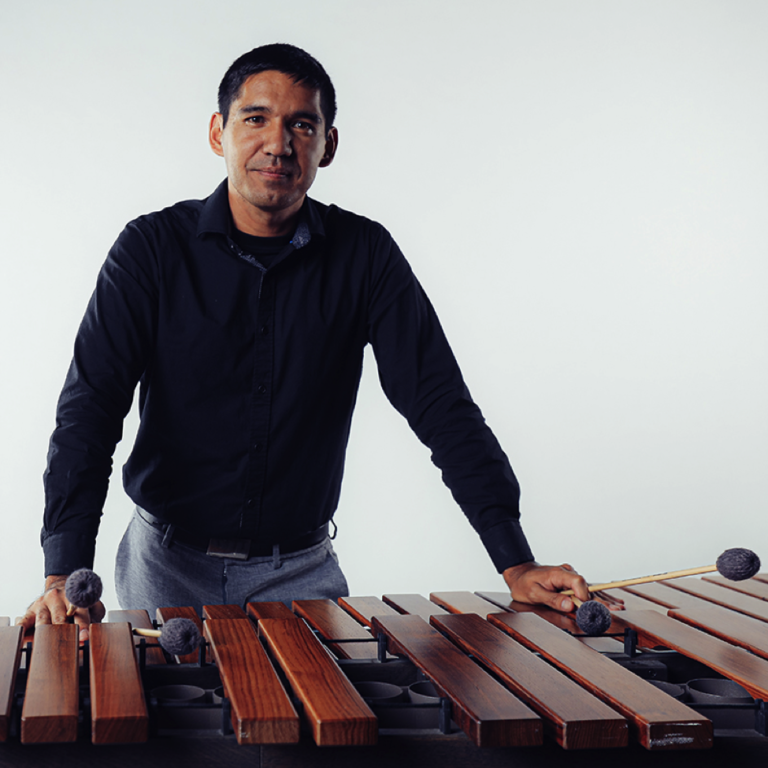
Omar Carmenates is the Charles Ezra Daniel Professor of Music at Furman University in Greenville, SC where he also serves as the founder and chair of the Council for Equity and Inclusion in Music. Under his direction, the Furman University Percussion Ensemble was named a winner the prestigious 2022 Percussive Arts Society International Percussion Ensemble Competition and, in collaboration with the Shi Institute for Sustainability, has also released premiere recordings of the ecoacoustic percussion music of composer Matthew Burtner through Navona Records. Students of the ensemble have also presented interdisciplinary performances and research at the Percussive Arts Society International Convention, the Ecomusics and Ecomusicologies conference, the nief-norf Summer Festival Research Summit, the International Conference on Romanticism, and the Esri International GIS User Conference.
Omar is also the director, producer, and arranger for the “John Psathas Percussion Project”, a collaboration aimed at recording and performing percussion arrangements of the works of John Psathas, New Zealand’s most prominent composer. The recordings and scores from this project are published through PARMA Recordings and Promethean Publications respectively. Omar’s debut solo recording, entitled The Gaia Theory, was released through Rattle Records in 2013 and he can also be heard on the Cantaloupe Records release of Pulitzer-Prize winning composer John Luther Adams’ Inuksuit for 9-99 outdoor percussionists, a work that he both co-commissioned and directed in its United States premiere.
In addition to his duties at Furman, Omar is an avid participant in the pageantry arts whose work can be seen and heard around the globe. While currently serving as an adjudicator for WGI Sport of the Arts, he has also served as a composer/arranger for the Cadets, the Boston Crusaders, and the Spirit of Atlanta Drum & Bugle Corps. Additionally, he has been the percussion arranger for high school programs across the United States including the Bands of America Grand National Champion Tarpon Springs High School Outdoor Performance Ensemble.
Omar is a proud endorser/artist for Grover Pro Percussion, Vic Firth, Inc. Remo Drumheads, Zildjian Cymbals, and Pearl Corporation/Adams Musical Instruments.