The Rt. Rev. Eugene T. Sutton
Presider
Sonya Subbayya Sutton
Director & Organist
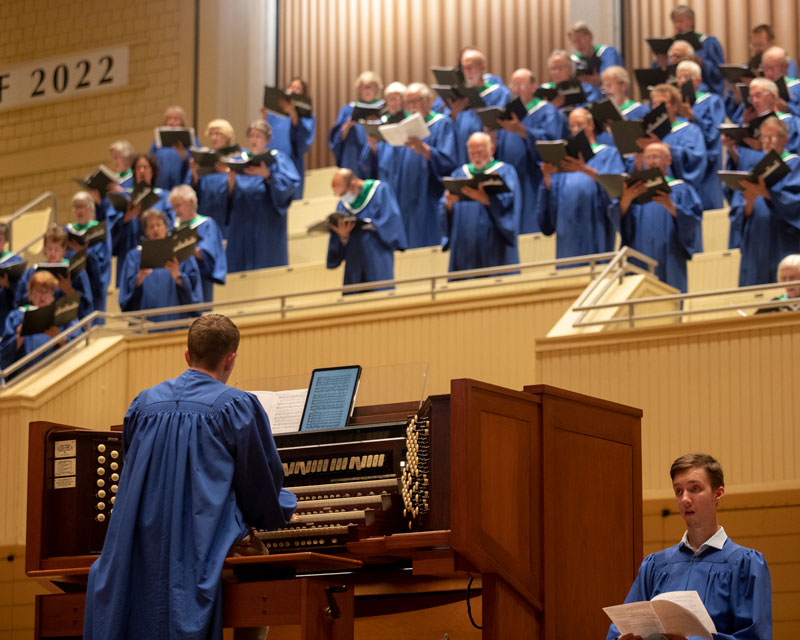
The Chautauqua Choir
Owen Reyda
Organist
Sophia Vastek & Sam Torres
Guest Musicians
D’Jena Kelly-Perry
Reader
We invite you to quietly prepare your hearts for worship during the Prelude.
* Denotes that the congregation is invited to rise in body or spirit.It is our custom to sing the first and last verses of hymns in unison, the interior verses may be sung in parts.
Prelude
Through the Smoke We See Each Other
Sophia Vastek, 2024
Hymn
“Day is dying in the west”
Chautauqua, William Fisk Sherwin, 1877
Mary Lathbury, 1877
Day is dying in the west;
Heav’n is touching earth with rest;
Wait and worship while the night
Sets her evening lamps alight
through all the sky.
Holy, holy, holy, Lord God of Hosts!
Heav’n and earth are full of Thee;
Heav’en and earth are praising Thee,
O Lord most high!
Welcome
A Prayer For Quiet Confidence
O God of peace, who hast taught us that in returning and rest we shall be saved, in quietness and confidence shall be our strength: By the might of thy Spirit lift us, we pray thee, to thy presence, where we may be still and know that thou art God; through Jesus Christ our Lord.
Amen.
Anthem
Dare to Call it Good
The Third Tune, Thomas Tallis, 1561
Arr. Lee Dengler, 2003
Text: Carl P. Daw, Jr., 1990
How shallow former shadows seem beside this great reverse,
as darkness swallows up the light of all the universe,
Creation shivers at the shock, the temple reads its veil.
A pallid stillness stifles time and nature’s motions fail.
This is no midday fantasy, no flight of fevered brain.
With vengeance grim, and real, chaos is come again.
The hands that formed us from the soil are nailed upon the cross.
The Word that gave us life and breath expires in utter loss.
Yet deep within this darkness lives a Love so fierce and free,
that arcs all voids and risk supreme! embraces agony.
Its perfect testament is etched in iron, blood, and wood.
With awe we glimpse its true import and dare to call it good.
Reading: A Contrapuntal Poem
Emily Dickinson and Maya Angelou
“Hope” is the thing with feathers -
That perches in the soul -
Just like moons and like suns,
With the certainty of tides,
Just like hopes springing high,
Still I’ll rise.
Did you want to see me broken?
Bowed head and lowered eyes?
Shoulders falling down like teardrops,
Weakened by my soulful cries?
That could abash the little Bird
That kept so many warm -
You may shoot me with your words,
You may cut me with your eyes,
You may kill me with your hatefulness,
But still, like air, I’ll rise.
Out of the huts of history’s shame
I rise
Up from a past that’s rooted in pain
I rise
I’ve heard it in the chillest land -
And on the strangest Sea -
I’m a black ocean, leaping and wide,
Welling and swelling I bear in the tide.
Leaving behind nights of terror and fear
I rise
Into a daybreak that’s wondrously clear
I rise
Bringing the gifts that my ancestors gave,
I am the dream
and the hope of the slave.
That perches in the soul -
And sings the tune without the words -
And never stops - at all -
I rise
I rise
I rise.
Reading: Psalm 121
The St. Helena Psalter
I lift up my eyes to the hills; (pause) from where is my help to come?
My help comes from God, (pause) the maker of heaven and earth.
God will not let your foot be moved; (pause) the One who watches over you will not fall asleep.
Behold, the One who keeps watch over Israel (pause) shall neither slumber nor sleep;
The Holy One watches over you (pause) and is your shade at your right hand,
So that the sun shall not strike you by day, (pause) nor the moon by night.
God shall preserve you from all evil (pause) and is the One who shall keep you safe.
God shall watch over your going out and your coming in, (pause) from this time forth for evermore.
Prelude to "As Torrents In Summer"
Elegy
Gary Davison, 2026
Anthem
Torrents of Summer, from “King Olaf”
Music: Edward Elgar, 1896
Text: Henry Wadsworth Longfellow, 1863
As torrents in summer, Half dried in their channels
Suddenly rise, tho’ the sky is still cloudlesss
For rain has been falling
Far off at their fountains;
So hearts that are fainting Grow full to o’erflowing
And they that behold it, Marvel, and know not
That God at their fountains
Far off has been raining!
Reading: Dark Night of the Soul
Susan Palo Cherwien, 2009
St. Therese certainly knew the dark night of the soul. St. John of the Cross, Jonah in the belly of the whale, the Israelites in captivity, and most likely every person has known the dark night of the soul, that rocky place of such sadness or grief or fear that it is almost death. That place where the air is too heavy for speech, too thick almost for breath. In this deepening spiral of becoming, down and down, and deeper down in the belly of the whale we may want to lay aside our harps, we may want to shake a fist at God - why me! why now! The dark night of the soul is not reserved for some elite group of mystics and saints, or for God’s chosen people. It is part of every life journey, it is spiraled into often more than once in a lifetime, and Christ says to us: Do not be defeated, do not be dismayed. I am here, and together we will return, together we will walk into the Light.
Anthem
Virtue
Music: Gary Davison, 2025
Text: George Herbert, 1633
Sweet day, so cool, so calm, so bright,
The bridal of the earth and sky;
The dew shall weep thy fall to-night,
For thou must die.
Sweet rose, whose hue angry and brave
Bids the rash gazer wipe his eye;
Thy root is ever in its grave,
And thou must die.
Sweet spring, full of sweet days and roses,
A box where sweets compacted lie;
My music shows ye have your closes,
And all must die.
Only a sweet and virtuous soul,
Like season’d timber, never gives;
But though the whole world turn to coal,
Then chiefly lives.
Closing Prayers
Joan Brown Campbell
God of all our seasons, God of all our years, Make of each year a blessing. Where there is sorrow, give us solace. Where there is pain, give us strength. Where there is joy, fill us with thanksgiving. Where there is bitterness, transform us with your love. God, who calls us to choose and cherish life, we are yours. We dare to risk a life of love and laughter.
Amen.
Hymn
"Now the day is over"
Merrial, Joseph Barnaby, 1868
Sabine Barind-Gould, 1865
Now the day is over, night is drawing nigh,
shadows of the evening steal across the sky.
O God, give the weary calm and sweet repose
with thy tend’rest blessing may our eyelids close.
When the morning wakens, then may I arise
pure, and fresh, and sinless in thy holy eyes. Amen.
Postlude
Largo
George Frederick Handel, 1738
from the opera Xerxes
Use of this piece to close the Sunday evening service has been Chautauqua’s tradition since the dedication of the Massey Memorial Organ on August 6, 1907. Part of the custom has been to remain in our seats until the piece is finished. It is a gesture that we treasure, and one in which you are invited to join. We invite you to leave the Amphitheater silently—without applause.
CHAUTAUQUA INSTITUTION
Department of Religion
Robert Wilson-Black
Director of Religion
The Rt. Rev. Eugene Taylor Sutton
Senior Pastor
Sonya Subbayya Sutton
Interim Director of Sacred Music
Owen Reyda
Organ Scholar
Carolyn Snider
Administrative Assistant
Alicen Roberts
Religion Intern