× Upcoming Events Past Events
Home
Image for Sacred Song Service
Sacred Song Service – Migration

The Rt. Rev. Eugene Taylor Sutton
Presider 

Maggie Brockman, Beth Miller 
Readers

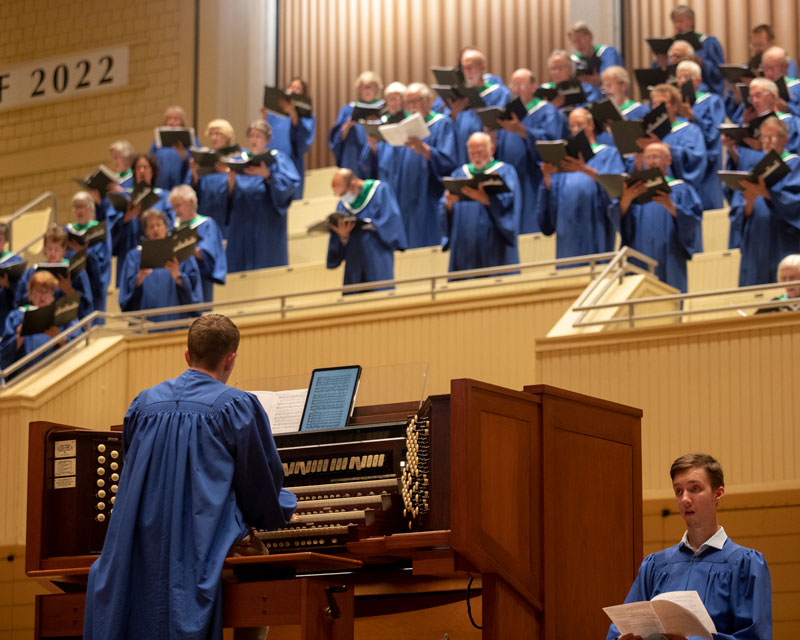
The Chautauqua Choir

Sonya Subbayya Sutton 
Interim Director & Organist

Owen Reyda
Organist

We invite you to quietly prepare your hearts for worship during the Prelude.

* Denotes that the congregation is invited to rise in body or spirit.It is our custom to sing the first and last verses of hymns in unison, the interior verses may be sung in parts.


Prelude

Lotus 

Billy Strayhorn, 1959 
arranged for organ by Alec Wyton 

Organist Alec Wyton's improvisation on Strayhorn's Lotus Blossom was first played at Duke Ellington's funeral in 1974.


Hymn

“Day is dying in the west”

Chautauqua, William Fisk Sherwin, 1877
Mary Lathbury, 1877

Day is dying in the west;
Heav’n is touching earth with rest;
Wait and worship while the night
Sets her evening lamps alight
through all the sky.

Holy, holy, holy, Lord God of Hosts!
Heav’n and earth are full of Thee;
Heav’en and earth are praising Thee,
O Lord most high!


Welcome

Opening Prayer

God our Creator: We ask for your loving presence and for your peace to be with refugees in our local communities and around the world. Be with all who are in fear. Be with those whose lives and livelihoods are under threat, and whose religious freedoms are being compromised. Be with us as we strive to enact your will in our welcome and support of refugees. Be with those in positions of leadership, that their decisions may bend toward peace and not division, and that they might realize the power they hold to do justice. Give us all strength and courage. Equip and empower us to be witnesses to your love – as advocates and as servants, as ministers of welcome and bearers of hope, especially for those seeking refuge. In your holy name we pray. 

Amen.


Anthem

A Hymn to the Evening 

Music: Robert Lehman, 2026 
Words: Phillis Wheatley, 1773 

Soon as the sun forsook the eastern main 
The pealing thunder shook the heav'nly plain; 
Majestic grandeur! From the zephyr's wing, 
Exhales the incense of the blooming spring. 
Soft purl the streams, the birds renew their notes, 
And through the air their mingled music floats. 
Through all the heav'ns what beauteous dies are spread! 
But the west glories in the deepest red: 
So may our breasts with ev'ry virtue glow, 
The living temples of our God below! 
Filled with the praise of him who gives the light, 
And draws the sable curtains of the night, 
Let placid slumbers sooth each weary mind, 
At morn to wake more heavenly, more refined; 
So shall the labours of the day begin 
More pure, more guarded from the snares of sin. 
Night's leaden sceptre seals my drowsy eyes, 
Then cease, my song, till fair Aurora rise. 

Phillis Wheatley (1753 – 1784) was kidnapped in West Africa as a child, transported to America, and sold to a prominent Boston family. Her name comes from the mechanism of her forced migration, a ship named The Phillis. The Wheatleys recognized Phillis’ aptitude for learning and supplied her with a proper education. By her early teens, she was reading Greek and Latin and writing poetry. Through contacts made possible by the Wheatley family, she published a book at the age of 20 -- the first enslaved African and the third colonial American female to do so. This setting of Wheatley's poem was commissioned for The Chautauqua Choir and receives its first performance tonight. 


Reading

Matthew 2:1-15 

After Jesus was born in Bethlehem in Judea, during the time of King Herod, Magi from the east came to Jerusalem and asked, “Where is the one who has been born king of the Jews? We saw his star when it rose and have come to worship him.” 

When King Herod heard this he was disturbed, and all Jerusalem with him. When he had called together all the people’s chief priests and teachers of the law, he asked them where the Messiah was to be born. “In Bethlehem in Judea,” they replied, “for this is what the prophet has written: 

“‘But you, Bethlehem, in the land of Judah, 

are by no means least among the rulers of Judah; 

for out of you will come a ruler 

who will shepherd my people Israel.’” 

Then Herod called the Magi secretly and found out from them the exact time the star had appeared. He sent them to Bethlehem and said, “Go and search carefully for the child. As soon as you find him, report to me, so that I too may go and worship him.” 

After they had heard the king, they went on their way, and the star they had seen when it rose went ahead of them until it stopped over the place where the child was. When they saw the star, they were overjoyed. On coming to the house, they saw the child with his mother Mary, and they bowed down and worshiped him. Then they opened their treasures and presented him with gifts of gold, frankincense and myrrh. And having been warned in a dream not to go back to Herod, they returned to their country by another route. 

When they had gone, an angel of the Lord appeared to Joseph in a dream. “Get up,” he said, “take the child and his mother and escape to Egypt. Stay there until I tell you, for Herod is going to search for the child to kill him.” 

So he got up, took the child and his mother during the night and left for Egypt, where he stayed until the death of Herod. And so was fulfilled what the Lord had said through the prophet: “Out of Egypt I called my son.” 


Anthem

Wade in the Water 

Spiritual, setting by Aaron David Miller, 2012 

Wade in the water, wade in the water children,
Wade in the water, God's gonna trouble the water.
Now see that host all dressed in white, God's gonna trouble the water.
The leader looks like the Israelite, God's gonna trouble the water.
Look over yonder, what do I see? God's gonna trouble the water.
The Holy Spirit’s coming for me, God's gonna trouble the water.
Now see that band all dressed in red, God's gonna trouble the water.
It looks like the band that Moses led, God's gonna trouble the water.
If you don't believe I've been redeemed, God's gonna trouble the water.
Just follow me down to Jordan's stream, God's gonna trouble the water.

It is thought that the legendary abolitionist, Harriet Tubman, who escaped enslavement and then made an astounding thirteen return trips into Maryland's eastern shore to free more than seventy others, used “Wade in the Water” to warn slaves to get off the trail and into the water to prevent the slavers' dogs from detecting their scent.


Reading

things we carry on the sea 

From My Name is Immigrant 
by Ping Wang, 2020 

we carry tears in our eyes: good-bye father, good-bye mother 

we carry soil in small bags: may home never fade from our hearts 

we carry names, stories, memories of our village, our civilization 

we carry scars from proxy wars of greed 

we carry carnage of mining, droughts, floods, genocides 

we carry dust of our families incinerated in mushroom clouds 

we carry our islands sinking under the sea 

we carry our hands, feet, bones, hearts and best minds to start 

a new life 

we carry diplomas: medicine, engineer, nurse, education, math, 

poetry, even if they mean nothing to the other shore 

we carry railroads, plantations, laundromats, bodegas, taco trucks, 

farms, factories, nursing homes, hospitals, schools, temples . . . 

built on our ancestors’ backs 

we carry old homes along the spine, new dreams in our chests 

we carry yesterday, today and tomorrow 

we’re orphans of the wars forced upon us 

we’re refugees of the sea drowning in plastic wastes 

we came from the same mother in Africa 

we’re your children, sisters and brothers, father and mother 

our tongues carry the same weight as we chant 


Chamber Ensemble

"Freedmen of the Five Civilized Tribes" 

Valerie Coleman, 2015
Reva Youngstein, flute and alto flute
Daniel Spitzer, clarinet 
Sarah Spitzer, violin 
Daryl Goldberg, cello 
Arlene Hajinlian, piano 

This work honors the legacy of Native Americans and formerly enslaved Africans who had been adopted into Native American tribal membership through emancipation or marriage, and who were forced to leave their homes in the southeastern U.S. and follow the "Trail of Tears" to Oklahoma. The composer writes: "The history of what is referred to as the Five Civilized tribes (the Chickasaw, Cherokee, Creek, Seminole and Choctaw nations) and their relationship with the Freedmen resonates within me as it is a true merging of cultures, sometimes clashing with aggression, but more than often melding into a soulful exchange."


Hymn

Where Charity and Love Prevail 

Tune: Ubi caritas 


Reading

Matthew 25: 34-40 

“Come, you that are blessed by my Father, inherit the kingdom prepared for you from the foundation of the world; for I was hungry and you gave me food, I was thirsty and you gave me something to drink, I was a stranger and you welcomed me, I was naked and you gave me clothing, I was sick and you took care of me, I was in prison and you visited me.” Then the righteous will answer him, “Lord, when was it that we saw you hungry and gave you food, or thirsty and gave you something to drink? And when was it that we saw you a stranger and welcomed you, or naked and gave you clothing? And when was it that we saw you sick or in prison and visited you?” And the king will answer them, “Truly I tell you, just as you did it to one of the least of these who are members of my family, you did it to me.” 


Anthem

Follow the Drinking Gourd 

Spiritual, arr. Dan Davison

Follow the drinking gourd.
When the sun comes back and the first quail calls,
Follow the drinking gourd.
For the old man is a–waitin’ for to carry you to freedom
Follow the drinking gourd.
O the riverbank becomes the road to freedom,
Dead trees show the way.
O the left foot, peg foot, helps you on your journey.
Follow the drinking gourd.
The river ends between two hills,
Follow the drinking gourd.
There's a greater river flowin’ on the other side.
Follow the drinking gourd.
For the old man is a-cryin’ and the old man is a-singin’.
Follow the drinking gourd.
For the old man is a–waiting for to carry you to freedom
If you follow the drinking gourd.

Kitchen ladles were made from dried gourds and used for drinking. The "drinking gourd" here refers to the Big Dipper, which enslaved people could use as a reference during their escape journeys to freedom in the north. The "old man" refers to a "conductor" on the Underground Railroad known as Peg Leg Joe. The lyrics are cartographic directions for an escape route. Though the song's origin and context remain unknown, and it was not published until 1928, it is a song which records the kinds of things that those escaping enslavement would have needed to look for. 


Reading

The Immigrant's Song 

Tishani Doshi, 2013 

Let us not speak of those days 
when coffee beans filled the morning 
with hope, when our mothers' headscarves 
hung like white flags on washing lines. 
Let us not speak of the long arms of sky 
that used to cradle us at dusk. 
And the baobabs—let us not trace 
the shape of their leaves in our dreams, 
or yearn for the noise of those
nameless birds 
that sang and died in the church's eaves. 
Let us not speak of men, 
stolen from their beds at night. 
Let us not say the word 
disappeared. 
Let us not remember the first smell 
of rain. 
Instead, let us speak of our lives now— 
the gates and bridges and stores. 
And when we break bread 
in cafés and at kitchen tables 
with our new brothers, 
let us not burden them with stories 
of war or abandonment. 
Let us not name our old friends 
who are unravelling like fairy tales 
in the forests of the dead. 
Naming them will not bring them back. 
Let us stay here, and wait for the future 
to arrive, for grandchildren to speak 
in forked tongues about the country 
we once came from. 
Tells us about it, they might ask. 
And you might consider telling them 
of the sky and the coffee beans, 
the small white houses and dusty streets. 
You might set your memory afloat 
like a paper boat down a river. 
You might pray that the paper 
whispers your story to the water, 
that the water sings it to the trees, 
that the trees howl and howl 
it to the leaves. If you keep still 
and do not speak, you might hear 
your whole life fill the world 
until the wind is the only word. 


Hymn

There's a place for everyone at the table 

Tune: Tablesong 
Words: Shirley Erena Murray, 1998 
Music: Jane Marshall, 1999 


Prayer

Trusting that God’s mercy is revealed in love for those who hurt or are in need, let us now lift up prayers for migrants and refugees, we pray 

God of love, 

turn our hearts to your ways; 

and give us peace. 

That migrants and refugees may receive compassionate and practical help and find comfort from their sorrow and fear, we pray, 

God of love, 

turn our hearts to your ways; 

and give us peace. 

That unaccompanied migrant children might be kept safe and reunited with families and loved ones, we pray 

God of love, 

turn our hearts to your ways; 

and give us peace. 

That governments will address the root causes of migration and implement fair and compassionate immigration policies, we pray 

God of love, 

turn our hearts to your ways; 

and give us peace. 

That all people of good will may stand in solidarity with migrants and refugees and have the courage to welcome every newcomer, we pray 

God of love, 

turn our hearts to your ways; 

and give us peace. 

That peaceful solutions may be found to the conflict, injustice, and violence that forces people to flee, we pray 

God of love, 

turn our hearts to your ways; 

and give us peace. 

That effective responses to climate change may halt the flooding, drought, and natural disasters that leads to migration of the poor, we pray 

God of love, 

turn our hearts to your ways; 

and give us peace. 

Amen.


Closing Prayer

Loving God, you create every person in your image and unite us all in one human family. As our brothers’ and sisters’ keepers, fill us with courage and compassion, that we might meet the hardships of migrants and refugees, not with silence and indifference, but with generous acts of mercy, welcoming every stranger as Christ in our midst. 

Amen. 


Hymn

"Now the day is over"

Merrial, Joseph Barnaby, 1868
Sabine Barind-Gould, 1865

Now the day is over, night is drawing nigh,shadows of the evening steal across the sky.

Jesus, give the weary calm and sweet reposewith thy tend’rest blessing may our eyelids close.

When the morning wakens, then may I arisepure, and fresh, and sinless in thy holy eyes. Amen.


Postlude

Largo

George Frederick Handel, 1738
from the opera 
Xerxes

This music has closed the Sunday evening service since the dedication of the Massey Memorial Organ on August 6, 1907. It is a Chautauqua tradition to remain seated until the music is finished and to then leave the Amphitheater silently, without applause. 


Chautauqua Institution
Department of Religion

Robert Wilson-Black
Director of Religion

The Rt. Rev. Eugene Taylor Sutton
Senior Pastor

Sonya Subbayya Sutton
Interim Director of Sacred Music

Carolyn Snider
Administrative Assistant

Alicen Roberts
Religion Graduate Fellow

Owen Reyda
Organ Scholar

Image for Sacred Song Service
Sacred Song Service – Migration

The Rt. Rev. Eugene Taylor Sutton
Presider 

Maggie Brockman, Beth Miller 
Readers

The Chautauqua Choir

Sonya Subbayya Sutton 
Interim Director & Organist

Owen Reyda
Organist

We invite you to quietly prepare your hearts for worship during the Prelude.

* Denotes that the congregation is invited to rise in body or spirit.It is our custom to sing the first and last verses of hymns in unison, the interior verses may be sung in parts.


Prelude

Lotus 

Billy Strayhorn, 1959 
arranged for organ by Alec Wyton 

Organist Alec Wyton's improvisation on Strayhorn's Lotus Blossom was first played at Duke Ellington's funeral in 1974.


Hymn

“Day is dying in the west”

Chautauqua, William Fisk Sherwin, 1877
Mary Lathbury, 1877

Day is dying in the west;
Heav’n is touching earth with rest;
Wait and worship while the night
Sets her evening lamps alight
through all the sky.

Holy, holy, holy, Lord God of Hosts!
Heav’n and earth are full of Thee;
Heav’en and earth are praising Thee,
O Lord most high!


Welcome

Opening Prayer

God our Creator: We ask for your loving presence and for your peace to be with refugees in our local communities and around the world. Be with all who are in fear. Be with those whose lives and livelihoods are under threat, and whose religious freedoms are being compromised. Be with us as we strive to enact your will in our welcome and support of refugees. Be with those in positions of leadership, that their decisions may bend toward peace and not division, and that they might realize the power they hold to do justice. Give us all strength and courage. Equip and empower us to be witnesses to your love – as advocates and as servants, as ministers of welcome and bearers of hope, especially for those seeking refuge. In your holy name we pray. 

Amen.


Anthem

A Hymn to the Evening 

Music: Robert Lehman, 2026 
Words: Phillis Wheatley, 1773 

Soon as the sun forsook the eastern main 
The pealing thunder shook the heav'nly plain; 
Majestic grandeur! From the zephyr's wing, 
Exhales the incense of the blooming spring. 
Soft purl the streams, the birds renew their notes, 
And through the air their mingled music floats. 
Through all the heav'ns what beauteous dies are spread! 
But the west glories in the deepest red: 
So may our breasts with ev'ry virtue glow, 
The living temples of our God below! 
Filled with the praise of him who gives the light, 
And draws the sable curtains of the night, 
Let placid slumbers sooth each weary mind, 
At morn to wake more heavenly, more refined; 
So shall the labours of the day begin 
More pure, more guarded from the snares of sin. 
Night's leaden sceptre seals my drowsy eyes, 
Then cease, my song, till fair Aurora rise. 

Phillis Wheatley (1753 – 1784) was kidnapped in West Africa as a child, transported to America, and sold to a prominent Boston family. Her name comes from the mechanism of her forced migration, a ship named The Phillis. The Wheatleys recognized Phillis’ aptitude for learning and supplied her with a proper education. By her early teens, she was reading Greek and Latin and writing poetry. Through contacts made possible by the Wheatley family, she published a book at the age of 20 -- the first enslaved African and the third colonial American female to do so. This setting of Wheatley's poem was commissioned for The Chautauqua Choir and receives its first performance tonight. 


Reading

Matthew 2:1-15 

After Jesus was born in Bethlehem in Judea, during the time of King Herod, Magi from the east came to Jerusalem and asked, “Where is the one who has been born king of the Jews? We saw his star when it rose and have come to worship him.” 

When King Herod heard this he was disturbed, and all Jerusalem with him. When he had called together all the people’s chief priests and teachers of the law, he asked them where the Messiah was to be born. “In Bethlehem in Judea,” they replied, “for this is what the prophet has written: 

“‘But you, Bethlehem, in the land of Judah, 

are by no means least among the rulers of Judah; 

for out of you will come a ruler 

who will shepherd my people Israel.’” 

Then Herod called the Magi secretly and found out from them the exact time the star had appeared. He sent them to Bethlehem and said, “Go and search carefully for the child. As soon as you find him, report to me, so that I too may go and worship him.” 

After they had heard the king, they went on their way, and the star they had seen when it rose went ahead of them until it stopped over the place where the child was. When they saw the star, they were overjoyed. On coming to the house, they saw the child with his mother Mary, and they bowed down and worshiped him. Then they opened their treasures and presented him with gifts of gold, frankincense and myrrh. And having been warned in a dream not to go back to Herod, they returned to their country by another route. 

When they had gone, an angel of the Lord appeared to Joseph in a dream. “Get up,” he said, “take the child and his mother and escape to Egypt. Stay there until I tell you, for Herod is going to search for the child to kill him.” 

So he got up, took the child and his mother during the night and left for Egypt, where he stayed until the death of Herod. And so was fulfilled what the Lord had said through the prophet: “Out of Egypt I called my son.” 


Anthem

Wade in the Water 

Spiritual, setting by Aaron David Miller, 2012 

Wade in the water, wade in the water children,
Wade in the water, God's gonna trouble the water.
Now see that host all dressed in white, God's gonna trouble the water.
The leader looks like the Israelite, God's gonna trouble the water.
Look over yonder, what do I see? God's gonna trouble the water.
The Holy Spirit’s coming for me, God's gonna trouble the water.
Now see that band all dressed in red, God's gonna trouble the water.
It looks like the band that Moses led, God's gonna trouble the water.
If you don't believe I've been redeemed, God's gonna trouble the water.
Just follow me down to Jordan's stream, God's gonna trouble the water.

It is thought that the legendary abolitionist, Harriet Tubman, who escaped enslavement and then made an astounding thirteen return trips into Maryland's eastern shore to free more than seventy others, used “Wade in the Water” to warn slaves to get off the trail and into the water to prevent the slavers' dogs from detecting their scent.


Reading

things we carry on the sea 

From My Name is Immigrant 
by Ping Wang, 2020 

we carry tears in our eyes: good-bye father, good-bye mother 

we carry soil in small bags: may home never fade from our hearts 

we carry names, stories, memories of our village, our civilization 

we carry scars from proxy wars of greed 

we carry carnage of mining, droughts, floods, genocides 

we carry dust of our families incinerated in mushroom clouds 

we carry our islands sinking under the sea 

we carry our hands, feet, bones, hearts and best minds to start 

a new life 

we carry diplomas: medicine, engineer, nurse, education, math, 

poetry, even if they mean nothing to the other shore 

we carry railroads, plantations, laundromats, bodegas, taco trucks, 

farms, factories, nursing homes, hospitals, schools, temples . . . 

built on our ancestors’ backs 

we carry old homes along the spine, new dreams in our chests 

we carry yesterday, today and tomorrow 

we’re orphans of the wars forced upon us 

we’re refugees of the sea drowning in plastic wastes 

we came from the same mother in Africa 

we’re your children, sisters and brothers, father and mother 

our tongues carry the same weight as we chant 


Chamber Ensemble

"Freedmen of the Five Civilized Tribes" 

Valerie Coleman, 2015
Reva Youngstein, flute and alto flute
Daniel Spitzer, clarinet 
Sarah Spitzer, violin 
Daryl Goldberg, cello 
Arlene Hajinlian, piano 

This work honors the legacy of Native Americans and formerly enslaved Africans who had been adopted into Native American tribal membership through emancipation or marriage, and who were forced to leave their homes in the southeastern U.S. and follow the "Trail of Tears" to Oklahoma. The composer writes: "The history of what is referred to as the Five Civilized tribes (the Chickasaw, Cherokee, Creek, Seminole and Choctaw nations) and their relationship with the Freedmen resonates within me as it is a true merging of cultures, sometimes clashing with aggression, but more than often melding into a soulful exchange."


Hymn

Where Charity and Love Prevail 

Tune: Ubi caritas 


Reading

Matthew 25: 34-40 

“Come, you that are blessed by my Father, inherit the kingdom prepared for you from the foundation of the world; for I was hungry and you gave me food, I was thirsty and you gave me something to drink, I was a stranger and you welcomed me, I was naked and you gave me clothing, I was sick and you took care of me, I was in prison and you visited me.” Then the righteous will answer him, “Lord, when was it that we saw you hungry and gave you food, or thirsty and gave you something to drink? And when was it that we saw you a stranger and welcomed you, or naked and gave you clothing? And when was it that we saw you sick or in prison and visited you?” And the king will answer them, “Truly I tell you, just as you did it to one of the least of these who are members of my family, you did it to me.” 


Anthem

Follow the Drinking Gourd 

Spiritual, arr. Dan Davison

Follow the drinking gourd.
When the sun comes back and the first quail calls,
Follow the drinking gourd.
For the old man is a–waitin’ for to carry you to freedom
Follow the drinking gourd.
O the riverbank becomes the road to freedom,
Dead trees show the way.
O the left foot, peg foot, helps you on your journey.
Follow the drinking gourd.
The river ends between two hills,
Follow the drinking gourd.
There's a greater river flowin’ on the other side.
Follow the drinking gourd.
For the old man is a-cryin’ and the old man is a-singin’.
Follow the drinking gourd.
For the old man is a–waiting for to carry you to freedom
If you follow the drinking gourd.

Kitchen ladles were made from dried gourds and used for drinking. The "drinking gourd" here refers to the Big Dipper, which enslaved people could use as a reference during their escape journeys to freedom in the north. The "old man" refers to a "conductor" on the Underground Railroad known as Peg Leg Joe. The lyrics are cartographic directions for an escape route. Though the song's origin and context remain unknown, and it was not published until 1928, it is a song which records the kinds of things that those escaping enslavement would have needed to look for. 


Reading

The Immigrant's Song 

Tishani Doshi, 2013 

Let us not speak of those days 
when coffee beans filled the morning 
with hope, when our mothers' headscarves 
hung like white flags on washing lines. 
Let us not speak of the long arms of sky 
that used to cradle us at dusk. 
And the baobabs—let us not trace 
the shape of their leaves in our dreams, 
or yearn for the noise of those
nameless birds 
that sang and died in the church's eaves. 
Let us not speak of men, 
stolen from their beds at night. 
Let us not say the word 
disappeared. 
Let us not remember the first smell 
of rain. 
Instead, let us speak of our lives now— 
the gates and bridges and stores. 
And when we break bread 
in cafés and at kitchen tables 
with our new brothers, 
let us not burden them with stories 
of war or abandonment. 
Let us not name our old friends 
who are unravelling like fairy tales 
in the forests of the dead. 
Naming them will not bring them back. 
Let us stay here, and wait for the future 
to arrive, for grandchildren to speak 
in forked tongues about the country 
we once came from. 
Tells us about it, they might ask. 
And you might consider telling them 
of the sky and the coffee beans, 
the small white houses and dusty streets. 
You might set your memory afloat 
like a paper boat down a river. 
You might pray that the paper 
whispers your story to the water, 
that the water sings it to the trees, 
that the trees howl and howl 
it to the leaves. If you keep still 
and do not speak, you might hear 
your whole life fill the world 
until the wind is the only word. 


Hymn

There's a place for everyone at the table 

Tune: Tablesong 
Words: Shirley Erena Murray, 1998 
Music: Jane Marshall, 1999 


Prayer

Trusting that God’s mercy is revealed in love for those who hurt or are in need, let us now lift up prayers for migrants and refugees, we pray 

God of love, 

turn our hearts to your ways; 

and give us peace. 

That migrants and refugees may receive compassionate and practical help and find comfort from their sorrow and fear, we pray, 

God of love, 

turn our hearts to your ways; 

and give us peace. 

That unaccompanied migrant children might be kept safe and reunited with families and loved ones, we pray 

God of love, 

turn our hearts to your ways; 

and give us peace. 

That governments will address the root causes of migration and implement fair and compassionate immigration policies, we pray 

God of love, 

turn our hearts to your ways; 

and give us peace. 

That all people of good will may stand in solidarity with migrants and refugees and have the courage to welcome every newcomer, we pray 

God of love, 

turn our hearts to your ways; 

and give us peace. 

That peaceful solutions may be found to the conflict, injustice, and violence that forces people to flee, we pray 

God of love, 

turn our hearts to your ways; 

and give us peace. 

That effective responses to climate change may halt the flooding, drought, and natural disasters that leads to migration of the poor, we pray 

God of love, 

turn our hearts to your ways; 

and give us peace. 

Amen.


Closing Prayer

Loving God, you create every person in your image and unite us all in one human family. As our brothers’ and sisters’ keepers, fill us with courage and compassion, that we might meet the hardships of migrants and refugees, not with silence and indifference, but with generous acts of mercy, welcoming every stranger as Christ in our midst. 

Amen. 


Hymn

"Now the day is over"

Merrial, Joseph Barnaby, 1868
Sabine Barind-Gould, 1865

Now the day is over, night is drawing nigh,shadows of the evening steal across the sky.

Jesus, give the weary calm and sweet reposewith thy tend’rest blessing may our eyelids close.

When the morning wakens, then may I arisepure, and fresh, and sinless in thy holy eyes. Amen.


Postlude

Largo

George Frederick Handel, 1738
from the opera 
Xerxes

This music has closed the Sunday evening service since the dedication of the Massey Memorial Organ on August 6, 1907. It is a Chautauqua tradition to remain seated until the music is finished and to then leave the Amphitheater silently, without applause. 


Chautauqua Institution
Department of Religion

Robert Wilson-Black
Director of Religion

The Rt. Rev. Eugene Taylor Sutton
Senior Pastor

Sonya Subbayya Sutton
Interim Director of Sacred Music

Carolyn Snider
Administrative Assistant

Alicen Roberts
Religion Graduate Fellow

Owen Reyda
Organ Scholar