× Upcoming Events Past Events
Home
Image for Sacred Song Service
Sacred Song Service – Remembering

Followed by Closing of the 152nd Assembly


The Rt. Rev. Eugene Taylor Sutton
Presider

Alan Seale 
Reader

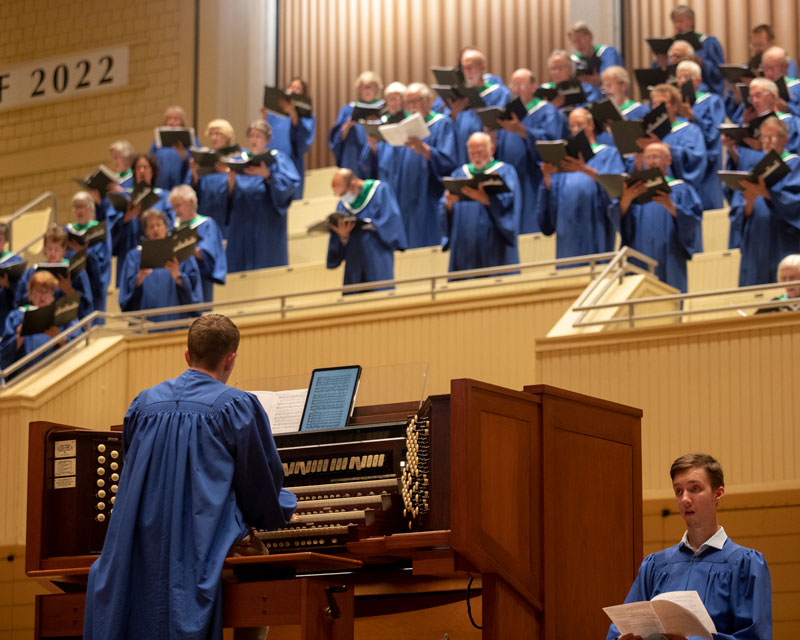
The Chautauqua Choir

Jen Stahl 
Violinist

Sonya Subbayya Sutton 
Interim Director for Sacred Music & Organist

We invite you to quietly prepare your hearts for worship during the Prelude.

* Denotes that the congregation is invited to rise in body or spirit.It is our custom to sing the first and last verses of hymns in unison, the interior verses may be sung in parts.


Prelude

Prelude for a Farewell 

Old Scottish Folk Tune 
arr. James Woodman, 2010


Hymn

“Day is dying in the west”

Chautauqua, William Fisk Sherwin, 1877
Mary Lathbury, 1877

Day is dying in the west;
Heav’n is touching earth with rest;
Wait and worship while the night
Sets her evening lamps alight
through all the sky.

Holy, holy, holy, Lord God of Hosts!
Heav’n and earth are full of Thee;
Heav’en and earth are praising Thee,
O Lord most high!


Welcome

Opening Prayer

O God, in the course of this busy life, you have given us times of 
refreshment and peace; grant that we may so use our 
leisure to rebuild our bodies and renew our minds, that our 
spirits may be opened to the goodness of your creation; 
through Jesus Christ our Lord. Amen. 


Anthem

Kumbaya 

Traditional, arr. Paul Sjolund 

(Come by here, Lord, Come by here) 

Kumbaya; my Lord, Kumbaya. 
Someone’s prayin’, Lord, Kumbaya. 
Someone’s cryin’, Lord, Kumbaya. 
Someone’s singin’ Lord, Kumbaya. 
Oh Lord, Kumbaya! Sing alleluia Lord! 


Reading

Lewis Miller, The Chautauqua Movement, 1886

Chautauqua was founded for an enlarged recognition of the Word. … It was at the start, made universal as to creeds; not undenominational but all-denominational, a place where each denomination or organization, as at the great feasts, brings its best contribution which the particular order would develop as a consecrated offering for magnifying God’s word and work. Not the least of Chautauqua’s mission is to develop and make more practical the teaching of the Book as condensed in the great second commandment, “Love thy neighbor as thyself.” How pleasing the thought, as the world is asked to take a survey of the foundations of Chautauqua, that the public platform and private tent were first consecrated by praise and adoration to God, that the first school for increased knowledge was the church school, and that the gathered people sat and ate at one common table! May that spirit ever remain.


Hymn

The Day You Gave Us, Lord, Is Ended

St. Clement

verse 1 - All, in harmony 
verse 2 - Upper voices, in unison 
verse 3 - Choir only 
verse 4 - Lower voices, in unison 
verse 5 - All, in harmony


Reading

Knoxville: Summer of 1915 

James Agee, 1938 

It has become the time of evening 
when people sit on their porches, 
rocking gently and talking gently 
and watching the street 
and the standing up 
into their sphere of possession of the trees, 
of birds’ hung havens, hangers. 
People go by; things go by. 
A horse, drawing a buggy, breaking his hollow iron music on the asphalt; 
a loud auto; a quiet auto; 
people in pairs, not in a hurry, 
scuffling, switching their weight of aestival* body, talking casually, 
the taste hovering over them of vanilla, strawberry, pasteboard and starched milk, 
the image upon them of lovers and horsemen, squared with clowns in hueless amber. 
A streetcar raising its iron moan: 
stopping, belling and starting; stertorous; rousing and raising again its iron increasing moan 
and swimming its gold windows and straw seats on past and past and past, 
the bleak spark crackling and cursing above it like a small malignant spirit set to dog its tracks; 
the iron whine rises on rising speed; 
still risen, faints; halts; the faint stinging bell; 
rises again, still fainter, fainter, lifting, lifts, faints forgone: forgotten. 
Now is the night one blue dew. 
Now is the night one blue dew, 
my father has drained, 
now he has coiled the hose. 
Low on the length of lawns, 
a frailing of fire who breathes … 
Parents on porches: rock and rock. 
From damp strings morning glories hang their ancient faces. 
The dry and exalted noise of the locusts from all the air at once enchants my eardrums. 
On the rough wet grass of the backyard my father and mother have spread quilts. 
We all lie there, my mother, my father, my uncle, my aunt, and I too am lying there … 
They are not talking much, and the talk is quiet, 
of nothing in particular, of nothing at all in particular, of nothing at all. 
The stars are wide and alive, they seem each like a smile of great sweetness, and they seem very near. 
All my people are larger bodies than mine, … 
with voices gentle and meaningless like the voice of sleeping birds. 
One is an artist, he is living at home. 
One is a musician, she is living at home. 
One is my mother who is good to me. 
One is my father who is good to me. 
By some chance, here they are, all on this earth; 
and who shall ever tell the sorrow of being on this earth, 
lying, on quilts, on the grass, in a summer evening, among the sounds of the night. 
May God bless my people, my uncle, my aunt, my mother, my good father, 
oh, remember them kindly in their time of trouble; 
and in the hour of their taking away. 
After a little I am taken in and put to bed. 
Sleep, soft smiling, draws me unto her: 
and those receive me, who quietly treat me, 
as one familiar and well-beloved in that home: 
but will not, no ,will not, not now, not ever; 
but will not ever tell me who I am. 

*aestival, is an adjective from the Latin aestas, “summer.” These words may be best known as the text for Samuel Barber’s richly evocative setting of them for soprano and orchestra in his Knoxville: Summer of 1915, Op. 24, composed in 1947. The words were published posthumously as part of the Prologue to Agee’s “A Death in the Family” in 1957. 


Inscribing Names In Books Of Memory

As the following music is sung, you are invited to come forward to the stage to inscribe the names of loved ones who have died into books of memory. These books are kept in the denominational houses. 


Anthem

Shalom 

Music: Dan Forrest, 2020 
Text: John 14:27 

Peace. Shalom. 
Peace I leave with you, peace I give to you. 
Not as the this world gives, I give to you. 
Do not be afraid. Shalom. 
I give to you, Peace.


Hymn

Abide with me 

Tune: Eventide


Anthem

Dona nobis pacem 

Giulio Caccini, arr. James A. Moore 

Give to us peace 


Closing Prayer

O Lord, support us all the day long, until the shadows 
lengthen, and the evening comes, and the busy world is 
hushed, and the fever of life is over, and our work is done. 
Then in thy mercy, grant us a safe lodging, and a holy rest, 
and peace at the last. Amen. 


Hymn

"Now the day is over"

Merrial, Joseph Barnaby, 1868
Sabine Barind-Gould, 1865

Now the day is over, night is drawing nigh, shadows of the evening steal across the sky.

Jesus, give the weary calm and sweet repose with thy tend’rest blessing may our eyelids close.

When the morning wakens, then may I arise pure, and fresh, and sinless in thy holy eyes. Amen.


Postlude

Largo

George Frederick Handel, 1738
from the opera 
Xerxes

This music has closed the Sunday evening service since the dedication of the Massey Memorial Organ on August 6, 1907. It is a Chautauqua tradition to remain seated until the music is finished and to then leave the Amphitheater silently, without applause. 


Three Taps of the Gavel

“The Privilege of Stewardship” 

Closing the 153rd Assembly
Kyle Keogh
Interim Chief Executive of Chautauqua Institution


Remarks

Laurie Branch
Chair, Chautauqua Board of Trustees


Closing Remarks

Mark Coolidge Johnson
Incoming President, Chautauqua Institution 


Chautauqua Institution
Department of Religion

Robert Wilson-Black
Director of Religion

The Rt. Rev. Eugene Taylor Sutton
Senior Pastor

Sonya Subbayya Sutton
Interim Director of Sacred Music

Carolyn Snider
Administrative Assistant

Alicen Roberts
Religion Graduate Fellow

Owen Reyda
Organ Scholar

Image for Sacred Song Service
Sacred Song Service – Remembering

Followed by Closing of the 152nd Assembly


The Rt. Rev. Eugene Taylor Sutton
Presider

Alan Seale 
Reader

The Chautauqua Choir

Jen Stahl 
Violinist

Sonya Subbayya Sutton 
Interim Director for Sacred Music & Organist

We invite you to quietly prepare your hearts for worship during the Prelude.

* Denotes that the congregation is invited to rise in body or spirit.It is our custom to sing the first and last verses of hymns in unison, the interior verses may be sung in parts.


Prelude

Prelude for a Farewell 

Old Scottish Folk Tune 
arr. James Woodman, 2010


Hymn

“Day is dying in the west”

Chautauqua, William Fisk Sherwin, 1877
Mary Lathbury, 1877

Day is dying in the west;
Heav’n is touching earth with rest;
Wait and worship while the night
Sets her evening lamps alight
through all the sky.

Holy, holy, holy, Lord God of Hosts!
Heav’n and earth are full of Thee;
Heav’en and earth are praising Thee,
O Lord most high!


Welcome

Opening Prayer

O God, in the course of this busy life, you have given us times of 
refreshment and peace; grant that we may so use our 
leisure to rebuild our bodies and renew our minds, that our 
spirits may be opened to the goodness of your creation; 
through Jesus Christ our Lord. Amen. 


Anthem

Kumbaya 

Traditional, arr. Paul Sjolund 

(Come by here, Lord, Come by here) 

Kumbaya; my Lord, Kumbaya. 
Someone’s prayin’, Lord, Kumbaya. 
Someone’s cryin’, Lord, Kumbaya. 
Someone’s singin’ Lord, Kumbaya. 
Oh Lord, Kumbaya! Sing alleluia Lord! 


Reading

Lewis Miller, The Chautauqua Movement, 1886

Chautauqua was founded for an enlarged recognition of the Word. … It was at the start, made universal as to creeds; not undenominational but all-denominational, a place where each denomination or organization, as at the great feasts, brings its best contribution which the particular order would develop as a consecrated offering for magnifying God’s word and work. Not the least of Chautauqua’s mission is to develop and make more practical the teaching of the Book as condensed in the great second commandment, “Love thy neighbor as thyself.” How pleasing the thought, as the world is asked to take a survey of the foundations of Chautauqua, that the public platform and private tent were first consecrated by praise and adoration to God, that the first school for increased knowledge was the church school, and that the gathered people sat and ate at one common table! May that spirit ever remain.


Hymn

The Day You Gave Us, Lord, Is Ended

St. Clement

verse 1 - All, in harmony 
verse 2 - Upper voices, in unison 
verse 3 - Choir only 
verse 4 - Lower voices, in unison 
verse 5 - All, in harmony


Reading

Knoxville: Summer of 1915 

James Agee, 1938 

It has become the time of evening 
when people sit on their porches, 
rocking gently and talking gently 
and watching the street 
and the standing up 
into their sphere of possession of the trees, 
of birds’ hung havens, hangers. 
People go by; things go by. 
A horse, drawing a buggy, breaking his hollow iron music on the asphalt; 
a loud auto; a quiet auto; 
people in pairs, not in a hurry, 
scuffling, switching their weight of aestival* body, talking casually, 
the taste hovering over them of vanilla, strawberry, pasteboard and starched milk, 
the image upon them of lovers and horsemen, squared with clowns in hueless amber. 
A streetcar raising its iron moan: 
stopping, belling and starting; stertorous; rousing and raising again its iron increasing moan 
and swimming its gold windows and straw seats on past and past and past, 
the bleak spark crackling and cursing above it like a small malignant spirit set to dog its tracks; 
the iron whine rises on rising speed; 
still risen, faints; halts; the faint stinging bell; 
rises again, still fainter, fainter, lifting, lifts, faints forgone: forgotten. 
Now is the night one blue dew. 
Now is the night one blue dew, 
my father has drained, 
now he has coiled the hose. 
Low on the length of lawns, 
a frailing of fire who breathes … 
Parents on porches: rock and rock. 
From damp strings morning glories hang their ancient faces. 
The dry and exalted noise of the locusts from all the air at once enchants my eardrums. 
On the rough wet grass of the backyard my father and mother have spread quilts. 
We all lie there, my mother, my father, my uncle, my aunt, and I too am lying there … 
They are not talking much, and the talk is quiet, 
of nothing in particular, of nothing at all in particular, of nothing at all. 
The stars are wide and alive, they seem each like a smile of great sweetness, and they seem very near. 
All my people are larger bodies than mine, … 
with voices gentle and meaningless like the voice of sleeping birds. 
One is an artist, he is living at home. 
One is a musician, she is living at home. 
One is my mother who is good to me. 
One is my father who is good to me. 
By some chance, here they are, all on this earth; 
and who shall ever tell the sorrow of being on this earth, 
lying, on quilts, on the grass, in a summer evening, among the sounds of the night. 
May God bless my people, my uncle, my aunt, my mother, my good father, 
oh, remember them kindly in their time of trouble; 
and in the hour of their taking away. 
After a little I am taken in and put to bed. 
Sleep, soft smiling, draws me unto her: 
and those receive me, who quietly treat me, 
as one familiar and well-beloved in that home: 
but will not, no ,will not, not now, not ever; 
but will not ever tell me who I am. 

*aestival, is an adjective from the Latin aestas, “summer.” These words may be best known as the text for Samuel Barber’s richly evocative setting of them for soprano and orchestra in his Knoxville: Summer of 1915, Op. 24, composed in 1947. The words were published posthumously as part of the Prologue to Agee’s “A Death in the Family” in 1957. 


Inscribing Names In Books Of Memory

As the following music is sung, you are invited to come forward to the stage to inscribe the names of loved ones who have died into books of memory. These books are kept in the denominational houses. 


Anthem

Shalom 

Music: Dan Forrest, 2020 
Text: John 14:27 

Peace. Shalom. 
Peace I leave with you, peace I give to you. 
Not as the this world gives, I give to you. 
Do not be afraid. Shalom. 
I give to you, Peace.


Hymn

Abide with me 

Tune: Eventide


Anthem

Dona nobis pacem 

Giulio Caccini, arr. James A. Moore 

Give to us peace 


Closing Prayer

O Lord, support us all the day long, until the shadows 
lengthen, and the evening comes, and the busy world is 
hushed, and the fever of life is over, and our work is done. 
Then in thy mercy, grant us a safe lodging, and a holy rest, 
and peace at the last. Amen. 


Hymn

"Now the day is over"

Merrial, Joseph Barnaby, 1868
Sabine Barind-Gould, 1865

Now the day is over, night is drawing nigh, shadows of the evening steal across the sky.

Jesus, give the weary calm and sweet repose with thy tend’rest blessing may our eyelids close.

When the morning wakens, then may I arise pure, and fresh, and sinless in thy holy eyes. Amen.


Postlude

Largo

George Frederick Handel, 1738
from the opera 
Xerxes

This music has closed the Sunday evening service since the dedication of the Massey Memorial Organ on August 6, 1907. It is a Chautauqua tradition to remain seated until the music is finished and to then leave the Amphitheater silently, without applause. 


Three Taps of the Gavel

“The Privilege of Stewardship” 

Closing the 153rd Assembly
Kyle Keogh
Interim Chief Executive of Chautauqua Institution


Remarks

Laurie Branch
Chair, Chautauqua Board of Trustees


Closing Remarks

Mark Coolidge Johnson
Incoming President, Chautauqua Institution 


Chautauqua Institution
Department of Religion

Robert Wilson-Black
Director of Religion

The Rt. Rev. Eugene Taylor Sutton
Senior Pastor

Sonya Subbayya Sutton
Interim Director of Sacred Music

Carolyn Snider
Administrative Assistant

Alicen Roberts
Religion Graduate Fellow

Owen Reyda
Organ Scholar