Monday, March 23, 2026 | 7:30 p.m.
Perkinson Recital Hall, North Court
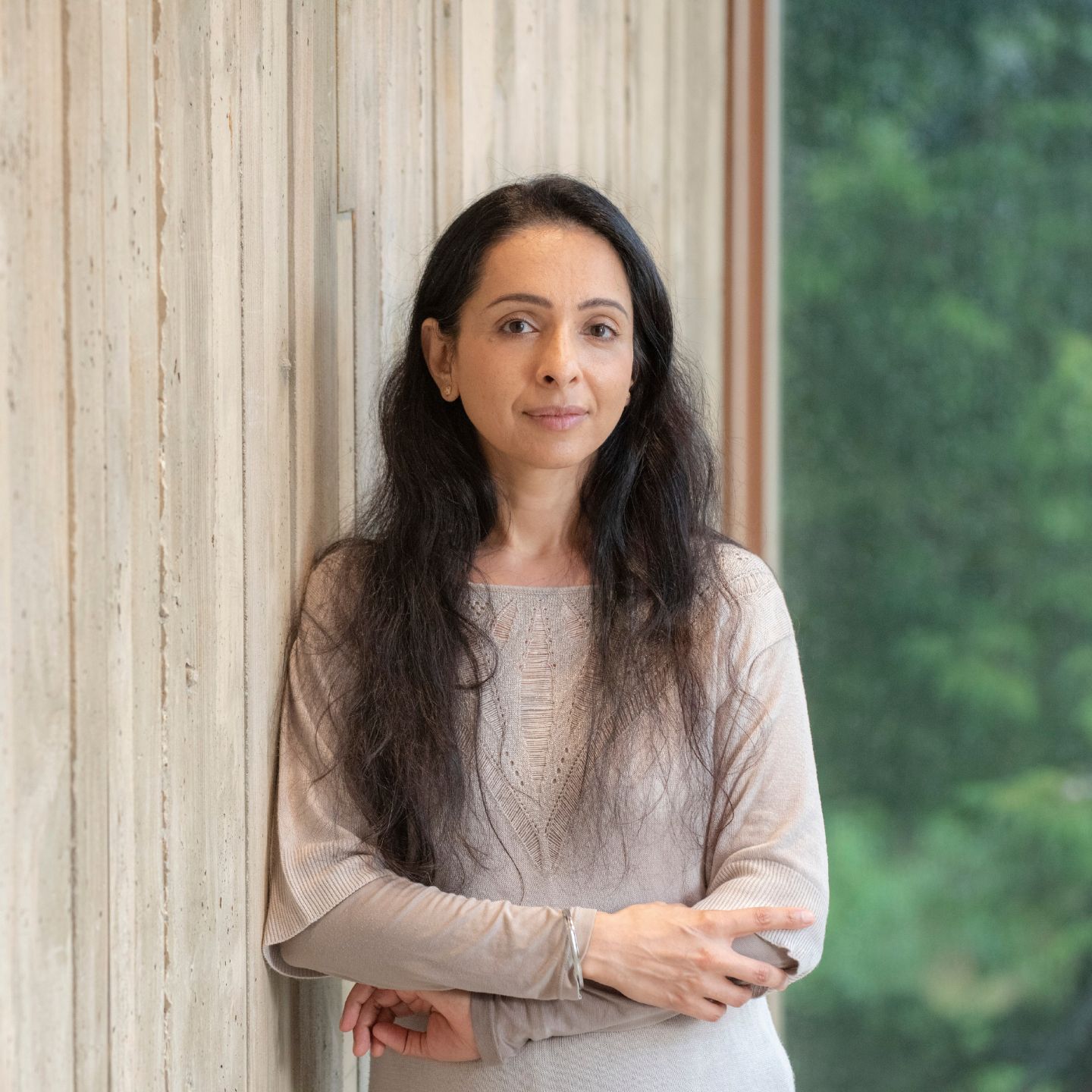
The 2025-26 Neumann Lecture on Music Gurminder Bhogal, speaker
3.23.26 | Department of Music Free Concert Series
Finding the Human in the Musical Humanities: Hideous Beauty and The Rite of Spring
What can the arts teach us about humanity, especially at a time when the humanities is being forced to justify its relevance to society? This talk takes a ballet from the Western European canon, The Rite of Spring, to remind us how the interplay of music, dance, costuming, and visual art points to something much more universal: a human mistrust of corporeal difference and the continued fight for agency. In conversation with the larger discourse on the humanities, this talk shows how performance and criticism can help us interrogate human behaviors while imagining utopian societies.
About the Speaker
Gurminder Kaur Bhogal is the Catherine Mills Davis Professor of Music at Wellesley College. Gurminder has published widely on the music and aesthetics of composers working in Paris at the turn of the twentieth century. Her first book, Details of Consequence: Ornament, Music, and Art in Paris, was published by Oxford University Press in 2013, and explores the expressive use of ornament in musical and visual contexts. Gurminder's second book, Claude Debussy's Clair de Lune, was published by Oxford University Press in 2018, and examines the impact of Debussy’s famous piano piece on popular culture, while exploring Clair de Lune’s rich intertextual history. She has recently published a book with the University of Chicago Press about South Asian devotional music called Sikh Kirtan and Its Journeys: Instruments, Theories, Technologies. Gurminder currently serves as editor of the American Musicological Society’s Studies in Music monograph series.
About the Neumann Lecture
What do protest songs, madrigals, Mozart, cognitive neuroscience, and the Civil Rights era have in common? They’ve all been topics presented at the University of Richmond Neumann Lecture Series. The Department of Music started the series in 2003 to remember former music faculty member Frederick “Fritz” Neumann, who taught violin and started the University Symphony. Neumann held a Ph.D. in music education, as one might expect of a music professor. But his career was hardly a conventional one. Though he had trained as a violinist in childhood, he earned his first Ph.D. (in 1934 at the University of Berlin) in economics and political science, writing a dissertation on the stock market crash of 1929. After spending a few years working as an export-market analyst in Prague, he decided to take up the violin again—this time, more seriously. His studies took him to several major European cities—Berlin, Paris, Basel—and finally to New York, leading him to apply for United States citizenship. During the Second World War, he served in U.S. Army Intelligence for three years before resuming his music studies at Columbia University, where he earned his second Ph.D.
Starting in his late fifties, Neumann pursued yet another career with great dedication and vigor: the study of performance practices in seventeenth- and eighteenth-century music. During the next few decades, he published over forty articles and three books that challenged performers and scholars to revisit long-held beliefs about how to execute musical ornaments and rhythms. He became a scholar of international renown, receiving grants from the National Endowment for the Humanities, the Guggenheim Foundation, the American Philosophical Society, and the American Council of Learned Societies. In 1987, the American Musicological Society awarded his book, Ornamentation and Improvisation in Mozart, one of its highest honors: the Otto Kinkeldey prize, given annually to a book of “exceptional merit.” After living for more than five decades in the United States, he had planned a trip to Prague in the spring of 1994, which would have been his first return visit since 1939. But he died that year in March at age 86, after a life overflowing with accomplishment.
The Neumann Lecture Series kicked off in 2003 with Christoph Wolff, a German-born scholar who taught at Harvard University and studies the music of J.S. Bach. Wolff and Neumann were cut from similar cloth: both were educated in Germany and interested in eighteenth-century music, reflecting a branch of music-historical study that centered on Austro-German repertoire from centuries ago. But the scholarly interests of Neumann lecturers rapidly diversified: Susan McClary (2004) applied feminist methods of scholarship in her talk, while Kay Kaufmann Shelemay (2005) spoke about Syrian Jewish music from an ethnomusicological perspective. To mark Mozart’s 250th birthday in 2006, Nicholas Till delivered a talk centered on that composer. Guthrie Ramsey (2007) is the only speaker to date who brought his own band with him to illustrate his lecture on music in the Civil Rights movement. Opera scholar and native Londoner Roger Parker (2008) talked about a 1930 production of Puccini’s Manon Lescaut at the famed La Scala opera house. Later that year, Suzanne Cusick introduced research on the use of music as a form of torture in the U.S. “global war on terror,” which she discovered through unclassified military documents and interviews with detainees and interrogators. In ensuing years, the series further broadened its scope by presenting the composer Lei Liang in 2011 and the conductor Joseph Flummerfelt in 2012.
The tenth Neumann lecturer, Craig Wright (2013), who started out as a scholar of medieval music, discussed a new project in which he applied current neuroscientific knowledge of the brain to Mozart’s compositional processes. Anthony Seeger (2014), nephew of folk singer Pete Seeger, talked about protest music in the 1960s, singing a few songs and accompanying himself on the guitar. In 2015, Jessie Ann Owens discussed how the Italian Renaissance composer Cipriano de Rore turned a well-known literary lament (that of Dido from Virgil’s Aeneid) into a small-scale musical drama. J. Peter Burkholder (2016) spoke about Charles Ives’s practices as a church organist and their impact on works such as his Third Symphony. Ethnomusicologist Deborah Wong investigated contemporary social policies with her 2017 talk titled “Listening to Pain.” The following year, George Lipsitz spoke about ethical acts of co-creation in “Accompaniment as Social Practice.” Guthrie Ramsey made a return visit in 2019 to share new research on the history of African-American music and its resonances of enslavement. In 2020 Tammy Kernodle historicized the role of Black women in framing the sonic contexts of Civil Rights and protest music, while in 2022 Robynn Stilwell focused on The Band’s Robbie Robertson and the musical impact of his marginalized identity.
Twenty years after the first Neumann lecture, the Canadian scholar Sherry Lee explored the place of music in the context of environmental crisis and vital energy transitions. In the fall of 2023, the ethnomusicologist Huib Schippers addressed sounds, communities, and cultural ecosystems. The influence of the playlist as a new cultural form was the subject of musicologist Robert Fink’s talk in 2024.
Building on this rich history of speakers and topics, the Department of Music looks forward to continuing the legacy of Frederick Neumann by highlighting dynamic and groundbreaking musical research.
Reminders
Electronic Devices
Thank you for helping us create a distraction-free experience. Please silence all electronic devices. We also ask that you refrain from taking any photos or videos.
