Saturday, April 4, 2026 | 3:00 pm
Camp Concert Hall
Andy McGraw, Director
Ensemble Directors: Nirmal Bajekal, Roderick Davis, Alasdair Denvil, Kevin Harding, Andy McGraw
Approximate Program Time: 100 mins.
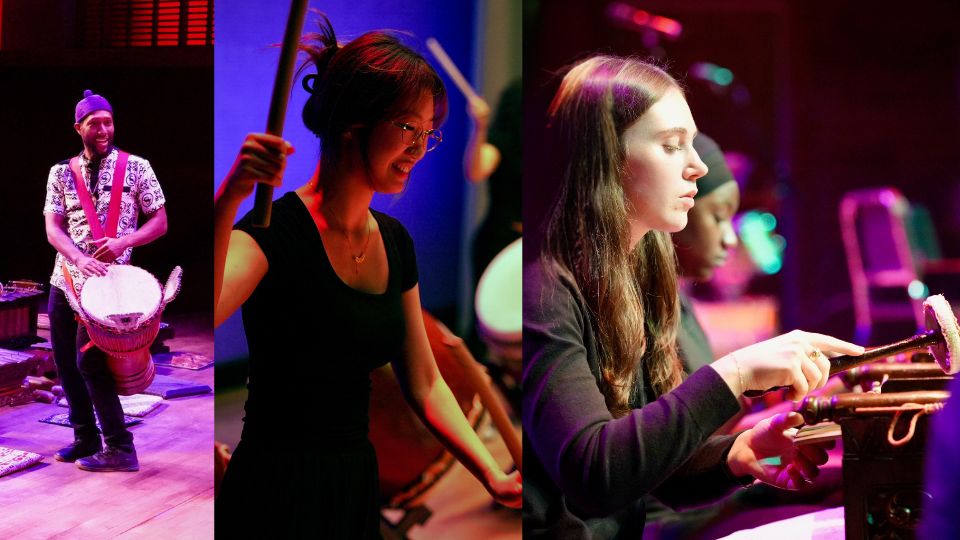
Indonesian (gamelan) Ensemble (MUS 125, MSEN 203-03, Gamelan Raga Kusuma). Feat. Artists in Residence Peni Candra Rini, I Putu Gede Sukaryana
Gambang Suling (MUS 125, MSEN 203-03, Gamelan Raga Kusuma). Composer: Ki Nartosabdho. A light gamelan work composed in the 1960s, describing the sound of the gamelan ensemble.
Sumambang Bali (Gamelan Raga Kusuma). Traditional Balinese gamelan composition in the ancient semar pegulingan style.
Bapang Selisir. (MUS 125, MSEN 203-03, Gamelan Raga Kusuma). Traditional composition performed to accompany Balinese temple dance.
West African (djembe) Ensemble (MSEN 203-02, Creative Hands Drum Ensemble).
Bando Djeli. This piece belongs to the Dununba (dance of the strong men) group of rhythms from Takoura in Upper Guinea. Bando is a species of monkey with a white tail. When it is frightened, it waves its white tail. For the rhythm, the dancers wear a type of stiff necklace or headband with a white tip symbolizing the tail of a monkey. They shake it by shrugging their shoulders or heads up and down rapidly.
Moribayassa. A Malinke rhythm from Northeast Guinea. This very old rhythm and dance were played exclusively for women. When they were faced with hardships or traumatic experiences, they sought counsel or help from the women’s societies. After overcoming their challenges, the entire village would gather in celebration by singing and dancing Moribayassa.
Djole. This rhythm originated with the Temine ethnic group from the border region of Guinea and Sierra Leone. Djole was originally a mask dance representing a woman, and the rhythm was initially played on square-shaped siko drums. This rhythm is also played at end of Ramadan celebrations and weddings.
Sitar Students (MSAP 182)
Raga Jaunpuri. A traditional North Indian classical bandish (tarana) composed by the legendary sitarist Ravi Shankar, set to a 16-beat rhythmic cycle (teentala). Sitar: Noor Kaifi, Sanskriti Basniyat. Vocals: Harshit Kohale. Tabla: Atharva Ranade.
Raga Adana. A Dhrupad composition in Raga Adana, set to Sooltaal (10 beats). Dhrupad is one of the oldest traditions of North Indian classical music, known for its slow, meditative unfolding and deep focus on pure sound. The performance begins with a free, unmetered exploration of the raga (Alaap), followed by a composed section set to a rhythmic cycle, accompanied by the pakhawaj (barrel drum). Pakhawaj: Kevin Johnson. Vocals: Mudit Mayank Jha (Dagar Gharana)
Brazilian Ensemble (MSEN 195)
Suspeita. Daudeth de Azevedo, Wilson das Neves (Arr. K. Harding). The composers were founding members of Os Ipanemas, one of Rio’s seminal samba groups, who described this tune as an afro-bossa.
Até Quem Sabe. João Donato (Arr. K. Harding). A classic bossa nova composition about the end of a romance.
Bloco do Amor. Paulo Cesar Baptista de Faria. A textually clever samba using images and ideas from Rio’s carnaval tradition to describe a romantic entanglement.
Berimbau. Baden Powell, Vinicius de Moraes (Arr. K Harding). An afro-samba from the originators of the genre, ca. 1966.
Taiko Ensemble (MSEN 203-01, River City Taiko)
Nagara Seiryu Nobori-Uchi (River City Taiko). The Nagara River is one of the Kiso Three Rivers running through the Nōbi Plain west of Nagoya. This song celebrates the annual migration of carp up and back down the river. The line of taiko represents the river, and the drummers play while moving back and forth along the line of drums.
Yataibayashi and Tama-ire (UR Taiko Ensemble and River City Taiko). “Yatai” refers to a cart or float pushed down the street during festivals. Yataibayashi is based on festival music from Chichibu, near Tokyo, where an annual festival features drummers playing taiko while sitting inside a yatai, with dancers on top. Tama-ire is played on smaller drums as the cart is turned around street corners.
Utsu-Hachijo and Oiuchi-daiko (UR Taiko Ensemble and River City Taiko). Hachijō-jima is an island nearly 200 miles south of Tokyo and was often a place where samurai were sent into exile. Many songs from Hachijo express a longing for friends and family on the mainland. During the song, the drummers briefly take the posture of archers, archery being one of the Bushidō (samurai) martial arts. Oiuchi-daiko is the middle section of this arrangement. “Oiuchi” means “attacking the routed enemy,” and the song was written by Sukeroku Daiko, a professional taiko group in Japan.
All are welcomed to stay after the performance
to play the instruments.
Gamelan Ensemble (MUS 203-03) Students: Charles Biaku, Mairin Conrad, Elias Grimsrud Humphry, Mudit Jha, Daniela Leyva Castro, Ina Loka, Hannah Lyu, Teegan Rowe, Anya Rubin, Shaheer Shehzad, Yufeng Wei, Menghan Zhang, Shikun Zhou.
MUS 125: Audrey Farhat, Velsy Garcia-Jimenez, Grant Higgins, Parth Patel, Tanner Whitehouse, Ethan Wong, Stella Wu, Yuxuan Wu.
Gamelan Raga Kusuma, Andy McGraw director: Andrea Beeman, Emily Bradford, Taylor Burton, Caio Davison, Paul Fleisher, Jackson Gillie, Brian Larson, Liz Leininger, Andy McGraw, Nicholas Merillat, Sita Nuenighoff, John Priestley, Rex Pyle, Julie Sidharta, Dan Wingo, Jessica Zike. I Putu Gede Sukaryana, Dr. Peni Candra Rini, guest Artistic Director.
Dr. Peni Candra Rini is a highly acclaimed Javanese singer, composer, and faculty member at the Indonesian Institute of the Arts. She's known for blending traditional Javanese music with contemporary styles, earning her recognition as one of Indonesia's most daring young composers and one of the few prominent female composers in the country.
I Putu Gede Sukaryana is one of Bali’s foremost performers and composers, currently an Artist-in-Residence at the University of Tennessee in Knoxville.
African Drumming Ensemble (MUS 203:02), Roderick Davis, director:
Marlyn Calderon, Kay Conrad, Stevi Dugas, Kyle Giardine, Deisy Gonzalez Ortiz, Shanudom Impat, Menglin Liu, Thuba Mnisi, Devin Morgan, Rosy Nguyen, Kevin Retana, Jiawei Wang, Yichang Wang, Mark Zhang.
Much appreciation to the Creative Hands Community Ensemble for assisting with the teaching and learning process of this complex genre of music.
Brazilian Ensemble (MUS 195), Kevin Harding, director:
Isabella Aldeguer, Alex Doell, Sakura Iijima, Jonathan Lee, Andres Mauco, Trang Nguyen, Livi Palalay, Jonathan Sackett, Will Scharf, Sahara Williamson.
Taiko Ensemble (MUS 203:01), Alasdair Denvil, director:
Muskan Agarwal, Ananya Bekele, Holly Hou, Shun Kadekawa, Eraj Khokhar, Kelly Li, Yinuo Liu, Kevin Retana, Dalin Sao, Will Scharpf, Akira Suzuki, Marcus Wang, Yitong Wang, Yuki Wu
River City Taiko, Alasdair Denvil, director:
Tsugumi Fukuma, Yumi Hwang, Audrey Short, Zach Sowers, Tadao Uchisawa, Ashley Wright
Consider these Fall 2026 .5 unit Courses.
No pre-reqs, All Welcome.
FSVP, AIVP credit (over 2 semesters),
Embodied Communication credit (over 1 semester).
MSEN 203-01: Japanese Taiko
MSEN 203-02: West African Drumming
MSEN 203-03: Indonesian Gamelan
MSEN 195-02: Brazilian Music
MSAP 181-01: Sitar lessons
MUS 229: Anthropology of Music (fulfills Gen Ed requirements: AIVP, IFWC)
UR’s Balinese gamelan was made in the 2004 by Bali’s foremost gongsmith, Pande Sukerta.
"Taiko" is the Japanese word referring to drums, and since the 1950s it has also referred to a modern style of ensemble drumming. Many taiko pieces incorporate traditional rhythms into new compositions.
Gamelan Raga Kusuma is a community gamelan in residence at the University of Richmond. Founded in 2008 by Andy McGraw and Gusti Putu Sudarta, the ensemble has appeared in performances in Bali, the Smithsonian Institution, the Indonesian Embassy and in several venues along the East Coast. Membership is free and open to the public. Interested? See: www.ragakusuma.org, our Facebook and Instagram profiles, or email amcgraw@richmond.edu. Rehearsals are held Sunday evenings 6-8 in North Court 024.
River City Taiko grew out of the University of Richmond Taiko Ensemble, which was founded in 2010 by Prof. Paul Yoon. River City Taiko provides taiko lessons and performs in Central Virginia and surrounding areas.
