
Saturday, September 12, 2026
7:30 PM
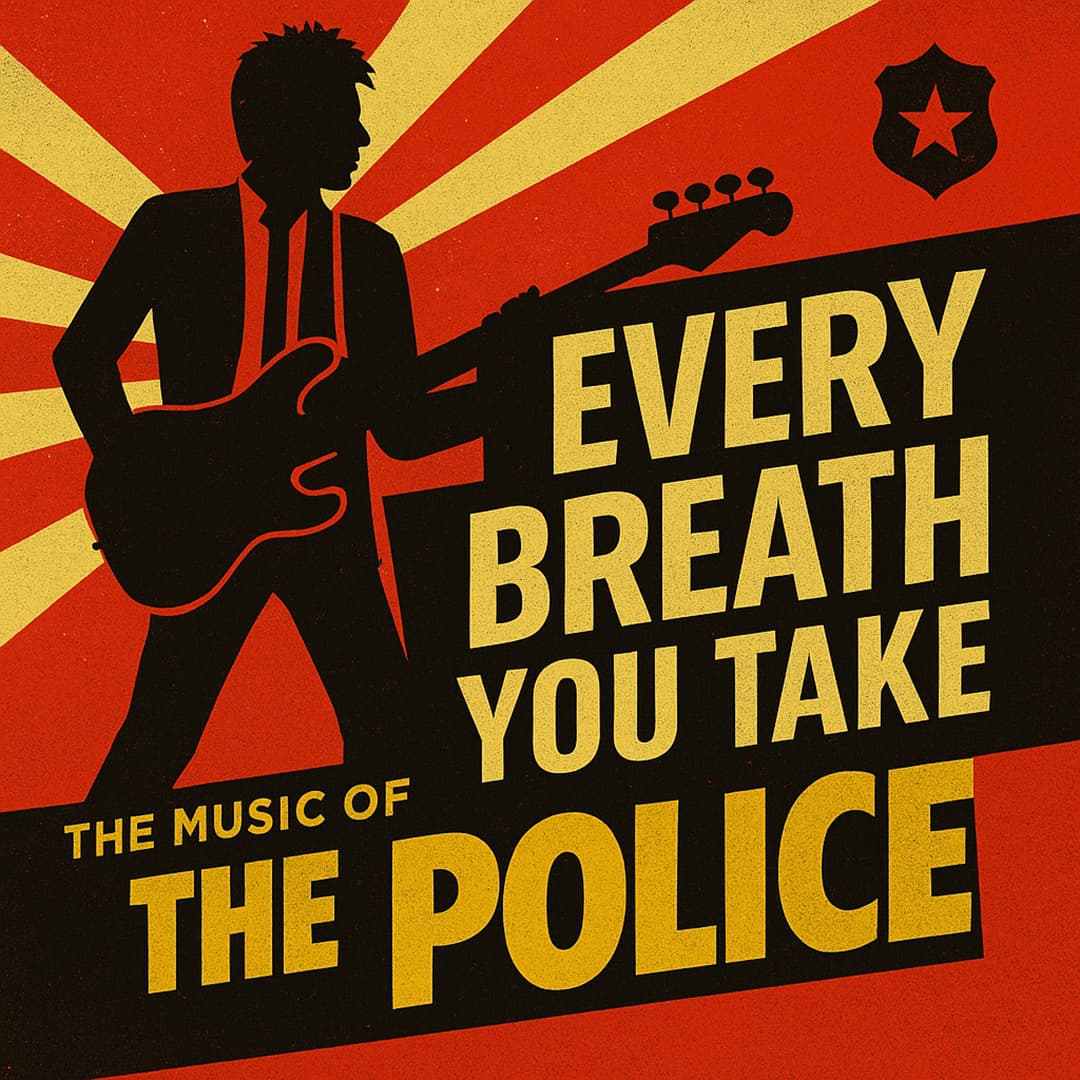
The Police fused rock music with reggae, punk, and new wave influences, creating an exciting, rhythmic and boundlessly energetic sound when they exploded into stardom in the early 1980's. Blending tight grooves and relentless rhythms with Sting’s melodic sophistication and introspective lyrics made for a unique combination revered by audiences, musicians and critics alike. Whether it's the classic "Roxanne" or Sting's emotional "Fields of Gold", these songs continue to inspire and enthrall audiences worldwide. Featuring two-time Grammy Award winner David Blamires on lead vocals.
Click HERE to read more about the story of The Police and their creative process.
INTERMISSION
Message in a Bottle
Reggatta de Blanc, 1979
A castaway throws an SOS into the sea and hears nothing back for a year. When he finally looks up, a hundred billion bottles have washed onto his shore. The joke and the consolation are the same: the loneliness he took to be uniquely his turns out to be the most common condition there is. It gave the band their first British number one, and Andy Summers, who wrote the famous opening figure, calls it the best song Sting ever wrote — he still ends his own concerts with it.
De Do Do Do, De Da Da Da
Zenyatta Mondatta, 1980
Taken for baby talk on release, and Sting has been objecting ever since. The verses are about the manipulative power of language — “poets, priests and politicians” and the words they use to persuade us — and the nonsense syllables of the chorus are the argument rather than a lapse. The phrases pop music remembers longest are frequently the ones that mean nothing at all. He puts it in the direct line of “she loves you, yeah yeah yeah.”
Walking on the Moon
Reggatta de Blanc, 1979
A song about buoyancy — the giddy, weightless business of walking home after being with someone, when your feet don't seem to be carrying your weight. Sting has also described it as an allegory for life on tour: confined to hotel rooms and stages while the world goes on turning below. He wrote it drunk in a Munich hotel room after a show, and sang it as “walking round the room” until a better title arrived. In October 1979 the band filmed the video at the Kennedy Space Center, where Stewart Copeland, handed a Saturn V moon rocket as a backdrop, climbed up and drummed on the side of it.
Don't Stand So Close to Me
Zenyatta Mondatta, 1980
A schoolteacher and a student who has fixed on him, told from inside the teacher's rising panic rather than from any safe distance. Sting had taught primary school in Northumberland a few years earlier and has been answering the autobiographical question ever since. The chorus name-checks “that book by Nabokov,” and the record was the best-selling single in Britain that year.
Wrapped Around Your Finger
Synchronicity, 1983
Unusually well-read for a top-ten single: it summons Scylla and Charybdis, Mephistopheles and the sorcerer's apprentice inside three verses. A young man submits to someone older and more powerful in order to learn from them — and then, in the last verse, the apprentice becomes the master and the finger of the title changes hands. Stewart Copeland cheerfully calls it his least favourite of Sting's songs on the grounds that he took the master-and-apprentice business personally.
Be Still My Beating Hear
…Nothing Like the Sun, 1987
The title is an instruction, not a sigh — an old phrase for telling your own heart to stop racing — and the song is a piece of self-counsel, the head advising the heart that it would be safer to stay cool and say nothing. Written in the year after his mother's death, it treats love plainly as a risk of injury. The album takes its name from Shakespeare's Sonnet 130, the one that refuses to flatter.
Englishman in New York
…Nothing Like the Sun, 1987
A portrait of the writer Quentin Crisp, who moved from London to the Bowery in his seventies and whom Sting knew and admired. Nearly every detail belongs to Crisp himself — the tea rather than coffee, the walking cane, the deliberate courtliness — and “I'm a legal alien” was his literal immigration status rather than a metaphor. The advice in the chorus, be yourself no matter what they say, was his entire public philosophy, held for decades at real cost.
Canary in a Coalmine
Zenyatta Mondatta, 1980
Two and a half minutes at a sprint, aimed at a hypochondriac — someone so finely tuned to danger that they keep mistaking their own nerves for evidence of it. The title comes from the pits: the bird carried underground to die first, so the men have warning enough to climb out.
Every Little Thing She Does Is Magic
Ghost in the Machine, 1981
The lyric is pure stage fright: a man who has rehearsed the speech a thousand times and still cannot get it out. It is also the oldest song of the evening and the one that took longest to finish. Sting had the title couplet as early as 1977, riding a bus full of English punk bands down to a festival in France, and by Stewart Copeland's account the song then stalled for years on the problem that almost nothing rhymes with magic — until he found tragic. His bandmates thought it too soft for the Police and tried to toughen it up; every attempt made it worse, and the version you know is essentially his own demo with the band playing over the top.
Intermission
Synchronicity II
Synchronicity, 1983
Jung's idea was that two events can be meaningfully connected without either one causing the other. So the song cuts, verse by verse, between a father's humiliating commute and a domestic morning coming apart — and something rising out of a dark Scottish loch, drawing steadily nearer for no reason anyone could name. The two stories never meet. They simply happen at the same time, which is the whole point.
King of Pain
Synchronicity, 1983
Written in Jamaica over the winter of 1982–83, while his first marriage was ending. Looking up at a sunspot, Sting said to Trudie Styler, “there's a little black spot on the sun today — that's my soul up there,” then went and wrote it down. The song is a catalogue of such emblems: a flag on a mast, a fossil trapped in rock, a dead salmon frozen in a waterfall, a blue whale beached by a spring tide. Each verse claims another one as his.
Spirits in the Material World
Ghost in the Machine, 1981
The album borrows its title from Arthur Koestler; this song, which opens it, borrows the argument — that we are minds inhabiting bodies and never quite at home in them. The lyric is flatly sceptical about politics as the answer: “there is no political solution to our troubled evolution.” Its origins are humbler than its subject. Stewart Copeland says the whole thing began with Sting fooling about on one of the toy Casio keyboards of the period, and that the skipping figure which opens the record is essentially that machine.
Tea in the Sahara
Synchronicity, 1983
Taken from Paul Bowles's novel The Sheltering Sky. Three sisters meet a prince and ask nothing of him but to drink tea together in the dunes; he promises to return, and they wait, and they are found there long afterwards with their cups full of sand. A song about a wish that consumes the people holding it.
Fields of Gold
Ten Summoner's Tales, 1993
Written looking out at the barley around his house in Wiltshire — barley rather than wheat, because barley moves: “in the summer it's fascinating to watch the wind moving over the shimmering surface, like waves on an ocean of gold.” Beneath the pastoral surface it is a song about time, carrying a couple from a first uncertain question through marriage and children to old age in the space of four verses, and ending with a promise to be remembered.
Fortress Around Your Heart
The Dream of the Blue Turtles, 1985
A sustained military metaphor for the wreckage of a marriage: a man who laid siege to the thing he loved, mined the ground all around it, and must now cross his own minefield to reach it again. The remarkable thing is that not one line steps outside the figure — trenches, barbed wire, a no-man's-land, and a bridge that has to be rebuilt before anyone can come home.
If You Love Somebody Set Them Free
The Dream of the Blue Turtles, 1985
His first single as a solo artist, and a deliberate answer to the song that had made him famous two years earlier: where that one watches and keeps, this one lets go. He has said so plainly. The chorus never argues the case — it simply repeats the title as an instruction until the instruction begins to sound like relief.
Every Breath You Take
Synchronicity, 1983
Written at three in the morning in Jamaica, at Ian Fleming's old desk, and misheard as a love song more or less permanently. Sting has been consistent that it is about surveillance, jealousy and control, and that he finds it sinister; couples have gone on dancing to it at weddings for forty years regardless. The band nearly threw it away. Andy Summers thought it a corny pop song beneath them and did not want to play it, and weeks went by arguing about the drums, until somebody told him to go into the studio and make it his own. He played the guitar part you know, over the whole song, once. It stayed at number one in America for eight weeks and has since passed a billion and a half plays on streaming alone.
Desert Rose
Brand New Day, 1999
A duet with the Algerian singer Cheb Mami, who recorded his part in Arabic without having been told what the English lyric said — and improvised, as it turned out, on longing, which is exactly what Sting had written. The song is about wanting something you cannot have and may have imagined: a rose that only appears where there is no water. American radio would not touch the record until Jaguar built an advertising campaign around its video, after which it was everywhere.
Roxanne
Outlandos d'Amour, 1978
A man in love with a prostitute, asking her to stop — tender and possessive at once, and never quite deciding which. Sting began it in a shabby Paris hotel in October 1977, where an old poster for Cyrano de Bergerac hung in the lobby and supplied the name. Andy Summers heard it before the band did: Sting was lodging at his flat, and Summers and his wife lay in bed listening through the wall as he sang it as a gentle bossa nova. The clang and the laugh at the top of the record are Sting sitting down on an open piano by accident, kept because it seemed funny. The single did nothing at all in 1978 — one small notice in Melody Maker told readers to watch this band, which Summers calls their single beacon of life. It was reissued a year later and went to number one. Same song.
PERSONNEL MANAGER Lee Blakeman
MUSIC LIBRARIAN Melissa Keeling
VIOLIN I Kameron Myers Melissa Bull Reagan Ballard Elizabeth Johnson Steven Kinnamon | VIOLIN II Julianna Waller-Martinez Julie Lastinger Todd Bornstein Malika Brower | VIOLA Elizabeth Jones Bruce Christensen Darrell Merryman | CELLO Sarah Berry Rebecca Price Eunice Kim |
BASS Paul Reich | FLUTE Heidi Alvarez Julie Ditzel | OBOE Jennifer Potochnic Stephanie Hile | CLARINET John Cipolla James Goodhue |
BASSOON Andrew Witherington Harold Skelton | HORN Kristen Sienkiewicz Joey Demko | TRUMPET Reese Land Caden Holmes | TROMBONE Lee Blakeman |
PERCUSSION Mark Berry Marty Sharer |