Eric Jacobsen, conductor
Ferguson Center for the Arts, Newport News,
Friday, September 13, 2024 at 7:30 PM
Sandler Center for the Performing Arts, Virginia Beach,
Sunday, September 15, 2024 at 2:30 PM
Valerie Coleman (b. 1970) | Fanfare for Uncommon Times | |
Mason Bates (b. 1977) | Philharmonia Fantastique: The Making of the Orchestra Music by Mason Bates |
-- intermission --
Modest Mussorgsky (1839-1881) orchestrated by Maurice Ravel | Pictures at an Exhibition Promenade |
Opening Weekend: Pictures at an Exhibition
Valerie Coleman: Fanfare for Uncommon Times
Founder of the critically acclaimed ensemble Imani Winds, flutist Valerie Coleman is earning wide recognition for her composition. Working on a portable organ at an early age, Coleman composed three full-length symphonies by age 14. She received two bachelor’s degrees—one in composition and one in flute performance—from Boston University and earned a master’s degree in flute performance from Mannes College of Music. She was the first African American woman composer to receive a commission from the Philadelphia Orchestra, fulfilling the commission in 2019 with Umoja, Anthem for Unity. This composition led the Washington Post in 2020 to name her “One of the Top 35 Women Composers.”
The Orchestra of St. Luke’s gave the premiere of Coleman’s Fanfare for Uncommon Times on June 27, 2021, at the Caramoor Center for Music and the Arts. “We [were] going through some strange times,” Coleman explained, so “it almost seem[ed] sarcastic ...to write a fanfare.” In an homage to Aaron Copland’s Fanfare for the Common Man, Coleman scores her work for brass and percussion, perhaps sensing the collective need for human connection. “I wanted to create a piece that brings people together,” she said, “a piece that touches that within us, that thing that wants to survive… that gives us that regenerative, renewable hope.” As a Black woman, she also wanted to “bring the Black experience in,” and incorporate the “turmoil, the upheaval” of the narratives around race in the United States. Coleman creates this unsettled mood throughout Fanfare for Uncommon Times, which is as uplifting and affirming as it is challenging and unsettling.
Mason Bates: Philharmonia Fantastique
Known as a composer, DJ, and curator, Mason Bates is changing the way classical music is created, consumed, and experienced. Legendary conductors from Riccardo Muti to Michael Tilson Thomas have championed his symphonic music, and he is among the first to receive widespread acceptance for his unique integration of electronic sounds. As the first composer-in-residence at the Kennedy Center for the Performing Arts, he used immersive production and stagecraft to present artists from many different backgrounds on his KC Jukebox. Working in clubs as DJ Masonic, Bates created Mercury Soul, a show combining DJing and classical music, performing to packed crowds with clubs and orchestras around the country, and won a Grammy award for his opera The (R)evolution of Steve Jobs. Current projects include The Amazing Adventures of Kavalier & Clay for The Metropolitan Opera and a piano concerto for Daniil Trifonov. Bates has also composed for film, including Gus Van Sant’s The Sea of Trees starring Matthew McConaughey and Naomi Watts.
Continuing the spirit of innovation, collaboration, and boundary-pushing, Bates’ Philharmonia Fantastique: The Making of the Orchestra is a 25-minute multi-media concerto created in partnership with Oscar-winning director and sound designer Gary Rydstrom and animation director Jim Capobianco. The animated film literally flies through the orchestra's instruments, exploring the fundamental connections between music, sound, performance, creativity, and technology. In 2023, the soundtrack won a Grammy Award for Best Engineered Album, Classical.
As its creators describe the work:
Philharmonia Fantastique portrays the four families of the orchestra, each with their own unique sound worlds and musical motifs: the slinky, sophisticated noir-jazz of the woodwinds; the lush romanticism of the strings; the aggressive techno-fanfares of the brass; and the percussion section “drum circle” in all its versatility. Ultimately the work’s message is one of unity: the diverse instruments of the orchestra are most powerful when working together as one giant instrument.
Guided by a magical Sprite, the film shows violin strings vibrate, brass valves slice air, and drum heads resonate. Imaginatively blending traditional and modern animation styles, it is a kinetic and compelling guide to the orchestra that engagingly illustrates the intricacies of how instruments work individually and collectively to produce such a huge range of sound.
Nearly every aspect of the production mirrors the central thesis that the orchestra is the ideal marriage of tradition and innovation. The title itself is a nod to Hector Berlioz’s Symphonie Fantastique (a striking dramatic storm with innovations in orchestration), but the music of Philharmonia Fantastique ventures beyond the bounds of classical to bring in elements of jazz and techno. The combination of music and animation echoes classics like Fantasia or Peter and the Wolf, but with a fresh approach and a new journey led by the Sprite.
The film features a unique hybrid of animation and live-action filming. Guided by Jim Capobianco, the animation team created a hand-drawn, 2D style reminiscent of 1950’s French films. To look inside instruments, the team used high-definition special effects cameras, including probe lenses, to peer inside a violin, flute, and up close to brass valves. The film also features sound design built from the key clicks of woodwinds, taps on the body of string instruments, and vintage analogue synthesizers.
Modest Mussorgsky/Maurice Ravel: Pictures at an Exhibition
Russia had a long tradition of importing music from other European countries. Still, the nationalistic fervor in Europe around 1850 gave rise to “The Five”—Modest Mussorgsky, Nikolai Rimsky-Korsakov, Alexander Borodin, César Cui, and Mily Balakirev—who strove to create a distinctly Russian idiom. Colleagues in other fields, including Mussorgsky's friend, artist Victor Hartmann, supported them. When Hartmann died suddenly at 39, a memorial exhibit of his artwork was organized, and it was at this event that Mussorgsky got the idea for Pictures at an Exhibition. He was overwhelmed with creativity; as he wrote to a friend, “[The work] is bubbling over. Ideas, melodies come to me of their own accord, like a banquet of music—I gorge and gorge and overeat myself. I can hardly manage to put them down on paper fast enough.”
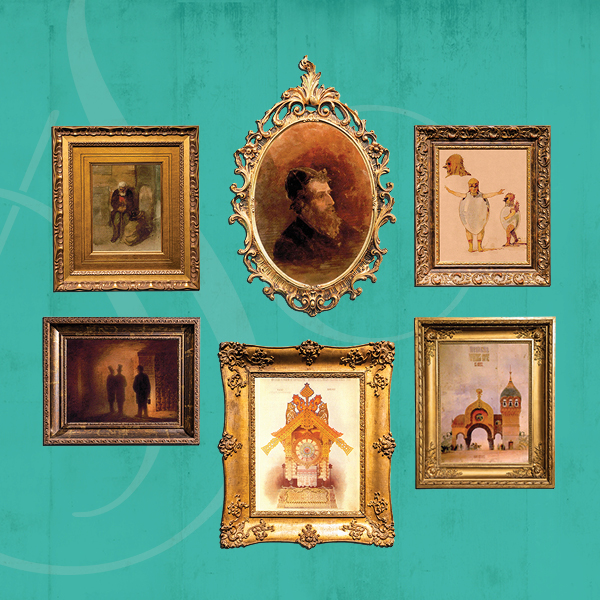
Originally written for piano and orchestrated by Ravel, each movement of Pictures at an Exhibition depicts a painting or sketch shown at Hartmann's posthumous show, unified by a musical “Promenade” via which the listener “walks” from work to work. Russian music critic Vladimir Stasov provides the following descriptions of each movement:
Promenade. This recurring melody illustrates Mussorgsky “roving through the exhibition, now leisurely, now briskly in order to come close to a picture that had attracted his attention, and, at times sadly, thinking of his friend.”
Gnomus (The Gnome): “A sketch depicting a little gnome, clumsily running with crooked legs.”
Il vecchio Castello (The Old Castle): “A medieval castle before which a troubadour sings a song.”
Tuileries (Dispute d'enfants après jeux) (Dispute between Children at Play): “An avenue in the garden of the Tuileries, with a swarm of children and nurses.”
Bydlo (The Ox-Cart): “A Polish cart on enormous wheels, drawn by oxen.”
Ballet of the Unhatched Chicks: “Hartmann's design for the décor of a picturesque scene in the ballet Trilby,” apparently depicting dancers encased in huge eggshells.
Samuel Goldenberg and Schmuyle. “Two Jews: one rich, the other poor.” Mussorgsky based both themes on incantations he had heard on visits to Jewish synagogues.
The Market at Limoges: “French women quarreling violently in the market.”
Catacombs: “Hartmann represented himself examining the Paris catacombs by the light of a lantern.”
Hut on Fowl’s Legs: “Hartmann's drawing depicted a clock in the form of Baba-Yaga's hut on fowl's legs. Mussorgsky added the witch's flight in a mortar.” (The fearsome witch Baba Yaga flies in the mortar in which she grinds human bones to eat.)
The Great Gate of Kiev: A musical realization of Hartmann’s design for a memorial gate in Kiev, in massive Old Russian style, in honor of Tsar Alexander II.
(for inclusion in the digital program)
Music by Mason Bates
Directed by Gary Rydstrom
Written by Mason Bates & Gary Rydstrom
Animation direction by Jim Capobianco
Produced by Alex D. da Silva & Mason Bates
Executive producers Jody Allen, Rocky Collins, Ruth Johnston & Mary Pat Buerkle
Commissioned by Chicago Symphony Orchestra, San Francisco Symphony, Pittsburgh Symphony Orchestra, Dallas Symphony Orchestra, National Symphony Orchestra, American Youth Symphony, Sakana Foundation, John & Marcia Goldman Foundation and Paul J. Sekhri & The Sekhri Family Foundation
With thanks to the Heinz Family Foundation, Bette and Joe Hirsch, Judy and David Anderson, Noelle and Evan Shahin, Robin Raborn and John Lazlo, Paula Blank and Irwin Derman for their generous contribution to the education program and digital materials for Philharmonia Fantastique and Sprite’s World.
Onscreen Musicians
Courtney Wise, flute
Marcus Phillips, oboe
Carlos Ortega, clarinet
Marko Bajzer, bassoon
Asuka Yanai, violin
Keith Lawrence, viola
Andres Vera, cello
Liu Yuchen, bass
Kristin Lloyd, harp
Margarite Waddell, French horn
Alia Kuhnert, trumpet
Adam Norton, tuba
Felix Regalado, trombone
Noah Luna, percussion
Mika Nakamura, timpani
Art Department
Concept Art: Louis Thomas, Glenn Hernandez, Theo Guignard, Lauren Kawahara, Katia Grifols
Production Design: Louis Thomas, Theo Guignard
Graphic Design: Susan Bradley
Animation
Animation Supervisor: Hanna Abi Hanna
Animation: Tati Moniz, Stephanie Alexander, Tim Allen
Motion Graphics: Chris Anderson
Additional Motion Graphics: Nick DeMartino
Live Action
Director of Photography: Donavan Sell
Gaffer: Arthur Yee
Camera Assistant: Leomar Moring
Studio: Ciel Creative Space
Music Group
Mary Pat Buerkle, management
Noah Luna, music preparation
Marguerite Robison, story consultant
Jonah Gallagher, assistant to Mr. Luna
Marko Bajzer, assistant to Mr. Bates
Post Production
Color a GoGo: San Francisco, CA
Colorist: Kent Pritchett
Producer: Kim Salyer
On Line Editor: Loren Sorenson
World's Greatest Synth
Noah Luna, administrator
Justin Ellis, sales (N. America)
Kate Caro, Intermusica, sales (Rest of World)
George Sheanshang, legal
Project Managers
Music Productions: Claire Long and Meg Davies
Thank You
Skywalker Sound
Tom M. Christopher
Cecilia Caparas Apelin
Kim & Elodie Collins
Zazie Capobianco
Danielle McLane & Naomi F. da Silva
Taliaferro & Ryland Bates