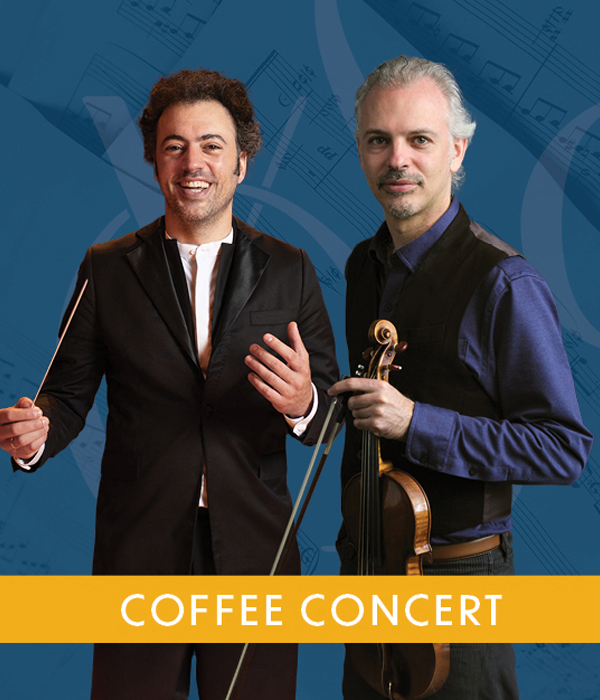
Eric Jacobsen, conductor
Colin Jacobsen, violin
Chrysler Hall, Norfolk, Friday, September 20, 2024 at 11:00 AM
Ludwig Van Beethoven | Overture to Coriolan Symphony No. 4 in B-flat major Concerto in D major for Violin and Orchestra Colin Jacobsen, violin |
Beethoven’s Violin Concerto with Eric & Colin Jacobsen
Ludwig van Beethoven: Coriolan Overture
While Beethoven composed only one opera, Fidelio, during his career, he did write music for ballet (Ritterballet and The Creatures of Prometheus) and for several plays largely unknown today (Egmont, Coriolan, King Stephen, The Ruins of Athens, Tarpeja, and Leonore Prohaska). First performed in Vienna on November 24, 1802, Coriolan was written by Court Secretary Heinrich Joseph von Collin, who was striving to merge German romanticism and classic tragedy. Inspired after attending its premiere, which featured a score cobbled together from Mozart’s Idomeneo—Beethoven set to work composing new incidental music for Coriolan. In Collin’s play, the general Coriolan is banished from Rome despite years of public service. To get revenge, he leads an opposing army against his native city. When the Romans send his mother and wife to persuade him to withdraw, he chooses suicide instead. Richard Wagner described the protagonist in an essay about Beethoven’s music as a “man of force untamable, unfitted for a hypocrite’s humility.”
The Coriolan Overture premiered in early 1807 as part of a subscription concert that is nearly impossible to imagine attending today—the program also included Beethoven’s first four symphonies, his Fourth Piano Concerto, and excerpts from his opera Leonore (an early version of what would evolve into Fidelio). In April 1807, Collin’s play was revived, perhaps to perform Beethoven’s music in its rightful place. The Coriolan Overture was famous from the start. In 1808, the Allgemeine musikalische Zeitung of Leipzig described the work as “Beethoven’s most recent grand overture to Collin’s Coriolan (in C minor), full of inner, powerful life, original harmonic twists and turns, and with a truly tragic effect (but difficult to perform well).” Four years later, the critic E.T.A. Hoffmann wrote that while he felt the work overwhelmed the “predominantly reflective poetry” of the play, “apart from those expectations that will be aroused only in a few connoisseurs who truly comprehend Beethoven’s music, the composition is completely suited to awaken the specific idea that a great, tragic event will be the content of the play that follows… No common tragedy can be performed after this overture, but specifically an elevated one, in which heroes rise up and are defeated.”
Beethoven: Symphony No. 4
Beethoven's Fourth Symphony often suffers in comparison to its symphonic neighbors. As Robert Robert Schumann put it, the Fourth—as compared to the Third and Fifth—is “a slender Grecian maiden between two Nordic giants.” Hector Berlioz also viewed Symphony No. 4 as a deviation—a slight detour or even a return to the past. “Here,” he wrote, “Beethoven entirely abandons ode and elegy, in order to return to the less elevated and less somber, but not less difficult, style of the Second Symphony.” Scholars are not entirely sure whether Beethoven wrote the Fourth as the result of a commission or simply as a result of artistic inspiration. In the summer of 1806, Beethoven went to Silesia (now part of Poland) with his patron Prince Lichnowsky. During their visit, the pair visited Count Franz von Oppersdorff, who believed in music's importance so strongly that he required every member of his staff to play an instrument. Oppersdorf entertained Lichnowsky and Beethoven with a performance of the composer's own Symphony No. 2, and either commissioned the Fourth—or, more likely, offered to purchase the already-completed work.
Whatever the reason for its creation, the few preliminary sketches suggest Beethoven had little trouble composing the Fourth Symphony despite his increasing deafness. In fact, 1806 was a particularly productive year, resulting in his Razumovsky Quartets (Opus 59), a revised version of the opera that eventually became Fidelio (including the famous Leonore Overture No. 3), the Violin Concerto, the Fourth Piano Concerto, and the Fifth Symphony. As Haydn often did, Beethoven opens the Symphony No. 4 with a quiet, somewhat pensive introduction, harmonically evasive but emphasizing the minor mode. While some were delighted with this opening, not everyone was so positive. As Carl Maria von Weber sarcastically wrote, “Every quarter of an hour, we hear three or four notes. It is exciting!” After a nocturne-like slow movement, the third movement scherzo encompasses a range of moods. The work closes with a perpetual-motion Allegro ma non troppo.
Ludwig van Beethoven: Violin Concerto
Written in the wake of the famous Heiligenstadt Testament of 1802, in which Beethoven declared his plans to devote himself to art alone, the Violin Concerto was intended for Viennese violinist Franz Clement. Upon its premiere in December 1806, with Clement as soloist, the work was not particularly well received, and Beethoven probably revised the solo part before its publication in 1807. The Violin Concerto grew much more popular in the second half of the 19th century, when Brahms’s friend and famous virtuoso Joseph Joachim performed it all over Europe. Why was the initial response lukewarm? It may have been due partly to the solo writing, which went somewhat against 19th-century aesthetics. At a time when flashy pyrotechnics were prized, Beethoven’s approach is more reserved; he withholds the soloist’s entrance and strikes a lyrical, almost genteel tone throughout the work. The concerto opens with one of the most extended movements Beethoven ever composed. After a placid second movement, the folk-like exuberance in the concluding Rondo places greater demands on the soloist. Beethoven did not compose cadenzas for the concerto, but Joachim composed several that are still regularly performed today, along with others by famous violinists Fritz Kreisler and Leopold Auer.