Carlos Simon
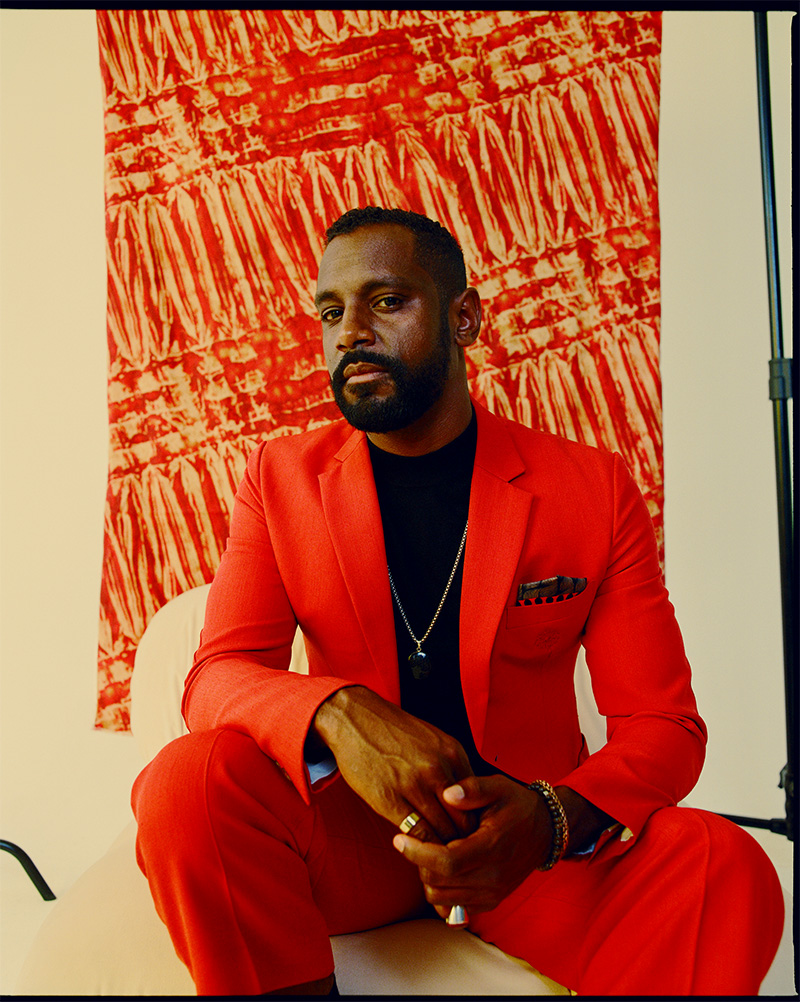
Born: 1986, Washington, D.C.
“My dad, he always gets on me. He wants me to be a preacher, but I always tell him, ‘Music is my pulpit. That’s where I preach,’” Carlos Simon reflected for The Washington Post. Having grown up in Atlanta, with a long lineage of preachers and connections to gospel music to inspire him, Grammy-nominated Simon proves that a well-composed song can indeed be a sermon. His music ranges from concert music for large and small ensembles to film scores with influences of jazz, gospel and neo-romanticism.
Simon is the current composer-in-residence for the John F. Kennedy Center for the Performing Arts and frequently writes for the National Symphony Orchestra and Washington National Opera. Simon also holds the position of inaugural composer chair of the Boston Symphony Orchestra, the first in the institution’s 143-year history.
In the 2024–25 season, Simon had premiere performances with the National Symphony Orchestra, Boston Symphony Orchestra, BBC Symphony Orchestra for the Last Night of the Proms (in his BBC Proms commissioning debut), Jacksonville Symphony Orchestra, Cincinnati Pops Orchestra and Carnegie Hall for the National Youth Orchestra of the USA. The season also featured the premiere of Simon’s Gospel Mass with Gustavo Dudamel and the LA Philharmonic, a work reimagining the traditional mass with gospel soloists and choir, with visual creations from Melina Matsoukas (Beyoncé’s Formation, Queen & Slim).
This follows previous commissions from the likes of the San Diego Symphony Orchestra, Washington National Opera (in collaboration with Mo Willems), New York Philharmonic and Bravo! Vail, Minnesota Orchestra, American Ballet Theatre and Detroit Symphony Orchestra.
As well as his composition work, Simon frequently curates concert programs, which often highlight his own music as well as that of close collaborators. Curation concerts have recently been programmed by the Atlanta Symphony Orchestra, Boston Chamber Players, Tanglewood Festival for Contemporary Music and Kennedy Center for the Performing Arts. Simon also curated and arranged Coltrane: Legacy for Orchestra, a new project co-commissioned by TO Live (for the Toronto Symphony Orchestra) and the San Francisco Conservatory of Music, in partnership with the Coltrane Estate.
August 2024 saw the release of Simon's first full-length orchestral album, Four Symphonic Works, comprising live concert recordings by the National Symphony Orchestra from the Kennedy Center Concert Hall, conducted by Gianandrea Noseda. Simon also composed the original soundtrack for the PBS documentary Shame of Chicago, Shame of the Nation, which was released as a digital album in April 2024.
In September 2023, Simon released two albums on Decca. Together is a compilation of solo and chamber compositions and arrangements featuring Simon and guests such as J’Nai Bridges, Randall Goosby, Seth Parker Woods and Will Liverman. The work draws on Simon’s personal experience as an artist to highlight the importance of heritage and identity, and the power of collaborative music-making.
Simon also released the live premiere recording of brea(d)th, a landmark work commissioned by the Minnesota Orchestra and written in collaboration with Marc Bamuthi Joseph, conducted by Jonathan Taylor Rush. “Arguably the most important commission of Simon’s career so far” (The New York Times), brea(d)th was written following George Floyd’s murder as a direct response to America’s unfulfilled promises and history of systemic oppression against Black Americans.
Simon was nominated for a 2023 Grammy Award for Best Contemporary Classical Composition for his previous album, Requiem for the Enslaved, a multi-genre musical tribute to commemorate the stories of the 272 enslaved men, women and children sold in 1838 by Georgetown University; the recording was released by Decca in June 2022. This work sees Simon infuse his original compositions with African American spirituals and familiar Catholic liturgical melodies, performed by Hub New Music Ensemble, Marco Pavé and MK Zulu.
Acting as music director and keyboardist for Grammy Award winner Jennifer Holliday, Simon has performed with the Boston Pops, Jackson Symphony and St. Louis Symphony. He has also toured internationally with soul Grammy-nominated artist Angie Stone, performing throughout Europe, Africa and Asia.
Simon earned his doctorate degree at the University of Michigan, where he studied with Michael Daugherty and Evan Chambers. He has also received degrees from Georgia State University and Morehouse College. He is an honorary member of Phi Mu Alpha Sinfonia Music Fraternity and a member of the National Association of Negro Musicians, Society of Composers International and Pi Kappa Lambda Music Honor Society. He has served as a member of the music faculty at Spelman College and Morehouse College in Atlanta and now serves as Associate Professor at Georgetown University. Simon was also a recipient of the 2021 Sphinx Medal of Excellence, the highest honor bestowed by the Sphinx Organization to recognize extraordinary classical Black and Latinx musicians, and he was named a Sundance/Time Warner Composer Fellow for his work for film and moving image.
Tales: A Folklore Symphony
- Composed: 2021
- Premiere: January 26, 2022, Ann Arbor, Mich., University of Michigan Symphony Orchestra, Kenneth Kiesler conducting
- Instrumentation: 2 flutes (incl. piccolo), 2 oboes, 2 clarinets, 2 bassoons, 4 horns, 2 trumpets, 3 trombones, tuba, timpani, drum set, anvil, bass drum, glockenspiel, guiro, 2 leather gloves, mark tree, snare drum, suspended cymbals, tam-tam, tom-tom, triangle, tubular bells, vibraphone, whip, strings
- CSO Notable Performances: These are the first CSO performances of Tales: A Folklore Symphony.
- Duration: approx. 23 minutes
Tales: A Folklore Symphony is a four-movement piece for orchestra that explores African American folklore as well as Afrofuturist stories. The work was commissioned by the Sphinx Organization for its 25th anniversary and the University of Michigan Symphony Orchestra.
I. MOTHERBOXX CONNECTION
“Where are all the Black people in comics?” This is a question posed by the creative duo Black Kirby (John Jennings and Stacey Robinson). Based heavily in Afrofuturism, Black Kirby’s characters show Black people as heroes, using ancient customs and futurist motifs from the African and African American diaspora. This piece is inspired by the many heroic characters found in the work of Black Kirby, but mainly Motherboxx Connection. (Black Kirby: In Search of the Motherboxx Connection).
According to scholar Regina N. Bradley, Motherboxx Connection is “a pun on Jack Kirby’s Mother Box, a living computer connected to the world; the Motherboxx too, is a living computer with a heightened awareness of racial and sexual discourses surrounding the Black body. The motherboxx is the technological equivalent of the 'mother land' in the Black diaspora imagination. She is where Black identities merge and depart.”
To represent the power and intelligence of the motherboxx, I have composed a short, fast-moving musical idea that constantly weaves in and throughout the orchestra. A majestic, fanfare-like motif also provides the overall mood of strength and heroism. I imagine the motherboxx as an all-knowing entity that is aware of the multi-faceted aspects of Blackness.
II. FLYING AFRICANS
Once, all Africans could fly, but lost their ability once they crossed the Atlantic Ocean as enslaved humans. This story tells how one African maintained the ability and secretly passed the gift on to others. The Negro spiritual “Steal Away” is referenced in the woodwinds, as well as in the cello section, while the upper strings hover effortlessly in the higher register.
Steal away, steal away, steal away to Jesus.
Steal away, steal away home.
I ain't got long to stay here.
III. GO DOWN MOSES (Let My People Go)
The Jewish biblical story of the Plagues of Egypt resonated with the enslaved, and they created songs that related to this story of bondage. While the horrific plagues that swept across Egypt are compelling in and of themselves, the focus of this piece is recounted from the perspective of the stubborn Pharaoh, who unwillingly loosens his grip on the enslaved people. The Pharaoh’s hardened heart is conveyed through two sharp, accented chords. The spirit of God, represented by light, heavenly, metallic sounds from the percussion, signals the beginning of each new plague. Frogs, pestilence and sickness are not enough to break the Pharaoh’s will. It is only with the “Angel of Death,” which takes the life of the Pharaoh’s first-born child, represented by dark, brooding harmonies, that he relents in despair. The orchestral texture grows thinner and thinner as the Pharaoh loathes in emotional anguish. The once prideful Pharaoh is now broken down to a powerless whimper. I use the Negro spiritual “Let My People Go (Go Down, Moses)” as a musical framework throughout this movement.
Go down, Moses,
Way down in Egypt’s land;
Tell ol’ Pharaoh to
Let my people go!
When Israel was in Egypt’s land,
Let my people go!
Oppressed so hard they could not stand,
Let my people go!
IV. JOHN HENRY
The story of John Henry is traditionally told through the work song, in versions with wide-ranging and varying lyrics. The well-known narrative ballad of "John Henry" is essentially the battle between man versus machine. Enslaved prisoners would often sing the story more slowly and deliberately, often with a pulsating beat suggestive of swinging the hammer. These songs usually contain the lines, "This old hammer killed John Henry / but it won't kill me." Writer Scott Nelson explains:
Workers managed their labor by setting a "stint," or pace, for it. Men who violated the stint were shunned. ... Here was a song that told you what happened to men who worked too fast: they died ugly deaths; their entrails fell on the ground. You sang the song slowly, you worked slowly, you guarded your life, or you died.