Ralph Vaughan Williams
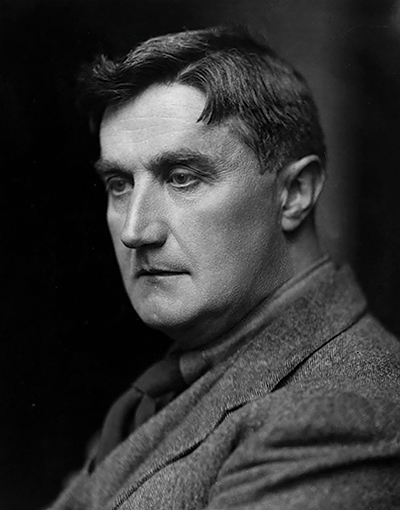
Born: October 12, 1872, Gloucestershire, England
Died: August 26, 1958, London, England
Symphony No. 1, A Sea Symphony
- Work Composed: 1903–1909
- Premiere: October 12, 1910 in Leeds, conducted by the composer
- Instrumentation: SATB chorus, soprano and baritone soloists, 3 flutes (incl. piccolo), 2 oboes, English horn, 2 clarinets, bass clarinet, E-flat clarinet, 2 bassoons, contrabassoon, 4 horns, 3 trumpets, 3 trombones, tuba, timpani, bass drum, crash cymbals, snare drum, suspended cymbals, triangle, 2 harps, organ, strings
- Duration: approx. 65 minutes
While Ralph Vaughan Williams was an undergraduate at Cambridge in the 1890s, he was introduced to the poetry of Walt Whitman by his fellow student Bertrand Russell. Whitman’s verses were enjoying a considerable vogue in England at that time, and Vaughan Williams was not immune to the lure of the American poet’s daring topics and experimental poetic structures, nor to his themes of mysticism, human dignity, love and freedom. The budding composer acquired several editions of Leaves of Grass, including one small selection that he carried around in his pocket.
As early as 1903 — the year in which English composer Frederick Delius brought out his Whitman-based Sea Drift — Vaughan Williams was considering a work for chorus and orchestra using the words of the American writer. As the basis of this proposed work, tentatively titled “Songs of the Sea,” he chose passages from Leaves of Grass that philosophically likened an ocean voyage to the individual’s journey of life. Both the topic and its musical realization were imposing artistic challenges for Vaughan Williams, who, at age 31, had written only some songs, chamber pieces and small works for orchestra. He sketched a few preliminary ideas for the new work, but he did not feel that his technique had developed sufficiently to make a success of it and was unable to bring the piece to completion.
A year later, Vaughan Williams turned his attention to another Whitman poem, "Whispers of Heavenly Death," and set a passage from it as “A Song for Chorus and Orchestra” titled Toward the Unknown Region. The work was presented at the 1907 Leeds Festival with enough success to encourage him to return to his earlier and larger Whitman piece, by then re-christened “Ocean Symphony.”
Things did not go smoothly. The music went through much rejection and rewriting; at one stage he scrapped an entire movement. He consulted friends for their advice, particularly seeking recommendations for a teacher who could help him expand his musical language to encompass the large task he had set for himself. He decided that his music was “lumpy and stodgy ... and that a little French polish would be of use,” so his first thought was to study in Paris with the distinguished composer and pedagogue Vincent d’Indy. The eminent music writer M.D. Calvocoressi, however, advised him to seek out a young composer (three years younger than Vaughan Williams, in fact) who was little known in England at the time but, Calvocoressi was convinced, full of the brightest promise — Maurice Ravel. Calvocoressi arranged the introductions and invitations, and Vaughan Williams left for France early in 1908 for three months of study with Ravel.
Vaughan Williams recounted his initial meeting with Ravel:
He was much puzzled at our first interview. When I had shown him some of my work he said that for my first lessons I had better "écrire un petit menuet dans le style de Mozart." I saw at once that it was time to act promptly, so I said in my best French, "Look here, I have given up my time, my work, my friends and my career to come here and learn from you, and I am not going to write a petit menuet dans le style de Mozart." After that, we became great friends and I learned much from him.
Vaughan Williams worked intensely in Paris, meeting with Ravel four or five times a week and benefiting greatly from the lessons. “The man is exactly what I was looking for,” he wrote to Calvocoressi. “I practice chiefly orchestration with him. ... He showed me how to orchestrate in points of colour rather than in lines.” Ravel was pleased with his student (“a pupil of whom I am proud,” he boasted), and their mutual respect grew into friendship. Ravel visited Vaughan Williams at his home in Cheyne Walk, London during spring 1909, and enjoyed himself immensely. In his note of thanks to Adeline, the English composer’s wife, Ravel wrote, “Here I am ... a Parisian, home-sick for London. I have never before really missed another country.”
Ravel’s influence on his British colleague was entirely beneficial. Not only did the overseas study strengthen Vaughan Williams’ compositional technique, but, even more significantly, it bolstered his self-confidence so that he was able to resume work with enthusiasm on the languishing Whitman piece. Charles Villiers Stanford, Vaughan Williams’ teacher at the Royal College of Music and an exemplar among Victorian composers, arranged to have the composition, finally called A Sea Symphony, performed at the 1910 Leeds Festival. The score was finished just in time for rehearsals (though Ralph continued to tinker with it for the next 14 years) and the composer conducted. The panoramic new work, one of the most important contributions in years to the revered English choral tradition, was a rousing success at its premiere and was the first composition to carry Vaughan Williams’ name to a wide public.
The four movements of A Sea Symphony approximate the traditional symphonic structure, though the form of each is, perforce, adapted to the requirements of Whitman’s poems. In his study of the composer’s symphonies, Hugh Ottaway wrote, “In Vaughan Williams’ selection, only the words of the scherzo are descriptive; the remainder view the sea as a symbol of human endeavor or a challenge to the mind and spirit. The tone is optimistic and Whitman’s emphasis on the brotherhood of man and the unity of being comes through clearly.” More than simply a musical seascape, this symphony concerns itself with some of the basic questions of existence that Whitman voiced with such force and grandeur. “In the Sea Symphony,” noted Vaughan Williams’ biographer James Day, “the sea itself is a symbol — of the innermost self that man can and must discover and explore, just as he explores the sea.”
The sung word dominates the symphony from beginning to end, with the orchestra playing an accompanimental role throughout. (The work is among the most demanding in the choral repertory.) The emphasis on singing arose from Vaughan Williams’ inclination toward the human voice, which, the composer wrote in his book National Music (1934), “is the oldest musical instrument and through the ages it remains what it was, unchanged; the most primitive and at the same time the most modern, because it is the most intimate form of human expression.” A Sea Symphony occupied Vaughan Williams for nearly six years. It shows evidence of many of the musical influences that played upon his thoughts as a young composer — Parry, Elgar, Stanford, Ravel, Purcell — and does not maintain throughout its large whole an equal inspiration. (Other than the operas, this is his longest work.) “Yet in the end,” concluded music critic Cecil Gray, “after tremendous efforts and an almost heroic tenacity, there emerges ... a real and lovable personality, unassuming, modest and almost apologetic.” With A Sea Symphony, one of music’s greatest 20th-century masters was first revealed in all his genius.
The forms of the individual movements of A Sea Symphony are indebted to the poetic structures and moods of Whitman’s words. There are traces in the opening movement (A Song for All Seas, All Ships) of traditional sonata form in the return and development of themes, but it is the text that gives shape and character to the music. A motif is presented in the opening measures that recurs later in the symphony as a means of unifying the work’s structure: the harmonic progression occurring with the words “Behold the sea” (B-flat minor to D major).
The baritone soloist and semi-chorus are entrusted with the slow second movement, On the Beach at Night, Alone. It is a three-part form (A–B–A) whose outer sections are solemn and almost mysterious, while the central portion (commencing with “A vast similitude”) is more animated in character. The harmonies that begin the first and third sections recall the “Behold the sea” progression from the opening movement.
The Scherzo (The Waves), the most pictorial movement in the Symphony, begins with a variation of the “Behold” harmonies. The bracing rhythms, the inclusion of two sea shanties as melodic material ("The Golden Vanity" and "The Bold Princess Royal") and the sweeping glissandos in the harp lend this music an invigorating nautical air. The central episode (“Where the great vessel sailing”) is a broad hymn tune in the tradition of the grand English processional.
In the finale (The Explorers), Vaughan Williams posed for himself the formidable task of setting not only a poem longer than the rest of the symphony’s texts combined, but one in which Whitman, noted Hugh Ottaway, “is at his most giddily metaphysical.” The success of the movement comes not from its form — which episodically follows the structure of the text — but rather from the composer’s melodic gift, harmonic boldness, orchestral ingenuity and complete sincerity of expression. It is a fitting conclusion to this grand musical voyage.
—©Dr. Richard E. Rodda