Duke Ellington
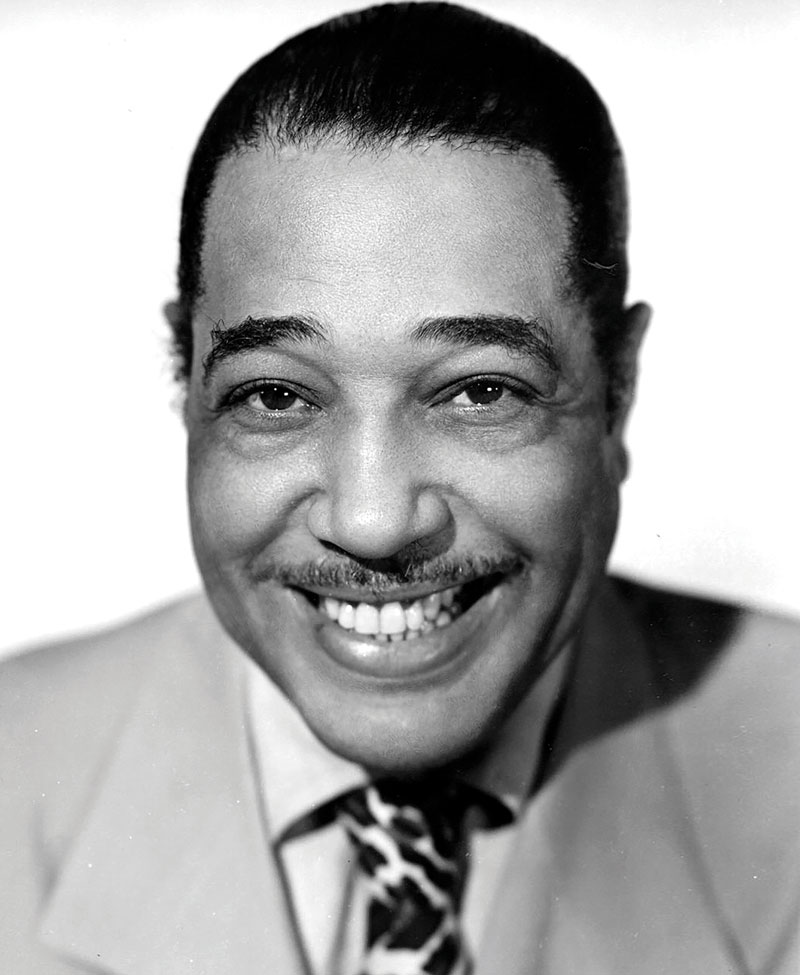
Born: April 29, 1899, Washington, D.C.
Died: May 24, 1974, New York, New York
The River Suite
- Work Composed: 1970
- Premiere: (“Seven Dances” version) June 25, 1970, Lincoln Center’s New York State Theater
- Instrumentation: 2 flutes (incl. piccolo), 2 oboes (incl. English horn), 2 clarinets, 2 bassoons, 4 horns, 3 trumpets, 3 trombones, tuba, timpani, bass drum, claves, glockenspiel, maracas, snare drum, suspended cymbals, xylophone, harp, piano, strings
- Duration: approx. 30 minutes
As a composer, bandleader and pianist, Duke Ellington was unparalleled. Throughout his five-decade career, he charted his own musical course, rejecting social trends and popular culture conventions. He refused to compromise even in the face of waning popularity and shifting tastes. His music was not just riffs, rhythms and ideas that streamed from his mind and piano into the instruments of his celebrated orchestra; it reflected his strong racial consciousness and resistance to the marginalization of Black intellectuality. It exemplified how he used music as a vehicle to advance social change. Ellington was a product of ecosystems imbued with social consciousness — cultural and intellectual labor purposed for an imagined world where social justice and civil rights were fully realized.
While much of Ellington’s musical legacy has been framed around popular songs such as "Take the A Train," "Mood Indigo" and "It Don’t Mean a Thing (If It Ain’t Got that Swing)," it is his suites, ballets and Sacred Concerts that extended that legacy beyond the realms of jazz history. Through the jazz suite, a multi-movement programmatic work, Ellington expanded the context of what constituted the American orchestral idiom during the second half of the 20th century. Much like the symphonic poem in classical music, the jazz suite has served as the musical canvas through which specific cultural narratives or ideas could be conveyed. The genesis of the idiom is often traced to the early compositions of Duke Ellington, which blended symphonic approaches with traditional jazz band instrumentation. (It should be noted, however, that it was Mary Lou Williams’ Zodiac Suite [1945] that provided the earliest evidence of how the jazz suite could be realized through the medium of the symphonic orchestra.) The River reflects how Ellington’s ideas followed this precedent — combining the musical possibilities of the symphony orchestra and the jazz big band.
In 1970, Lucia Chase, co-director of the American Ballet Theater, approached Ellington about writing a piece in honor of the company’s 30th anniversary. The commission resulted in the coupling of two of the most creative minds of the 20th century — Ellington and choreographer Alvin Ailey. The two would have a long and varied collaborative history, which first began in 1963 when Ailey choreographed a series of dances to Ellington’s work, My People. In that instance, Ellington had a fully realized score when Ailey began his work. But with The River, Ellington’s process was more disjointed, which delayed Ailey from fully creating dances for all of the movements. When the work debuted June 25, 1970, it was titled Seven Dances from a Work in Progress entitled "The River."
Extant scores revealed that Ellington initially intended the work to have 12 movements. But in time, the eight movements featured in this May Festival concert became the standard version. Orchestration was done by Canadian composer Ron Collier, who worked with Ellington throughout this latter stage of his career.
As with many of his multi-movement works, Ellington wrote an extensive program outlining the themes and concepts he wished to portray musically. Scholars have posited that ideas for the work pre-dated the American Ballet Theatre commission. According to Ellington’s son, Mercer, jazz historian Stanley Dance had suggested to the composer sometime before 1970 the idea of writing a large-scale work centered on a water theme.
On the surface, the narrative of the work focuses on the development of a river from its beginnings as a stream through various stages of evolution before it returns to the sea. Each stage of development is depicted through specific melodic and rhythmic ideas. However, by 1970, Ellington’s philosophical and compositional perspective was becoming more informed by a spiritual consciousness that no doubt reflected awareness of his own mortality. Thus, the narrative of The River became for Ellington a spiritual metaphor for life, death and anticipated rebirth in heaven.
The first movement, “Spring” is described as representing a newborn baby, who in his cradle, “spouting, spinning, wiggling, gurgling, squirming, squealing, making faces, reaching for his nipple or bottle, turning, tossing and tinkling all over the place.” This movement is slow and expressive, beginning with the horn introducing a motive that invokes the swirling of water. The pastoral nature of the scene is further painted with the entrance of the oboe and strings. As this motive develops, it takes on a Middle Eastern or North African flavor.
“Meander” represents the movement of the child from the safety of the cradle. Ellington noted, “Undecided whether to go back to the cradle or pursue his quest in the wake of the big bubble. There he is, rolling around from one side to the other on the floor up and down, back and forth, until he sees the door, the kitchen door, and looks out into that big backyard.” Ellington represents the aimless wandering through a blues-tinged motive that bears the hallmarks of his style — growling horns, bombastic crescendos and call-and-response across sections of instruments. The indirect course of the water (child) and each bend in its path is reflected in various tempo changes that move from long, sustained lyrical passages, to swinging rhythms, to a fast, bluesy waltz. The movement ends with a flute cadenza that embodies the untamed nature of the developing stream.
The third movement, “Giggling Rapids” begins with a syncopated piano introduction that grows into motivic interplay between the horns, woodwinds and glockenspiel. This motive grows in intensity before the call and response shifts to the strings and horns. Note how the strings’ motive mimics the swirling of water. Ellington described “Lake” as “beautiful and serene … in all its beauty, God-made and untouched, until people come — people who are God-made and terribly touched by the beauty of the lake.” The exotic melody heard in the first movement returns. But this time Ellington explores the full tonal possibilities of this motive, establishing aspects of its identity that were not heard in the first movement. The serenity of this movement is disrupted by the intensity of “Vortex” and “Fals.”Both represented Ellington’s interpretation of how one must navigate the hazards of life and fight to regain the serenity once experienced.
In the narrative description of The River included in his memoir Music is My Mistress, Ellington envisioned the “Village Virgins” to represent the fully formed identity of the river. This movement marks the final stage of transformation and anticipates its return to the Mother, the sea. The final movement, “Riba,” is a reminder of the musical alchemy that defined the uniqueness of the Ellington sound. Here, he reimagines the symphony orchestra as an extension of his iconic dance orchestra through the execution of driving rhythms, blues-tinged riffs, and punctuated phrases with an improvisatory feel.
—©Tammy Kernodle, University Distinguished Professor and the Park Creative Arts Professor of Music at Miami University