Claude Debussy
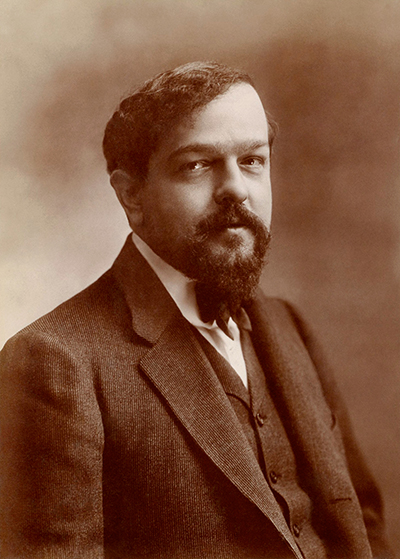
Born: August 22, 1862 in St. Germain-en-Laye, near Paris
Died: March 25, 1918 in Paris
Première rapsodie for Clarinet and Orchestra
- Work Composed: 1909-1910.
- Premiere: January 16, 1911 in Paris, with Prosper Mimart as clarinetist.
- Duration: approx. 7 minutes
As a youngster growing up in Paris, Debussy studied piano with one Antoinette Mauté de Fleurville, who claimed to be a pupil of Chopin (though no documentation exists to prove her assertion). She quickly recognized the boy’s musical talents, and prepared him so effectively that he was admitted to the Paris Conservatoire at the age of ten. He continued his study of piano there, and won a second prize in performance in 1877, but his interest in a career as a concertizing virtuoso waned soon thereafter, and he concentrated his subsequent efforts in the areas of theory, harmony, and composition. He was runner-up for the Prix de Rome in 1882, and in 1884 he won the Grand Prix, which required him to spend two years in Rome. This obligation he looked at askance since it meant leaving the vibrant artistic climate of Paris, but refusal was unthinkable, so off he went to Rome. He hated it. He was “crushed and annihilated” by the city; called the Villa Medici “a prison” and its director, the painter Ernest Hébert, “a jailer.” He was late in meeting his deadlines, the scores he submitted received only grudging approval from the competition’s governing committee, and he created a fuss over some of the performance requirements stipulated for his works. Though he had been an exemplary student in his younger days, it is little wonder that his relations with the Conservatoire were strained during the years after his Roman sojourn.
By 1907, despite his iconoclastic views, his unprecedented musical style, and the scandals surrounding his personal life (he abandoned his first wife in 1904 for another woman — Paris was deliciously outraged), it could no longer be denied by those in bureaucratic power that Debussy, the author of the Prelude to the Afternoon of a Faun, the Nocturnes, and the hotly debated opera Pelléas et Mélisande, had established a significant reputation as a leading French composer. As a sort of back-handed recognition in lieu of a formal faculty position, he was invited by Gabriel Fauré, then director of the Paris Conservatoire, to help judge the competitions for prizes in wind instrument performance in 1907. Apparently Fauré was pleased with Debussy’s participation, since he invited him to become a regular competition judge in February 1909. In December 1909 and January 1910, Debussy wrote two short works for the 1910 clarinet competitions — a Première Rhapsodie intended as the principal examination composition and a Petite Pièce for sight-reading. When Prosper Mimart, professor of clarinet at the Conservatoire and the dedicatee of the score, gave the public premiere of the Première Rhapsodie (Debussy never composed a “deuxième rhapsodie”) on January 16, 1911 at a Paris concert of the Société Musicale Indépendente, Debussy allowed that the piece was “among the most pleasant I have ever written.” He orchestrated both clarinet works later that year.
As is true with virtually all of Debussy’s compositions, the Première Rhapsodie does not follow a traditional form, but is rather a seemingly free but actually tightly controlled elaboration of several thematic motives wrapped in the opulent harmonies and sonorities of his Impressionistic musical language. It is a realization of a philosophy he expressed in a letter in 1907 to his publisher, Jacques Durand: “I am more and more convinced that music, by its very nature, is something that cannot be poured into a tight and traditional form. It is made up of colors and rhythms.” The Première Rhapsodie, in which “the clarinet is treated with sympathy and insight,” according to American musicologist and critic Oscar Thompson, is disposed in several continuous sections that become more animated and virtuosic as they progress.
©2026 Dr. Richard E. Rodda