Leonard Bernstein
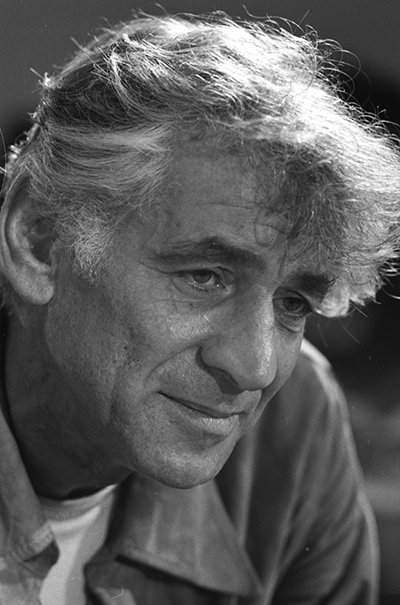
Born: August 25, 1918, Lawrence, Massachusetts
Died: October 14, 1990, New York, New York
“Make Our Garden Grow,” Finale from Act 2 of Candide
- Work Composed: 1953–1956
- Premiere: Operetta premiered: Martin Beck Theater, New York City, December 1, 1956
- Instrumentation: SATB chorus; soprano, tenor, baritone soloists; 2 flutes, oboe, 2 clarinets (incl. bass clarinet), bassoon, 2 horns, 2 trumpets, 2 trombones, tuba, timpani, bass drum, chimes, crash cymbals, glockenspiel, suspended cymbals, harp, piano, strings
- Duration: approx. 4 minutes
Leonard Bernstein’s scores for musical theater span his mature compositional career, though his most familiar today are likely those from the 1950s, including the irreverent Candide. He began work on Candide with playwright and screenwriter Lillian Hellman in 1953, after she originally presented the idea years earlier, and they worked first with John Latouche then Richard Wilbur for the project’s lyrics. (Bernstein and Dorothy Parker also wrote lyrics, and Stephen Sondheim later helped revise.) By Bernstein’s standards, it was a commercial flop. Its original 1956 version ran previews in Boston and premiered on Broadway on December 1, 1956, at the Martin Beck Theater, but lasted only 74 performances, closing by February. Yet today, opera and musical theater companies regularly perform the work (including nearly 350 times during the Bernstein centennial); its overture is a mainstay curtain raiser; and select numbers like “Glitter and Be Gay” are popular showpieces for singers. In the choral repertoire, the finale, “Make Our Garden Grow,” has become a favorite for its affirmational, aspirational message and Americanist sound.
The play tells the story of utopia-minded Candide, an illegitimate naïf living in his Westphalian uncle’s estate, where he fawns over the perfect Cunegonde. Family intrigues expel Candide from the castle, and he is conscripted into a rival army. He subsequently travels the globe, repeatedly encountering his mentor, Pangloss, and a cast of other Westphalians. The satire, after Voltaire’s 1759 novella, ridicules muddled, egocentric Aristotelian inductive reasoning that presumes personal observations represent laws of the cosmos: what you see holds universal truth. Candide airs this in mocking declarations that the characters’ world — the only one they know — is “the best of all possible worlds.” “Make Our Garden Grow” marks Candide’s final union with Cunegonde, once his “hero” journey has granted him the wisdom to recognize her imperfections. Their common optimism is now realized in life’s wholeness, in good and bad facets.
Candide’s facile rosy surface transmutes dark suspicions that had overtaken parts of American culture after World War II, staged in Congressional inquiries that took evidence at face value and interrogated those with alleged communist sympathies, including many artists. Of those subpoenaed before the House Committee on Un-American Activities (HUAC) during the high McCarthyism of the 1940s and 50s, many were listed in an expansive 1950 pamphlet titled Red Channels. Though he was never subpoenaed by HUAC, Bernstein’s name and cultural-political dossier appear in the publication. Bernstein and Hellman’s collaboration began when it did as a rumination on her testimony before HUAC in 1952. Candide skewers a dissonant psychology of distorted truth perceived to undergird HUAC’s proceedings, which the play represents with a Catholic Inquisition of heretics. Candide also lampoons the hearings’ apparent excesses, manifest in the operetta’s many globe-trotting absurdities, great lengths, and revivals of deceased characters.
Bernstein deftly used his uncanny ability to write in disparate styles to translate the libretto’s incongruities into music. There are Viennese waltzes (conjuring blithe Silver Age operetta) and other European dances, flashes toward austere atonality (“Quiet”), and folkish melodies (“It Must Be Me”). “Make Our Garden Grow” at once invokes the individual-to-collective grandeur that closes Mozart’s Così fan tutte (“E nel tuo, nel mio bicchiero” to “Fortunato l’uom che prende”) and resounds Aaron Copland’s capacious Americanist sound of the 1930s. Comparison to Così is apt for their similarly contrived plots, but “Fortunato l’uom” also advocates an optimistic worldview through trials and tribulations, the very message of “Make Our Garden Grow.” Candide’s wide stylistic breadth has caused unease with genre designation — is it opera? operetta? musical comedy? all or none of these? — and even this seems to reflect its themes and inspiration. Candide also reverberates Bernstein’s other dramatic works from the 1950s, with some affinity for passages in Trouble in Tahiti and, especially, the near-coeval West Side Story. Shades of West Side Story’s “Tonight” peak through in Candide’s melodic and orchestral writing, and “One Hand, One Heart” was at one point part of Candide.
Although many midcentury American musical theater works resonate with one another, Bernstein seems to have been inspired specifically by Copland’s then-recent opera, The Tender Land (1954), a similarly politically coded drama. Perhaps the clearest parallel between Candide and The Tender Land is in their famous communitarian choruses, with “Make Our Garden Grow” conjuring Copland’s act-one finale, “The Promise of Living.” As musicologist Elizabeth Crist has written, both operas respond to HUAC, speaking to what some called a maturation of leftist politics, away from Popular Front utopianism toward a more realist modern liberalism that emerged once the Soviet Union’s ultra-left communism produced the Red Scare.
Just before “Make Our Garden Grow,” having reunited with Cunegonde, Candide sings the aria “Nothing More than This,” in which he comes to terms with his flawed, naïve idealization of her. We learn they purchase a farm and life continues in a more realistic way, foil to the operetta’s prior utopianism. The chorus assembles for “Universal Good,” a sober precis on Candide’s realization: “Life is neither good nor bad. Life is life, and all we know.” Candide and Cunegonde exchange affirmations that their love can be genuine and mature, then Candide proposes marriage and flutes, clarinets and bassoons enter with the opening notes of “Make Our Garden Grow.”
The opening woodwind phrase of “Make Our Garden Grow” conveys simultaneous optimism in its high-arching opening interval and realism in the following two-note descent. After the short introduction, Candide invites Cunegonde to a more honest self-actualization and delivers a textual refrain that calls her (and us) to embrace the virtue of self-sufficiency through work. Cunegonde responds in kind, taking up Candide’s melody and sentiments, pointing the way forward to a better future. Bernstein set these respective strains in keys that are equally distant from the key of the third and final section sung by full chorus. When the full ensemble joins in this centralized key, it symbolically reinforces the lead characters’ exhortation with now-unified voice, finishing on a final, triumphant chord.
—©Jacques Dupuis