Gioachino Rossini
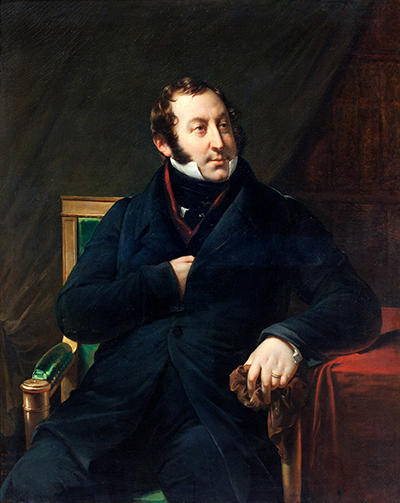
Born: February 29, 1792, Pesaro, Italy
Died: November 13, 1868, Paris, France
Petite messe solennelle
- Work Composed: 1863–1864
- Premiere: March 14, 1864 in Paris
- Instrumentation: SATB chorus; soprano, mezzo-soprano, tenor and bass-baritone soloists; 2 pianos, harmonium
- Duration: approx. 86 minutes
After dazzling Europe with no fewer than 39 operas between 1808 and 1829, Rossini abruptly stopped composing at the hardly advanced age of 37. Except for some vocal and instrumental entertainment pieces called Sins of My Old Age that he jotted down from time to time and a setting of the Stabat Mater sketched out in 1831–32 but not finished until 1841, he thereafter retired completely from creative activity, traveling extensively in Italy and France, and growing increasingly alarmed about the deteriorating state of his health. In 1855, he settled in Paris, and the following summer was ordered by his French doctors to seek relief at the medicinal baths in Wildbad, Kissingen and Baden. The treatment succeeded, and he moved into a new apartment in central Paris in the autumn of 1856 with renewed vigor, though he maintained a strict daily regimen of walking, rest, dining and receiving visitors. The only variation in his schedule came on Saturday evenings, when he hosted one of the most popular salons in the city — invitations to his soirées samedi were among the most eagerly sought by artists and socialites from all over Europe.
Although Rossini’s life had settled into a comfortable pattern in Paris, where he was freed from the pressures of production deadlines, ambitious prima donnas and publisher demands, one last important composition demanded its creation from him — the Petite messe solennelle (“Little Solemn Mass”). It is unclear exactly what inspired Rossini to return to creative work in the summer of 1863, more than two decades after his last substantial composition, the 1841 Stabat Mater. It was once thought that a performance of Liszt’s Missa solemnis at St. Eustache at that time raised his enthusiasm, but it seems more likely that his inspiration came, at least in part, from the singing of two sisters, Barbara and Carlotta Marchisio, who made their joint debuts at the Paris Opéra in 1860 in his Semiramide. For Rossini, Barbara (contralto) and Carlotta (soprano) fired memories of the bel canto style of his youth, a manner of singing then greatly in decline because of the changed musico-dramatic requirements imposed by Verdi, Wagner and French grand opera. He said that the Marchisio sisters were the “possessors of that song which is sensed in the soul,” and he engaged them for several private performances of his Stabat Mater in Paris. They remained friendly with Rossini through his last years; Barbara sang at the ceremony for the reburial of his remains in Santa Croce in Florence in 1887.
Rossini undertook the Petite messe solennelle in the summer of 1863 — his wife, Olympe, reported that his return to the challenge of the blank page made him cranky and irritable — and he worked on the score through the end of the year, creating what he told his friend Edmond Michotte was his “final legacy, an example of how to write for the voice.” When the work was done, Rossini appended the following insouciant preface to the score:
Petite messe solennelle, in four voices with the accompaniment of two pianos and harmonium [a small reed organ], composed during my country stay at Passy. Twelve singers of three sexes — men, women and castrati — will be enough for its performance: that is, eight for the chorus, four for the solos, a total of 12 cherubim. God, forgive me the following rapprochement. Twelve also are the apostles in the celebrated Last Supper by Leonardo: who would believe it! Among Thy disciples there are those who strike false notes! Lord, rest assured, I swear to Thee that there will be no Judas at my supper, and that mine will sing properly and con amore Thy praises and this little composition, which is, alas, the last mortal sin of my old age.
At the end of the manuscript, Rossini jotted a “letter to God”:
Good God, there we have it, complete, this poor little Mass. Is it really sacred music that I have made, or something devilish? I was born for opera buffa, as Thou well knowest. Little skill, little heart, and that is all. So be Thou blessed, and admit me to Paradise. G. Rossini. Passy, 1863.
Rossini hoped to have the messe premiered in a properly consecrated space, but when a petition to Pope Pius IX failed to ease the ban on women singing in church, he settled for the private chapel in the house of the Count and Countess Pillet-Will in the Rue Moncey. The performance took place on March 14, 1864, before a small select audience that included composers Daniel Auber, Giacomo Meyerbeer (who was so excited by the messe that it affected his already failing health; he died two months later and Rossini wrote a tiny piece for male chorus and drum for the funeral) and Ambroise Thomas. The Marchisio sisters sang, of course, and two performers from the Théâtre-Italien — tenor Italo Gardoni and Belgian bass Louis Agniez — took the male parts; Auber chose the chorus from among the best students at the Conservatoire. A second performance the following day for a larger audience left the listeners thunderstruck. The critic for Le Siècle reported that the Mass, with its expressive fervor and harmonic audacities (“I didn’t spare the dissonances, but I put some sugar into it, too,” Rossini explained), “would provide fire enough to melt marble cathedrals.” Meyerbeer wrote, “To Jupiter Rossini, Divine Master! I cannot allow the day to end without thanking you again for the enormous pleasure given me by the experience of hearing your latest sublime creation.” News of the triumph brought Rossini new honors, including appointment as a grand officier of the Legion d’Honneur.
Calls began immediately for Rossini to orchestrate the messe (“Petite” refers to the small forces required, not to the duration of the piece — it rivals Beethoven’s Missa Solemnis in length), but he steadfastly refused, insisting that he preferred the work in its original chamber scoring. Finally, in 1867, claiming that it would be better for him to make the arrangement himself than to allow someone else to do it after he was gone, he reworked the Petite messe solennelle for full orchestra, but then forbade any performance in that form during his lifetime. The orchestral version was first heard at the Théâtre-Italien in Paris on February 24, 1869, three months after the composer’s death. So great was the demand to hear the messe that 14 performances were given at the Italien in a month, and a three-month tour by the same troupe was undertaken through France, Holland and Italy. The piece was heard in Sydney, Australia within a year.
The Petite messe solennelle is less operatic than might be expected, given Rossini’s background in the theater, but it sacrifices none of the lyricism or exquisite handling of vocal color that made him the most popular composer of his day. In place of musical drama, Rossini imbued this work with the richly textured counterpoint of traditional sacred music, a technique in which he had been drilled as a student 60 years before, and a wide-ranging harmonic vocabulary that reflects his knowledge of recent advances in that art. (To place the messe in its historical context — Wagner’s Tristan, Bruckner’s earliest symphony and Verdi’s La forza del destino cluster within a few years of its composition.)
In his study of Rossini, Richard Osborne summarized the wealth of expression and the breadth of reference in the Petite messe solennelle:
We glimpse here a darker, more troubled side to his nature as well as a contemporary love of the older, pre-classical choral disciplines, themselves complemented by Rossini’s acute and delighted sense of new possibilities in matters of texture and harmony. The messe, a singular achievement at a time when choral music was becoming ever more bloated, looks back to Palestrina and forward to the sacred music of such composers as Fauré and Poulenc.
—©Dr. Richard E. Rodda