Florence Price
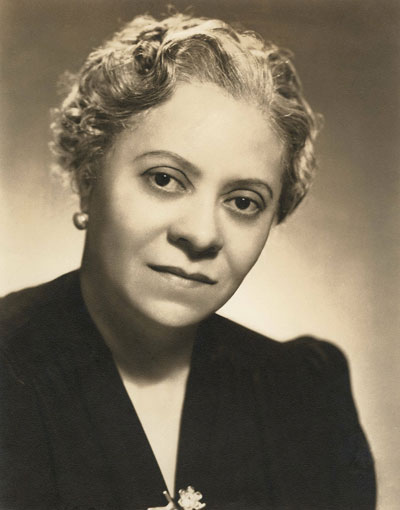
Born: April 9, 1887, Little Rock, AR
Died: June 3, 1953, Chicago, IL
Concerto in D Minor in One Movement for Piano and Orchestra
- Work Composed: 1934
- Premiere: 1934 at the Chicago Music College commencement program
- Instrumentation: solo piano, flute, oboe, 2 clarinets, bassoon, 2 horns, 2 trumpets, 2 trombones, timpani, bass drum, crash cymbals, snare drum, suspended cymbals, strings
- Duration: approx. 18 minutes
Born in Little Rock, Ark., in 1888, Florence Beatrice Price rose to prominence in the evolving classical music scene of interwar America. As the first Black woman composer to have works performed by major American orchestras, Price’s music aligned with that of her peers — William Grant Still, R. Nathaniel Dett and William Dawson — in advancing an aesthetic of Black high art that came to exemplify modern Black intellectuality. Of these contemporaries, Price was the most prodigious, composing over 300 works in her lifetime. While she wrote for many settings, Price’s works for voice and piano have had the most sustained performance history.
Price’s Piano Concerto in D Minor reflects how the composer both embraced and challenged Romantic-era conventions. This work does not adhere to the standard three-movement form of the Romantic-era concerto. Instead, Price condenses the structural and motivic model into a single movement consisting of three distinct sections, each identified by motives, tempi and moods. As a result, this work is commonly referred to as the Concerto in One Movement rather than Piano Concerto in D Minor.
Musically, the Concerto in One Movement bears the hallmarks of Price’s compositional voice: a reverence for Black folk idioms, a rich and colorful harmonic palette and keen mastery of the Romantic style. Each section of the concerto also references the cultural spaces that framed Black identity in early America and shaped the development of the earliest forms of Black music in America: the brush arbor, the praise house and the frolic.
The first section, marked Andantino, begins with a short passage of call and response between solo trumpet and a woodwind trio consisting of oboe, flute and clarinet that contains fragments of the main theme. This interplay transitions to call and response between the trombone and trio before giving way to a piano cadenza. This is one of the first direct ways in which Price moves away from compositional convention. Rather than begin with an orchestral exposition, she limits the orchestral statement and gives the first musical exposition to the piano. This leads into a more developed orchestral exposition, which evolves into the orchestra and piano engaging in the dramatic development of the motivic fragments presented at the very beginning. While this would seem to be the primary motive of the section, it is not. We are well into the work before Price finally presents the primary theme — one that Price scholar Rae Linda Brown asserts resembles the spiritual “Po’ Mourner’s Got a Home at Las.” The development of the theme takes on the frenetic energy of the ring dances, singing and polyrhythmic clapping that permeated the clandestine religious services that defined the cultural space of the brush arbor, before giving way to quiet reverence in the second section.
The Adagio is not only marked by its slow tempo, but also by the motivic interplay between solo oboe and piano. The former takes on the quality of the singing voice, with first the piano and later the orchestra serving as the affirming collective response. The energy of the frolic, a cultural space where syncopated instrumental music and secular dancing were prominent, frames the rhythmic and motivic identity of the third section. Similar to the third movements of her symphonies, Price based the primary theme of the last section on the syncopated rhythms and melodies of the Juba, a form of Black folk dancing.
Price’s use of the Juba rhythms may provide some insight as to how she viewed herself within the genealogy of two intersecting aspects of American music that encapsulated the cultural labor of Black musicians born in the decades following Emancipation. This labor underscored the development and progression of the Black classical aesthetic and America’s popular music industry during the first half of the 20th century. It forms a sonic genealogy that traces the transformation of these syncopated rhythms and melodies into the idiom of Ragtime, one of the first forms of popular culture to emerge out of America’s Gilded Age. Simultaneously, the syncopations and rhythms represent Black identity within an aesthetic of American classical music that extended from the stylized idiom of piano music of Scott Joplin to the music of Will Marion Cook and James Reese Europe, and lastly to Price’s orchestral works.
The Concerto in One Movement was written at the height of Price’s ascendancy into America’s classical music industry in 1934. One year prior to completing the concerto, Price made history when Federick Stock debuted her Symphony No. 1 in E Minor with the Chicago Symphony Orchestra. It marked the first time a symphony written by a Black woman composer was performed by a major American orchestra. The reception of Symphony No. 1 inspired a wave of composition and performances that ended only with Price’s untimely death in 1953.
Price served as soloist for the premiere performance of Concerto in One Movement during the commencement program at the Chicago Music College in 1934. Over the next few years, the work’s performance history reflected the diverse musical circles Price engaged with during the 1930s and 1940s. The Women’s Symphony Orchestra of Chicago and the Michigan Works Progress Administration Orchestra were among the organizations that programmed the work, and acclaimed pianist/composer Margaret Bonds also performed it several times. In addition to the original setting for piano and orchestra, Price also produced arrangements for two pianos and three pianos, and also for piano with orchestral reduction. However, like many of Price’s larger orchestral works, the original orchestral score was lost in the years following her death.
The afterlife of the Concerto in One Movement reflects the complexity that has surrounded the recovery of Price’s musical and cultural legacy. Following the discovery of orchestral fragments and parts of the arrangement for two pianos in 2009, the Center for Black Music Research at Columbia College in Chicago commissioned composer Trevor Weston to reconstruct the orchestral score. The New Black Music Repertory Ensemble, under the direction of Leslie B. Dunner, with Karen Walwyn as soloist, recorded this version of the work in 2011. In 2019, a copy of the original orchestral score was obtained at an auction. This setting of the work is the version featured in this concert.
—©Dr. Tammy L. Kernodle, University Distinguished Professor of Music/Park Creative Arts Endowed Professor, Miami University