The Pietà was one of four ospedali grandi in Venice, and home to nearly a thousand students. The boys lived separately in the home and learned a trade. The girls studied music, and the most accomplished were placed in a special class — the figlie di coro, (daughters of the choir) — where they could attain a certain celebrity and, if lucky, marriage offers from the nobility.
Eyewitness Reports
There were between 40 and 60 students in a coro. Public performances took place in chapels and drew travelers from around Europe. Some of the (male) interest was clearly voyeuristic, as the girls performed in galleries, cloaked behind metal grills.
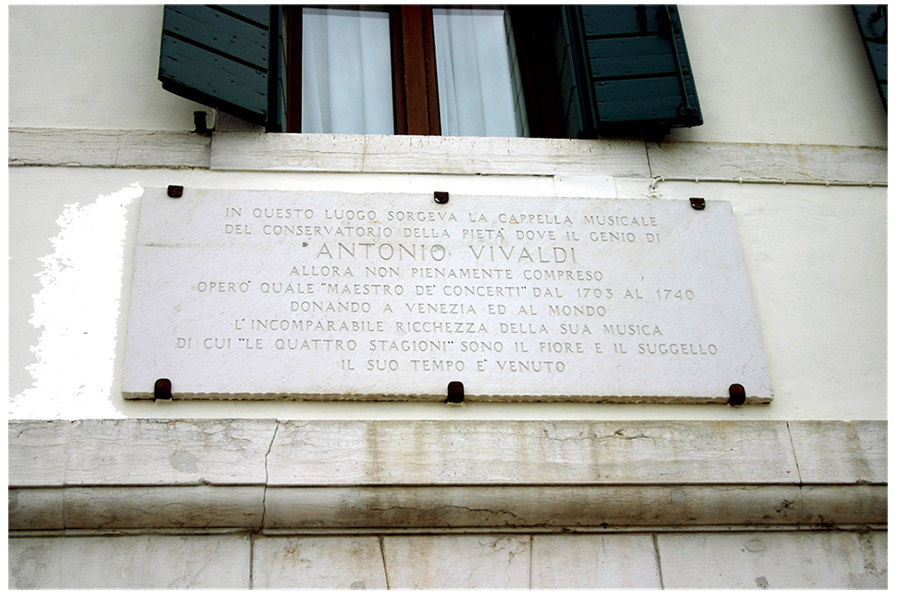
Commemorative plaque beside the Ospedale della Pietà (Devout Hospital of Mercy) in Venice.
“The chapel is always full of music lovers,” reported the writer and philosopher Jean-Jacques Rousseau. “Even the singers from the Venetian opera come so as to develop genuine taste in singing based on these excellent models. What grieved me was those accursed grills, which allowed only tones to go through and concealed the angels of loveliness of whom they were worthy.”
Another visitor, the French politician Charles de Brosses, claimed to steal glimpses of the girls through the latticework during or after a performance.
“There is no instrument, however unwieldy, that can frighten them,” he wrote. “They are cloistered like nuns. It is they alone who perform, and about 40 girls take part in each concert. I vow to you that there is nothing so diverting as the sight of a young and pretty nun in a white habit, with a bunch of pomegranate blossoms over her ear, conducting the orchestra and beating time with all the grace and precision imaginable.”