Festive Overture, Op. 96 (1954)
DMITRI SHOSTAKOVICH 1906-1975
Shostakovich composed the Festive Overture for a concert on November 7, 1954 commemorating the 37th anniversary of the Russian Revolution, but its jubilant nature suggests that it may also have been conceived as an outpouring of relief at the death of Joseph Stalin one year earlier. One critic suggested that the Overture was “a gay picture of streets and squares packed with a young and happy throng.” As its title suggests, the Festive Overture is a brilliant affair, full of fanfare and bursting spirits. It begins with a stentorian proclamation from the brass as preface to the racing main theme of the piece. Contrast is provided by a broad melody initiated by the horns, but the breathless celebration of the music continues to the end.
Novelletten No. 3 for Strings and Percussion, Op. 52, No. 3 (1902) SAMUEL COLERIDGE-TAYLOR (1875-1912)
Though Samuel Coleridge-Taylor was English by birth, training and residence, he was unquestionably a hero to American audiences. Born in London in 1875 to a white English woman and a physician from Sierra Leone, Samuel was brought up in suburban Croydon by his mother after his father returned to Africa to practice medicine. As a boy, Coleridge-Taylor studied violin with a local teacher, sang in a church choir, and showed talent as a composer, and in 1890, he was admitted to the Royal College of Music. By the time he graduated in 1897, he had produced a significant collection of works, including a symphony and several large chamber compositions, a number of which were performed publicly. His music became known to Edward Elgar, who offered the young musician advice and encouragement. Coleridge-Taylor’s greatest success came in 1898 with the premiere of the cantata Hiawatha’s Wedding Feast, the first of several works inspired by the poetry of Henry Wadsworth Longfellow. He held a number of conducting and teaching positions thereafter in London, including appointments as professor of composition at the Trinity College of Music and Guildhall School of Music. Coleridge-Taylor composed steadily throughout his life, and became one of the most respected musicians of his generation on both sides of the Atlantic — New York orchestral players described him as the “Black Mahler” on his visit to that city in 1910. His premature death from pneumonia at the age of 37 in 1912 seems to have been partly a result of overwork. The title, scale and expressive intent of Coleridge-Taylor’s Four Novelletten were influenced by Robert Schumann’s eponymous piano miniatures of 1838, while their lyricism, keen sense of instrumental color, and technical polish are indebted to the music of Dvořák and Elgar. No. 3, a wistful Andante, is balanced in form and expression by two animated interludes of brighter character.
Gloria for Soprano, Choir and Orchestra (1974)
JOHN RUTTER BORN IN 1945
John Rutter is among today’s most successful and widely performed choral composers and conductors. Born in London in 1945, Rutter received his earliest musical education as a chorister at Highgate School before entering the degree programs at Clare College, Cambridge (B.A., 1967; Mus.B., 1968; M.A., 1970). Rutter wrote his first published compositions and conducted his first recording while still a student. From 1975 to 1979, he was Director of Music at Clare College, whose choir he directed in a number of broadcasts and recordings. After giving up the post at Clare to allow more time for composition, he formed the Cambridge Singers as a professional chamber choir primarily dedicated to recording, and he now divides his time between composition and conducting. In 1980, he was made an honorary Fellow of Westminster Choir College in Princeton, New Jersey, and in 1988, a Fellow of the Guild of Church Musicians. In 1996, the Archbishop of Canterbury conferred a Lambeth Doctorate of Music upon him in recognition of his contribution to church music, and he was made a CBE in 2007. Rutter wrote, “The Latin text, drawn from the Ordinary of the Mass, is a centuries-old challenge to the composer: exalted, devotional and jubilant by turns. The setting of the Gloria, which is based mainly on one of the Gregorian chants associated with the text, is in three movements roughly corresponding to traditional symphonic structure. The outer movements make quite a joyful noise unto the Lord, but the middle movement is soft and introspective.”
Concertino for Organ and Orchestra (2017)
ERIC EWAZEN BORN IN 1954
Eric Ewazen, born in Cleveland in 1954, studied at the Eastman School of Music and Juilliard. Ewazen (ee-WAY-zen) has taught at Juilliard since 1980, and has also served on the faculties of the Hebrew Arts School and Lincoln Center Institute. From 1982 to 1989, he was Vice President of the United States Section of the League of Composers–International Society of Contemporary Music. He also served as Composer-in-Residence with the St. Luke’s Chamber Ensemble from 1996 to 1999, and has lectured in the New York Philharmonic’s “Musical Encounters” series. Ewazen’s honors include a Tanglewood Fellowship, BMI Award, Gershwin Memorial Foundation Fellowship and Rodgers & Hammerstein Scholarship. Ewazen wrote, “Concertino for Organ and Orchestra is gratefully dedicated to the Allen Organ Company, who commissioned the piece, the Allentown Symphony Orchestra, conducted by my friend Diane Wittry, and the organ soloist, Hector Olivera. My Concertino is a two-movement work celebrating the beautiful, resonant colors of the organ in tandem with the rich colors of a symphony orchestra. Throughout the piece, organ and orchestra toss melodies and themes back and forth, often joining together in resonant, even heroic moments. As such, Concertino is a celebratory work. The first movement is filled with lively themes with an ‘Americana’ feel, in the tradition of Copland and Bernstein, with folk-inspired melodies and dancelike, playful and energetic rhythms. The second movement begins with smooth lyrical lines and melodies supported by a lilting and flowing rhythm leading to contrasting passages, bold and grand, full of life and excitement, bringing the piece to an exhilarating finale.”
The Pines of Rome (1923-1924)
OTTORINO RESPIGHI 1879-1936
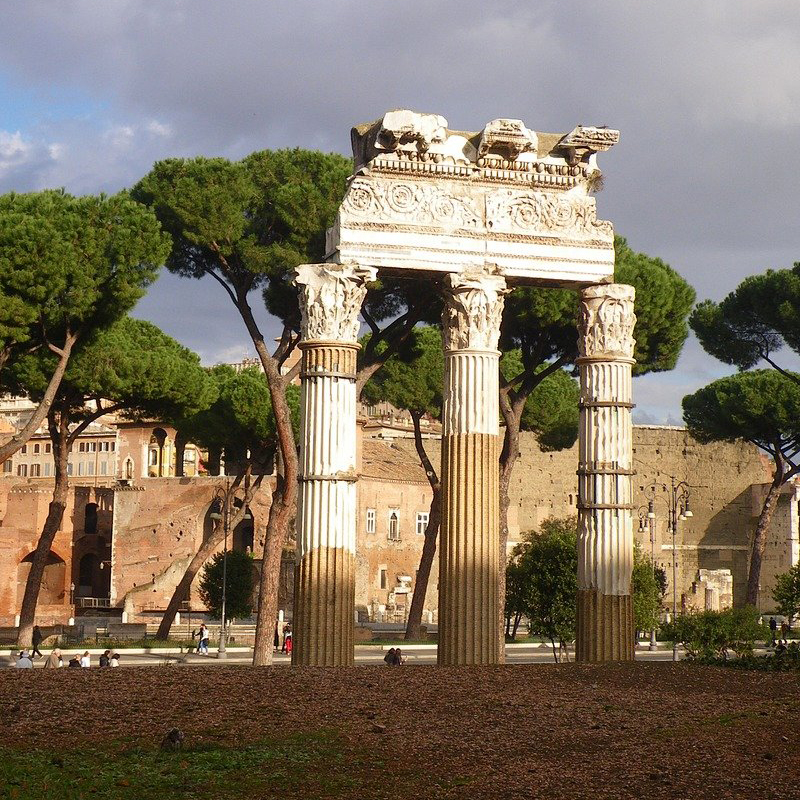
The Pines of Rome is the second work of Respighi’s trilogy on Roman subjects. The first was The Fountains of Rome of 1916; the last, Roman Festivals, dates from 1928. He wrote that The Pines of Rome takes “the centuries-old trees that dominate the Roman landscape to recall memories and visions of important events in Roman life. “1. The Pines of the Villa Borghese. Children are at play in the pine grove of the Villa Borghese, dancing the Italian equivalent of Ring around the Rosy; mimicking marching soldiers and battles; twittering and shrieking like swallows at evening; and they disappear. Suddenly the scene changes to ... 2. The Pines near a Catacomb. We see the shadows of the pines, which overhang the entrance of a catacomb. From the depths rises a chant which re-echoes solemnly, like a hymn, and is then mysteriously silenced. 3. The Pines of the Janiculum. There is a thrill in the air. The full moon reveals the profile of the pines of Gianicolo’s Hill. A nightingale sings. 4. The Pines of the Appian Way. Misty dawn on the Appian Way. The tragic country is guarded by solitary pines. Indistinctly, incessantly, the rhythm of innumerable steps. To the poet’s fantasy appears a vision of past glories; trumpets blare, and the army of the Consul advances brilliantly in the grandeur of a newly risen sun toward the Sacred Way, mounting in triumph the Capitoline Hill.”
©2019 Dr. Richard E. Rodda