




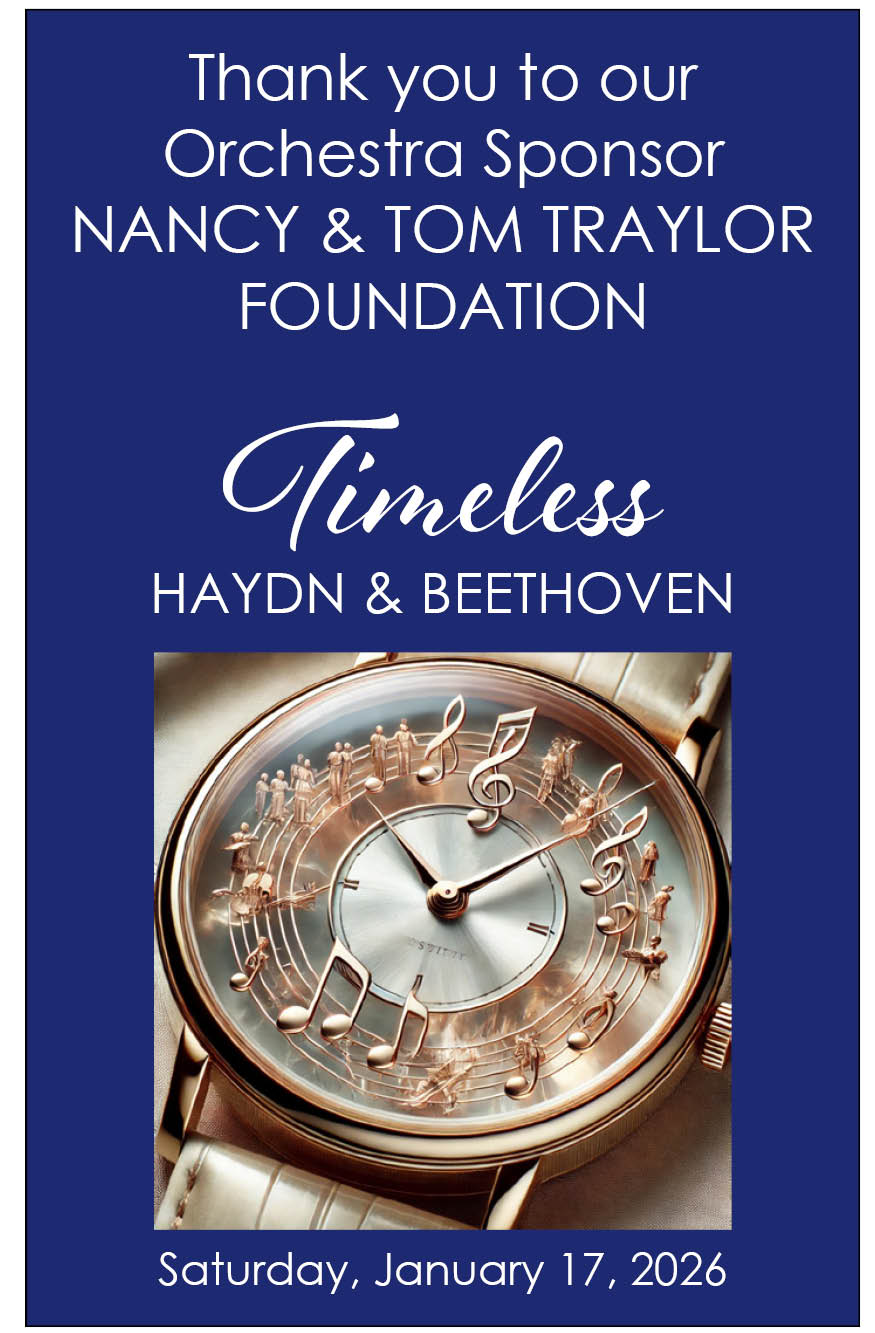

























SATURDAY, JANUARY 17, 2026, AT 7 P.M.
VICTORY THEATRE
CONCERT SPONSOR | ORCHESTRA SPONSORS | |
SYMPHONY OF COLOR SPONSOR | ||

EVANSVILLE PHILHARMONIC ORCHESTRA
Roger Kalia, Conductor
KARL JENKINS | Palladio | |
PINK FLOYD | “Time” from Dark Side of the Moon | |
FRANZ JOSEPH HAYDN | Symphony No. 101, “The Clock” II. Andante | |
MAX RICHTER | “On the Nature of Daylight” from The Blue Notebooks | |
PHILIP GLASS | Suite from The Hours Movement I | |
| INTERMISSION | ||
LUDWIG VAN BEETHOVEN | Symphony No. 8 I. Allegro vivace e con brio II. Allegretto scherzando III. Tempo di minuetto IV. Allegro vivace | |
Official IT Services Provider

Steinway is the official piano of the Evansville Philharmonic Orchestra
Official Photographer
Daniel Knight of Studio B Photography
Ticket Sponsor


Written by Bill Hemminger
ALLEGRETTO FROM PALLADIO
SIR KARL JENKINS
Duration: 3:37
Jenkins, born in Wales in 1944, is an instrumentalist as well as a popular and immensely versatile composer. Skilled at playing a number of instruments, he began his musical career with the jazz-rock band Soft Machine in 1972. He later undertook a more traditional musical formation at Cardiff University and the Royal Academy of Music, where he continues to be a fellow. His large and varied body of creative work—that crosses many genres—includes large-scale choral works—including The Armed Man (recently performed at First Presbyterian Church in Evansville)—music for the advertising industry, and innumerable songs. He has received several doctorates in music and was awarded a Knighthood in 2015 for “services to composing and crossing musical genres.” His autobiography Still with the Music was published in 2015.
Tonight’s work is the first movement of what the composer has called a concerto grosso, a work that features solos of various instruments within a string orchestra. The work was written in 1995; its name alludes to the sublime creations of Renaissance architect Andrea Palladio, who looked back to Roman antiquity for a harmonious blend of elements in his own buildings. Jenkins has said that, in this composition, he has worked to combine musical elements in a similarly harmonious, even mathematical, way. Unlike Palladio, however, Jenkins employs time as a structural element in his work: its percussive heartbeat pervades the entire work, especially the allegretto.
The movement may also sound familiar to many listeners; its theme was famously used in De Beers’ 1993 “A Diamond Is Forever” diamond commercial.
“TIME” FROM DARK SIDE OF THE MOON
PINK FLOYD/Arr. Steven Snowden
Duration: 6:00
Pink Floyd is the well-known British rock band formed in 1965. The group’s music is synonymous with psychedelic rock that gave voice to much of the cultural angst of the hippie era. In later years the band popularized the concept album for the mass rock audiences. Many of their albums were immensely popular, especially The Dark Side of the Moon (1973—from which this work is taken), Animals (1977), and The Wall (1979).
The lyrics of the song (whose instrumental version you are hearing tonight) concern the inescapable passage of time and a recognition of the insidious effects of aging. The song begins, appropriately enough, with recordings of clocks chiming and alarms ringing—as they mark moments of life that have passed, not to be relived. It remains one of the most popular of the rock group’s works.
Ticking away the moments that make up a dull day
You fritter and waste the hours in an off-hand way
Kicking around on a piece of ground in your home town
Waiting for someone or something to show you the way
Tired of lying in the sunshine, staying home to watch the rain
And you are young and life is long, and there is time to kill today
And then one day you find ten years have got behind you
No one told you when to run, you missed the starting gun
And you run and you run to catch up with the sun but it’s sinking
Racing around to come up behind you again
Sun is the same, in a relative way, but you’re older
Shorter of breath and one day closer to death
Every year is getting shorter, never seem to find the time
Plans that either come to naught, or half a page of scribbled lines
Hanging on in quiet desperation is the English way
The time is gone, the song is over, thought I’d something more to say
Source: Musixmatch
Time lyrics © Roger Waters Music Overseas Ltd, Pink Floyd Music Publishers Ltd
ANDANTE FROM SYMPHONY NO. 101, “THE CLOCK”
FRANZ JOSEPH HAYDN
Duration: 8:00
Austrian-born Haydn (1732 [the same year as Mozart]-1809) was one of the great figures in the development of classical music and classical musical forms. In particular he solidified the structure of the string quartet and the symphony. For a time, he was a music instructor to Beethoven, and in a letter he noted that he was proud to have had an influence on such a remarkable young composer. Astonishingly prolific, he wrote more than 100 symphonies, at least 70 string quartets, operas, a number of masses, many wonderful piano sonatas, among other compositions. He was a perfect exemplar of the Enlightenment—an assiduous craftsman who combined a careful balance of intellectual activity and emotion in his work.
Like his predecessor George Frideric Handel, Haydn and his music were much appreciated across the English Channel. In fact, historians refer to the “English period” of Haydn’s work. The composer arrived in England in 1791, and in this as well as a succeeding visit Haydn composed no fewer than 12 symphonies, the tick-tock section of one of which you will hear today. He was much fȇted in England, heralded as a genius, and, one hopes, well-paid (though that is not always the case for musicians).
Symphony 101 was completed by 1794; it was performed to enthusiastic audiences in London. The second movement begins with pizzicato strings and bassoon; the plucked, tick-tock beats continue throughout the movement.
“ON THE NATURE OF DAYLIGHT”
MAX RICHTER
Duration: 6:11
Richter, born in 1966, is a British composer born in Germany. Like others of the “timeless” composers on tonight’s program, he composes in a number of genres, most typically what is called post-minimalism. He had a fairly classical musical upbringing, studying at the University of Edinburgh as well as the Royal Academy in London. He has become widely known for his classical-electronic works, his contributions to film and television, and his efforts to document political trauma in the musical world.
Richter’s works include the 2002 experimental album Memoryhouse, which combines ambient sounds from wars in Kosovo and elsewhere as well as readings from the Russian dissident poet Maria Tsvetaeva. He followed this composition with The Blue Notebooks, which the composer describes as a protest album about the Iraq War; it features readings of Kafka and Czeslaw Milosz. The album garnered much international praise. He has continued to produce works that defy genre classification as they explore significant social and political events world-wide.
On the Nature of Daylight appears on Richter’s 2018 album entitled The Blue Notebooks. This lugubrious work has been featured in a number of films, including Arrival, Shutter Island, and The Last of Us, its lurching melancholy a hallmark. There is also a music video, featuring Elisabeth Moss (which I highly recommend). The composition was inspired by the 1960 song, written by Clyde Otis and sung by Dinah Washington, rhythm and blues musicians who knew a thing or two about oppression and sadness but also about the redeeming qualities of love.
This bitter Earth
Well, what fruit it bears?
Ooooh
This bitter Earth
And if my life
Is like the dust
Oooh, that hides
The glow of a rose
What good am I?
Heaven only knows.
Lord, this bitter Earth
Yes, can be so cold
Today you’re young
Too soon, you’re old
But while a voice
Within me cries
I’m sure someone may answer my call.
And this bitter Earth
Ooooh, may not
Ooooh, be so bitter
After all.
This bitter Earth
Lord, this bitter Earth
What good is love
Mmmm, that no one shares?
And if my life
Is like the dust
That hides
The glow of a rose
What good am I?
Heaven only knows.
Source:
Artist: Max Richter
Album: Retrospective
SONGLYRICS
FIRST MOVEMENT FROM SUITE FROM THE HOURS
PHILIP GLASS
Duration: 10:20
Once again, the many, varied compositions of Glass (born 1937) defy easy classification. Typically considered a creator of minimalism (along with Estonian Arvo Pärt [listen to spellbinding Spiegel im Spiegel if you haven’t already], Henryk Górecki [whose magnificent Symphony No. 3 established the vocal career of Dawn Upshaw], and American Steven Reich, among many others), Glass has written in just about every musical form. Among his operas, Akhnaten (premiered in 1984) features texts in Akkadian, tour guides reading from Baedekers (old tour books), and the titular role of the Egyptian king who dabbled in monotheism and whose role is sung by a countertenor. More recently, Glass has taken up the wonderful novel by Nobel-prize winner J. M. Coetzee, Waiting for the Barbarians, which focuses on a white colonial settlement in an unnamed African country. Unsurprisingly, Glass has also written for film, and he has written symphonies and “classical” compositions for piano. He even calls himself a “classicist,” having had a rigorous traditional western musical training; he studied in Paris with the fabled Nadia Boulanger.
Tonight’s work became the musical underpinnings of the 2002 film The Hours. The film is an adaptation of Michael Cunningham’s 1998 novel based on Mrs. Dalloway, by Virginia Woolf (written in 1925). Cunningham ties Woolf’s heroine, Mrs. Dalloway, with two other women, one in 1951 California, the other in 2001 New York. Like the eponymous novel (whose working title was The Hours), all three stories take place within one calendar day and depict the difficulties of life that all three women share despite differences in time and place. This was Glass’s assignment—how to imply without telling, how to comment without intruding. The music is scored for piano, strings, harp, and celesta. Most listeners find the score mesmerizing.
SYMPHONY NO. 8
LUDWIG VAN BEETHOVEN
Duration: 26:00
Beethoven (1770-1827) wrote this symphony of four movements in 1812. The mood of the symphony is, throughout, light-hearted and joyous, though those sentiments do not reflect Beethoven’s life at the time (no surprise—why should they?). Unlike other symphonies, the eighth has no dedication. Critics have commented that this symphony, in its relative “lightness”, looks backward to the more classical works of Mozart and Haydn. Its tightly-compressed neo-classical form supports that thought. What’s more, tonight’s program makes clear an obvious musical link between Haydn and his genius student Beethoven.
Yet many others—including Beethoven himself—affirm that the work is an uncannily sculpted work. The allegretto is reputed to be an homage to the metronome maker Gustav Maelzel, the movement’s clock-work-like tempo pushing the movement to its inevitable conclusion. (Who among you piano students did NOT have a small pyramidal wooden instrument sitting atop the piano punishing you for lagging or rushing the tempo?) But Beethoven is able to keep time quite readily.