













× Podcast Conductor Biographies Bill Hemminger Biography Photos Videos Articles and Reviews Radio Broadcast Schedule History of the EPO Mission and Values Board of Directors 2025-2026 Sponsors 2025-2026 Philharmonic Gives Back Donors 10/1/2024 - 10/1/2025 Thoughtful Tributes 10/1/2024 - 10/1/2025 Past Events
Home Podcast Conductor Biographies Bill Hemminger Biography Photos Videos Articles and Reviews Radio Broadcast Schedule History of the EPO Mission and Values Board of Directors 2025-2026 Sponsors 2025-2026 Philharmonic Gives Back Donors 10/1/2024 - 10/1/2025 Thoughtful Tributes 10/1/2024 - 10/1/2025
Image for Handel's Messiah
Program


Friday, December 19, 2025, at 7 p.m. CST
Trinity United Methodist Church, Evansville

Saturday, December 20, 2025, at 7 p.m. EST
St. Joseph Catholic Church, Jasper

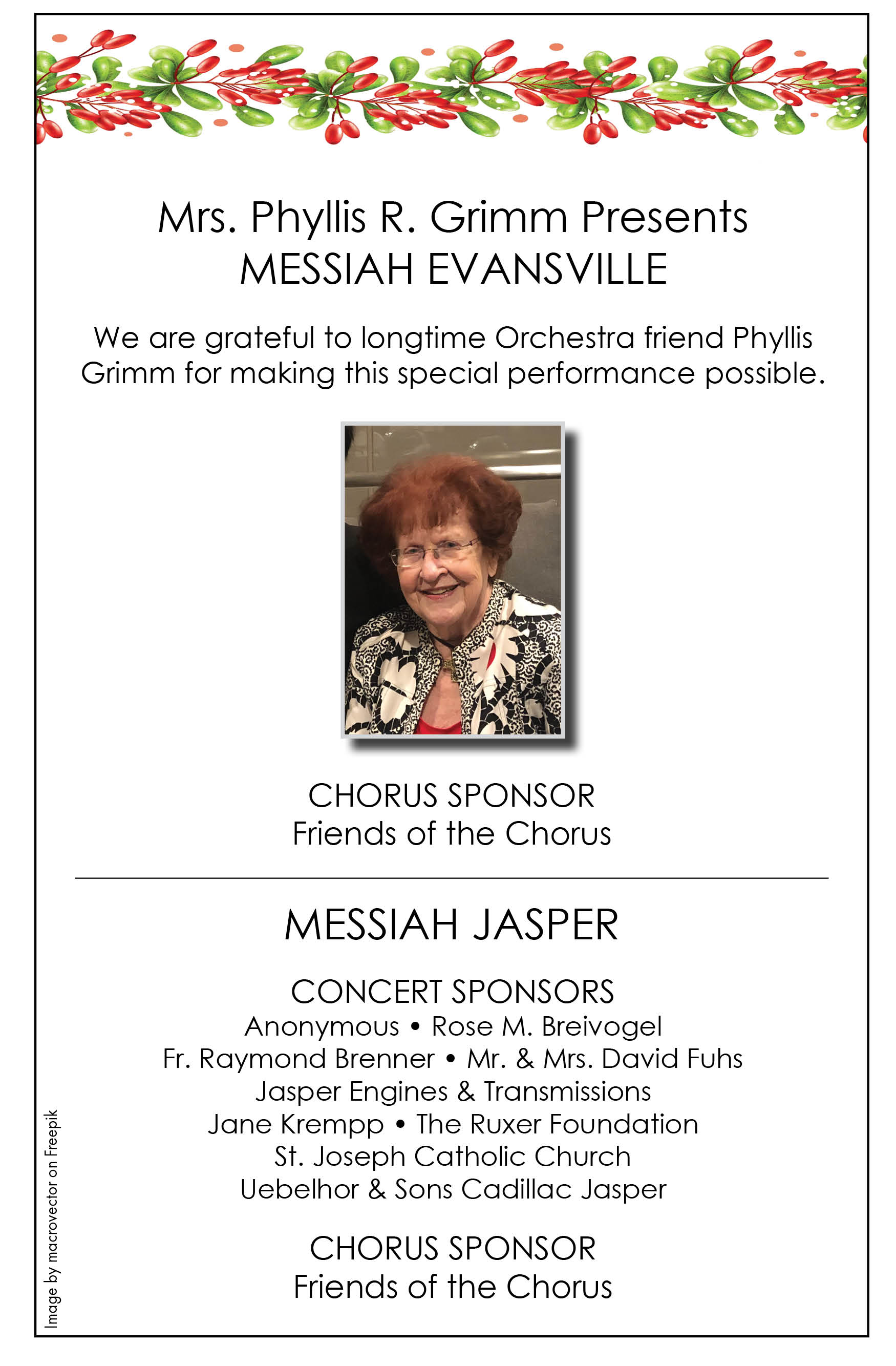
EVANSVILLE SPONSORS
PRESENTING SPONSOR
Mrs. Phyllis R. Grimm

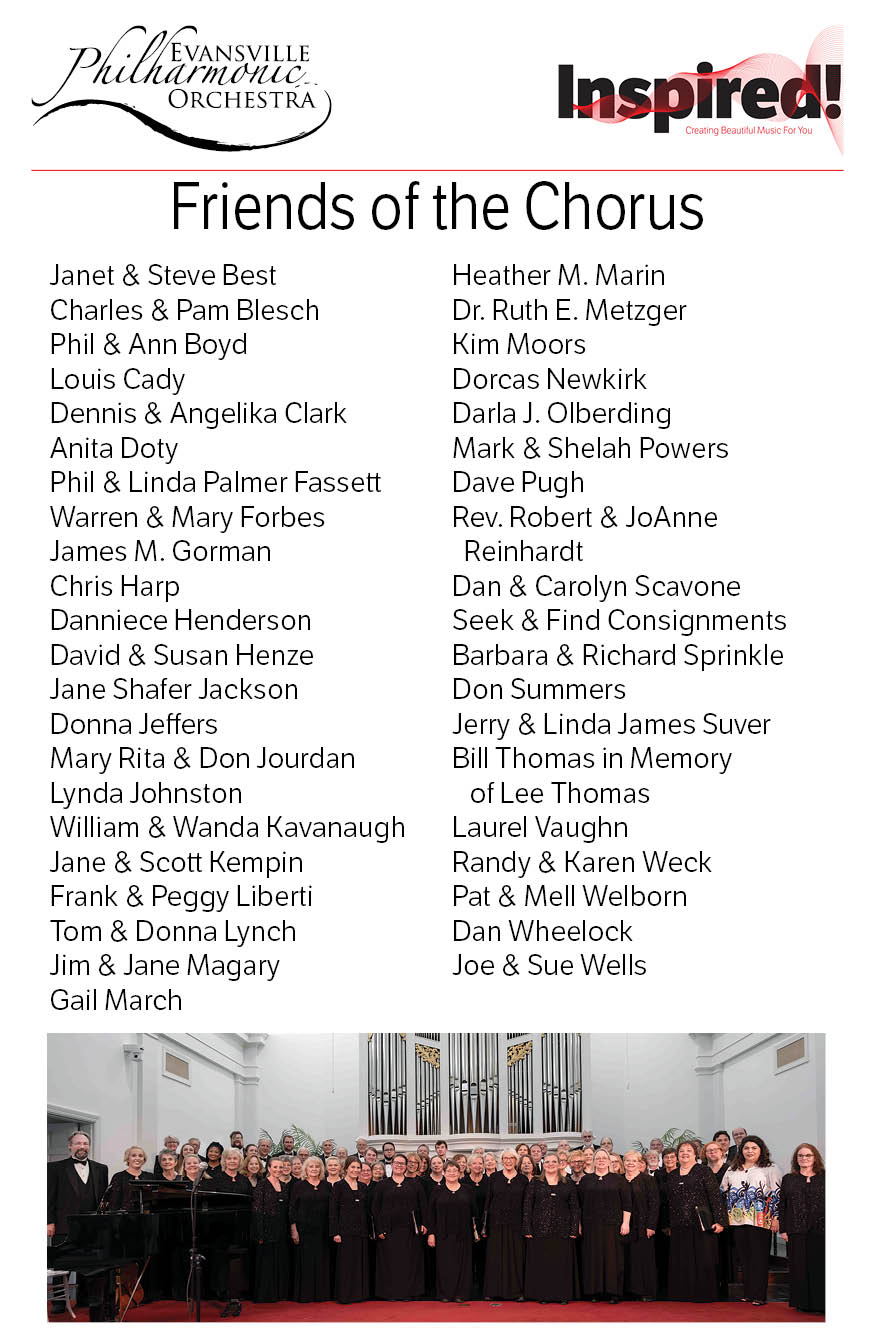
CHORUS SPONSOR
Friends of the Chorus


jasper sponsors

CONCERT SPONSORS
Anonymous
Rose M. Breivogel
Fr. Raymond Brenner
Mr. & Mrs. David Fuhs
Jasper Engines & Transmissions
Jane Krempp
The Ruxer Foundation
St. Joseph Catholic Church
Uebelhor & Sons Cadillac Jasper

CHORUS SPONSOR
Friends of the Chorus

  class=

EVANSVILLE PHILHARMONIC ORCHESTRA
Roger Kalia, Conductor
Evansville Philharmonic Chorus
Andrea Drury, Chorus Master
Lisa Clark, Soprano
Chris Albanese, Tenor | Daniel Lentz, Baritone

PART I
Sinfonia

Orchestra


Comfort ye,
comfort ye my people 

Tenor recitative


Ev’ry valley shall be exalted
Tenor aria


And the glory,
the glory of the Lor

Chorus


Thus saith the Lord,
the Lord of Hosts

Bass recitative


And He shall purify
Chorus


For behold,            
darkness shall cover the earth

Bass recitative


The people that walked in darkness
Bass aria


For unto us a Child is born


Chorus


Pifa (Pastoral Symphony)


Orchestra


There were shepherds abiding in the field
Soprano recitative 


And lo, the angel of the Lord came upon them
Soprano recitative


And the angel said unto them
Soprano recitative


And suddenly            
there was with the angel

Soprano recitative


Glory to God in the highest
Chorus


Rejoice greatly, O daughter of Zion
Soprano aria


His yoke is easy, His burden is light
Chorus


INTERMISSION


PART II 
Behold the Lamb of God

Chorus


Unto which of the Angels
Tenor recitative


Let All the Angels of God Worship Him  
Chorus


Why do the nations so furiously rage    
 Bass aria


He that dwelleth in Heaven
Tenor recitative


Thou shalt break them
Tenor aria


Hallelujah!            
Chorus 


PART III 
I know that my Redeemer liveth


Soprano aria


Since by man came death
Chorus


Behold, I tell you a mystery
Bass recitative


The trumpet shall sound
Bass aria


Worthy is the Lamb; Amen            
Chorus


Official IT Services Provider

Steinway is the official piano of the Evansville Philharmonic Orchestra

Official Photographer
Daniel Knight of Studio B Photography

Ticket Sponsor



Program Notes

Written by Bill Hemminger

MESSIAH
GEORGE FRIDERIC HANDEL

George Frideric Handel was born Georg Friedrich Händel in 1685 in Halle, Germany. The British took a great liking to his music early in his career, and Handel wisely chose to relocate to a country that supported him so generously with money and prestige; indeed, George II (King of England from 1727 to 1760 and also, interestingly, a German—so much for nuance-less nationalism) became Handel’s greatest patron. In 1727 Handel became a British citizen. Except for a few forays to the Continent after that, he remained in England until his death in 1759. He was buried in Westminster Abbey. Since his death, Handel’s music has become practically synonymous with the best in British culture; in the intervening years his reputation in that country has never waned.

Born to a barber-surgeon (happily, since that time, these two career paths have split), Handel had the good fortune of relative fortune so that, when his father died early in the composer’s life, Handel could afford a quality education and a life free from debt. From 1706-10 he travelled throughout Italy, where Baroque music flourished, absorbing the music of Corelli and Scarlatti while continuing to compose his own works. Among other forms, he mastered those of the opera and solo cantata, which he adapted later in his oratorios. Before Messiah was written in 1741, the British had tired of Italian operas, typically based on fairly scandalous plots and performed with even more scandalous celebrity singers. Handel perspicaciously read the writing on the wall (or, in this case, on the manuscript page) and shifted to large-scale works with Biblical themes.

As the whole world knows, Messiah was first performed not in Britain but in Ireland in 1742 (Ireland had to wait before being absorbed into Great Britain). Yet George II appears to have been present, though no one knows if he stood up or not—or for what reason if he did. The libretto of the oratorio was crafted by Charles Jennens from the King James Bible and from the Coverdale Psalter. Part I of Messiah begins with Old Testament prophecies and concludes with the angels’ annunciation to the shepherds. Part II is devoted to the passion of Jesus and ends with the spectacular “Hallelujah” chorus. Part III celebrates Jesus’s resurrection and the redemption of all believers; a nine-fold Amen brings the entire oratorio to its triumphant conclusion.

After 1750, Messiah was performed frequently in Britain. Portions of the oratorio were extracted and performed regularly as anthems in church services. By 1800, large-scale productions had become de rigueur. Handel’s original score specified a small orchestra, mostly strings, and a small but strong singing ensemble. One Berlin performance in 1788 brought 259 singers on stage; they were accompanied by an instrumental juggernaut of at least 142 players. Large performances remained popular in the 19th century and prompted at least one critic, George Bernard Shaw, to lament the sacrifice of musical quality for the effect of musical pomposity. A return to the apparent intentions of Handel’s original score began to take place in the 1970s, when Christopher Hogwood and, later, John Eliot Gardiner trimmed the size of both orchestra and chorus.

Image for Handel's Messiah
Program


Friday, December 19, 2025, at 7 p.m. CST
Trinity United Methodist Church, Evansville

Saturday, December 20, 2025, at 7 p.m. EST
St. Joseph Catholic Church, Jasper

EVANSVILLE SPONSORS
PRESENTING SPONSOR
Mrs. Phyllis R. Grimm

CHORUS SPONSOR
Friends of the Chorus


jasper sponsors

CONCERT SPONSORS
Anonymous
Rose M. Breivogel
Fr. Raymond Brenner
Mr. & Mrs. David Fuhs
Jasper Engines & Transmissions
Jane Krempp
The Ruxer Foundation
St. Joseph Catholic Church
Uebelhor & Sons Cadillac Jasper

CHORUS SPONSOR
Friends of the Chorus

  class=

EVANSVILLE PHILHARMONIC ORCHESTRA
Roger Kalia, Conductor
Evansville Philharmonic Chorus
Andrea Drury, Chorus Master
Lisa Clark, Soprano
Chris Albanese, Tenor | Daniel Lentz, Baritone

PART I
Sinfonia

Orchestra


Comfort ye,
comfort ye my people 

Tenor recitative


Ev’ry valley shall be exalted
Tenor aria


And the glory,
the glory of the Lor

Chorus


Thus saith the Lord,
the Lord of Hosts

Bass recitative


And He shall purify
Chorus


For behold,            
darkness shall cover the earth

Bass recitative


The people that walked in darkness
Bass aria


For unto us a Child is born


Chorus


Pifa (Pastoral Symphony)


Orchestra


There were shepherds abiding in the field
Soprano recitative 


And lo, the angel of the Lord came upon them
Soprano recitative


And the angel said unto them
Soprano recitative


And suddenly            
there was with the angel

Soprano recitative


Glory to God in the highest
Chorus


Rejoice greatly, O daughter of Zion
Soprano aria


His yoke is easy, His burden is light
Chorus


INTERMISSION


PART II 
Behold the Lamb of God

Chorus


Unto which of the Angels
Tenor recitative


Let All the Angels of God Worship Him  
Chorus


Why do the nations so furiously rage    
 Bass aria


He that dwelleth in Heaven
Tenor recitative


Thou shalt break them
Tenor aria


Hallelujah!            
Chorus 


PART III 
I know that my Redeemer liveth


Soprano aria


Since by man came death
Chorus


Behold, I tell you a mystery
Bass recitative


The trumpet shall sound
Bass aria


Worthy is the Lamb; Amen            
Chorus


Official IT Services Provider

Steinway is the official piano of the Evansville Philharmonic Orchestra

Official Photographer
Daniel Knight of Studio B Photography

Ticket Sponsor


Program Notes

Written by Bill Hemminger

MESSIAH
GEORGE FRIDERIC HANDEL

George Frideric Handel was born Georg Friedrich Händel in 1685 in Halle, Germany. The British took a great liking to his music early in his career, and Handel wisely chose to relocate to a country that supported him so generously with money and prestige; indeed, George II (King of England from 1727 to 1760 and also, interestingly, a German—so much for nuance-less nationalism) became Handel’s greatest patron. In 1727 Handel became a British citizen. Except for a few forays to the Continent after that, he remained in England until his death in 1759. He was buried in Westminster Abbey. Since his death, Handel’s music has become practically synonymous with the best in British culture; in the intervening years his reputation in that country has never waned.

Born to a barber-surgeon (happily, since that time, these two career paths have split), Handel had the good fortune of relative fortune so that, when his father died early in the composer’s life, Handel could afford a quality education and a life free from debt. From 1706-10 he travelled throughout Italy, where Baroque music flourished, absorbing the music of Corelli and Scarlatti while continuing to compose his own works. Among other forms, he mastered those of the opera and solo cantata, which he adapted later in his oratorios. Before Messiah was written in 1741, the British had tired of Italian operas, typically based on fairly scandalous plots and performed with even more scandalous celebrity singers. Handel perspicaciously read the writing on the wall (or, in this case, on the manuscript page) and shifted to large-scale works with Biblical themes.

As the whole world knows, Messiah was first performed not in Britain but in Ireland in 1742 (Ireland had to wait before being absorbed into Great Britain). Yet George II appears to have been present, though no one knows if he stood up or not—or for what reason if he did. The libretto of the oratorio was crafted by Charles Jennens from the King James Bible and from the Coverdale Psalter. Part I of Messiah begins with Old Testament prophecies and concludes with the angels’ annunciation to the shepherds. Part II is devoted to the passion of Jesus and ends with the spectacular “Hallelujah” chorus. Part III celebrates Jesus’s resurrection and the redemption of all believers; a nine-fold Amen brings the entire oratorio to its triumphant conclusion.

After 1750, Messiah was performed frequently in Britain. Portions of the oratorio were extracted and performed regularly as anthems in church services. By 1800, large-scale productions had become de rigueur. Handel’s original score specified a small orchestra, mostly strings, and a small but strong singing ensemble. One Berlin performance in 1788 brought 259 singers on stage; they were accompanied by an instrumental juggernaut of at least 142 players. Large performances remained popular in the 19th century and prompted at least one critic, George Bernard Shaw, to lament the sacrifice of musical quality for the effect of musical pomposity. A return to the apparent intentions of Handel’s original score began to take place in the 1970s, when Christopher Hogwood and, later, John Eliot Gardiner trimmed the size of both orchestra and chorus.