
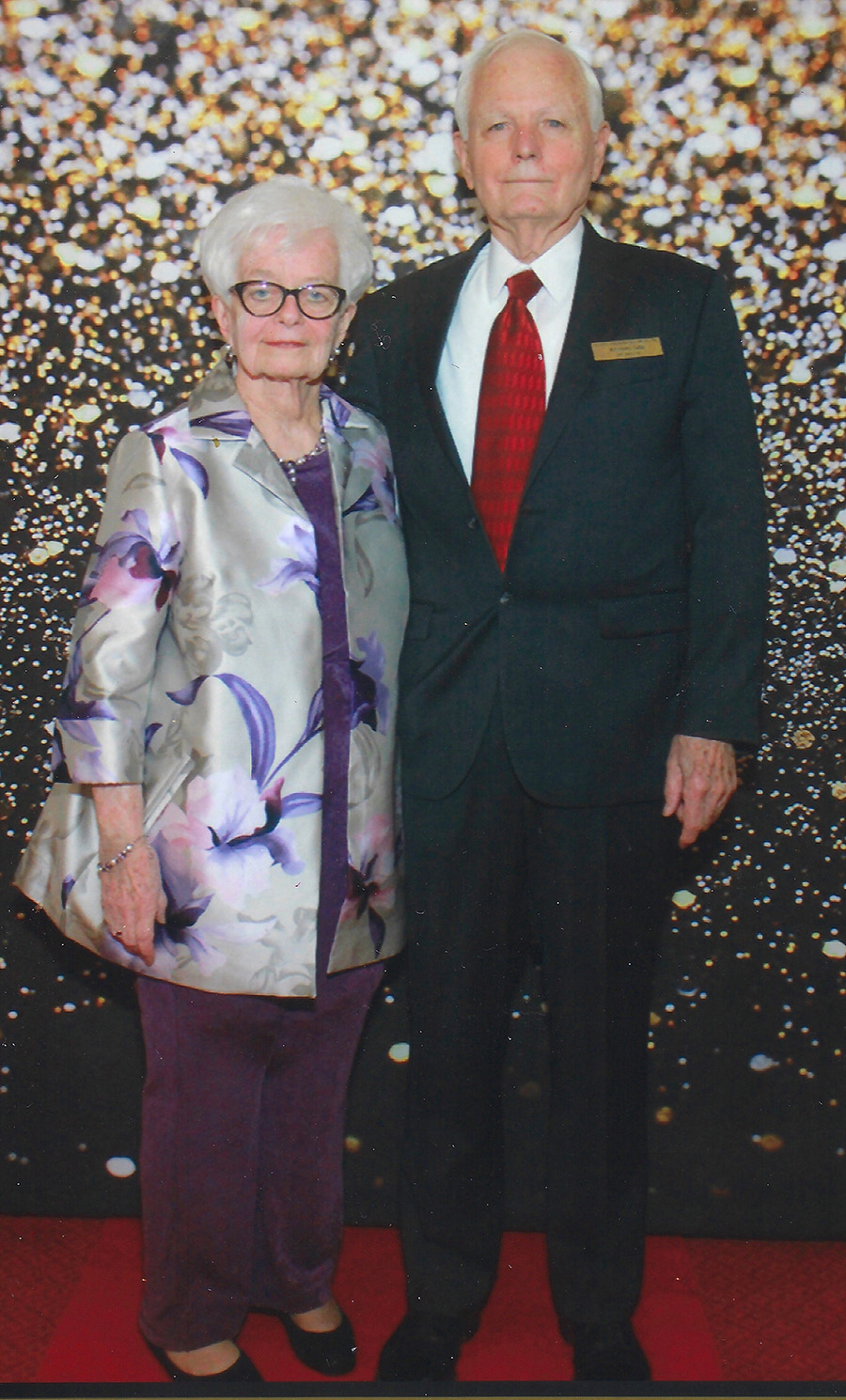
 Tonight, IPO turns the spotlight on two of our own: Andrea and Richard Gibb, longtime stalwarts of this orchestra, as we present them with the 2026 LEO AND ANNE MICHUDA IPO AWARD FOR LIFETIME SERVICE — one of the highest honors IPO can bestow. It's an honor reserved for those who show Excellence in Leadership, the Securing of Resources vital to the success of IPO, and the Application of Extraordinary Efforts to enhance the image or promote the artistic mission of IPO in the greater Chicago metropolitan area.
For more than 40 years, the Gibbs have been part of the IPO family. "We've shared a love of classical music throughout our marriage and for 40 years, IPO has been a meaningful part of our journey."
Ask Richard why IPO matters so much, and he'll tell you it's about more than the music itself.
"Music enriches our lives, contributes significantly to the development of youth, and provides wonderful opportunities to develop friendships with like-minded people. In our community, the Illinois Philharmonic Orchestra is the premier source of classical music," he says. "We enjoy the professionalism of our players, appreciate the expertise of our Staff, and take pride in our Board of Directors and their historical selection of truly talented music directors. Our current Music Director, Stilian Kirov, continues leadership critical to the continued success of the IPO."
That kind of clear-eyed devotion is exactly what has made the Gibbs indispensable. Always with an eye on the future and a finger on the pulse of the orchestra, they've worn nearly every hat IPO has to offer — financial stewards, visionary volunteer leaders, and some of the organization's most enthusiastic champions in the community.
And their commitment doesn't stop at intermission. Deeply invested in IPO's future, Andrea and Richard want the generations who come after us to feel what they have felt — the power and grace of OUR live orchestra. As members of the IPO Encore Society, both have remembered IPO in their wills, helping ensure our artistic and cultural force keeps playing on for our community for years to come.
Tonight, IPO is proud to celebrate Andrea and Richard Gibb for a lifetime of service and friendship — and we look forward to many encores still to come.
Leo Michuda was an Illinois Philharmonic Orchestra benefactor, board member, and 30-year member of the violin section. Anne, a renowned soprano and a highly respected vocal coach, offered the orchestra decades of unwavering guidance and support. Together, the couple’s love of music and deep commitment to philanthropy shaped IPO in lasting ways – through financial and musical support and through their steady presence and advocacy, including many receptions and musical events at their home, the “Villa di Musica.” After Leo’s death in 2014, the IPO Board of Directors created this award to honor his memory and those who showed similar sustained, outstanding contributions and exemplary service to the orchestra. In 2026, the award was renamed the Leo and Anne Michuda Award in recognition of Anne’s equally lasting contributions to IPO.


Stilian Kirov, Conductor
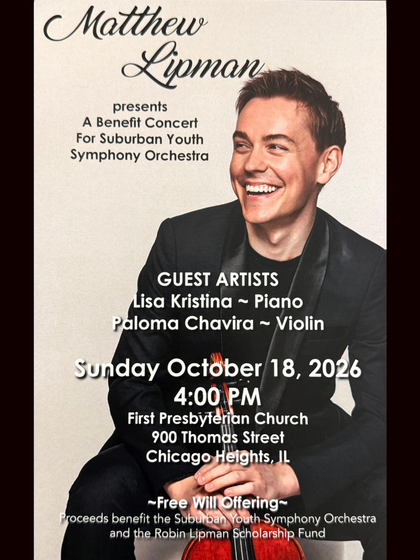
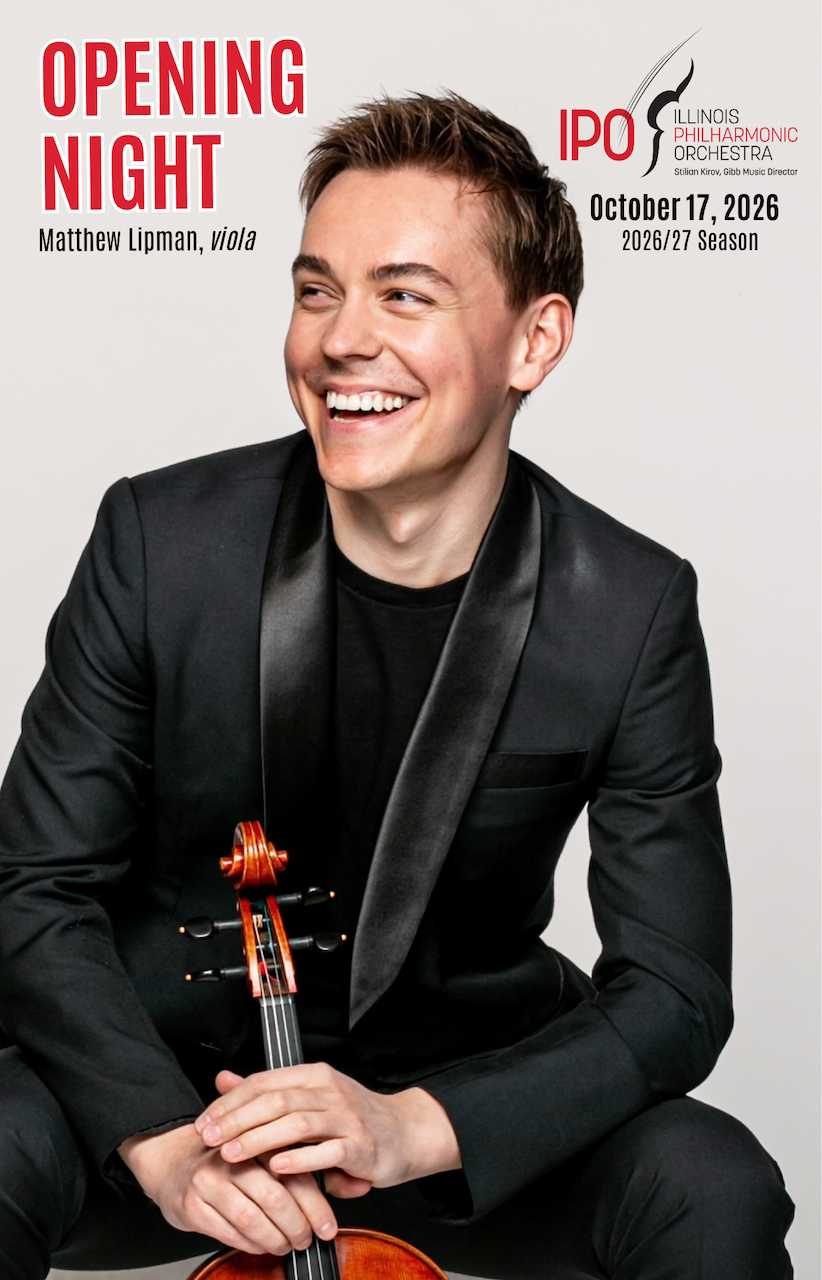
Matthew Lipman, Viola
Matthew Lipman sponsored by
 |  |
Ruslan and Lyudmila: Overture | Mikhail Glinka | |
Viola Concerto | William Walton | |
| INTERMISSION | ||
Presentation of the Leo and Anne Michuda | ||
Symphony No. 1, Op. 68 in C minor | Johannes Brahms | |
OPENING ACT LOBBY PERFORMERS
VCM String Ensemble: VanderCook College of Music
Contact: Dr. Yvonne Davila-Cortez
ydavilacortez@vandercook.edu
Opening Act Lobby Performers are sponsored by

Azusa Tashiro, Concertmaster
Stanley and Lois Birer
VIOLIN 1
Lilian Chou, Assistant Concertmaster
Stephane Collopy
Hobart Shi
Carlos Chacon
Steven Wilke
Jacob Murphy
Vlad Gebe
Emily Nardo
Iwona Augustyn
Joseam Cuadrado
VIOLIN 2
Linda Veleckis, Principal
Grannon Second Violin Chair
Kamen Vatchev, Assistant Principal
Anna Carlson
Caroline Slack
Matthew Weinberg
Munire Mona Mierxiati
Samantha May
Kristen Wiersum
Nic Orbovich
VIOLA
Benjamin Weber, Acting Principal
Gerhard Haigis
Nicholas Munagian, Acting Assistant Principal
Scott Gordon Dowd
Matthew Barwegan
Benton Wedge
Becky Coffman
Tim Hoorelbeck
Monica Reilly
CELLO
Jacob Hanegan, Principal
Brian and Carolee Samuels
Emily Lewis Mantell, Acting Assistant Principal
Ingrid Krizan
Nazar Dzhuryn
Everardo Sanchez
Krystian Chiu
BASS
Phillip Serna, Acting Principal
Billie and Henry Hauser
Andrew French, Acting Assistant Principal
Patrick Dugan
Hanna Wilson Smith
FLUTE
Cynthia Fudala, Principal
Dr. Jerri E. Greer
Dominic Dagostino, Piccolo
OBOE
Naomi Bensdorf Frisch, Principal
Steve and Joey Buck
Christine Janzow Phillips
Ricardo Castaneda, English Horn
CLARINET
Trevor O’Riordan, Principal
Leonard Achtenberg and Steven Livesey
Claire Werling
William Olsen, Bass Clarinet
BASSOON
Erin Kozakis, Principal
Dr. Mel and Janet Muchnik
Lynette Pralle-McCortney
Matt Harvell, Contrabassoon
HORN
John Schreckengost, Acting Principal
Barbara Sturges
Elizabeth Mazur-Johnson
Amy Krueger
Anna Jacobson
TRUMPET
Jhoan Garcia, Principal
Richard and Andrea Gibb
Greg Fudala
TROMBONE
Serdar Cizmeci, Principal
Thomas Stark
Andrew Rozsa
TIMPANI
Simón Gómez Gallego, Principal
HARP
Yoojin Jung
Patti and John Flanagan
Chair Sponsor indicated
in blue text
"Music has always been the common thread in our family. Our parents, Leo and Anne Michuda, devoted their lives to music and believed deeply in supporting the musicians who bring it to life. The Illinois Philharmonic Orchestra has been part of our family's story for many years, and we are honored to carry their legacy forward. We hope our support helps keep the music playing—and their love of music alive—for generations to come."
-The Michuda and D'Ortenzio families
IPO acknowledges support from


Ruslan and Lyudmila: Overture
Mikhail Glinka
Mikhail Glinka (1804-1857) was the “Father” of Russian music who, with his Russian-language opera Ruslan and Ludmilla (1842), showed the world that Russia can have its own musical culture independent of those Germans and Italians. This lesson was especially taken to heart by the nationalist Russian composers of the later 19th century. The opera’s famous “Overture” is a six-minute blast of energy.
Viola Concerto
William Walton
The lowly viola, filler of harmonies --a character actor rather than a star -- is often the butt of jokes. Yet, a surprising number of major composers played the viola as their favored string instrument including Mozart, Beethoven, Dvořák, and arguably Mendelssohn. Still, only Mozart graced the instrument with a concerto, and that was his Sinfonia Concertante, where the solo viola shares the spotlight with the solo violin. Beethoven and Mendelssohn wrote violin concertos that are staples of the orchestral repertoire, while Dvořák wrote THE cello concerto for the Romantic Era. But where is THE viola concerto that has the emotional power of the Dvořák Cello Concerto? It is here, the Viola Concerto (1929, revised 1961-62) by the British composer William Walton (1902-1983).
Perhaps the fact that Walton mastered no instrument (he was a choral singer) allowed him to be open to the suggestion in 1928 by the famous English conductor Thomas Beecham that he compose a viola concerto for the prominent British violist Lionel Tertis. At that point, the young Walton had mostly gained scandalous notice with Façade (1923).
The Viola Concerto was completed in 1929, but Tertis rejected the piece as being too modern, possibly referring to its harmonic richness including melancholic, jazz-inflected “blues” notes with a gentle major/minor bitonality -- now heard as essentially Romantic and certainly not modernist. Horror of horrors, the discouraged Walton contemplated recomposing the piece as a violin concerto. But eminent composer/violist Paul Hindemith stepped into the breach and performed the solo, with the composer conducting, to great success. (Tertis soon changed his tune and became a champion of the work.) The Viola Concerto has become beloved of violists and audiences while many greedy concert violinists, who also play the viola, very happily poach the piece for their own performances.
The Viola Concerto is in three movements. The opening “Andante Comodo” (comfortably walking pace) has a lilting, sublimely melancholic opening melody. It is played in the deep register of the viola but also in its brilliant higher reaches that we seldom hear performed with this emotional impact. There is a baritonal second theme. This dominates the development which starts after an exciting city-life transition. The movement ends with the oboe, which had been prominent at the opening, and the flute playing the opening melody with the soloist in trilling accompaniment. Soloist and orchestra conclude in a quiet A-minor chord. The propulsive, short second movement is headed: “Vivo, con molto preciso” (fast and very precise) -- probably Walton’s warning to pay attention to the vertigo-inducing off-beat accents and shifts in meter. The finale “Allegro moderato” (moderately fast) seems to deflate the emotional intensity opening with a jaunty, solo bassoon melody. But no, the second theme of this complex rondo/sonata movement burrows into the soul with sadness. The recurrences of the movement’s opening passage are always transformed into music that is more passionate and vigorous. Then, like the somber epilogue of the finale of the Dvořák Cello Concerto, Walton brings back the first-movement’s heart-wrenching melody-- finally for the solo viola. The last, subdued chord is seen on the page as A major, but there is no happy ending.
Symphony No. 1, Op. 68 in C minor
Johannes Brahms
In 1853, when Brahms was only 20 years old, he visited Robert and Clara Schumann at their house in Düsseldorf. That musical power couple was astonished by his compositions and piano playing. Robert came out of retirement as a music critic and essayist to declare Brahms as a genius and true heir to Beethoven and the symphonic tradition. There is a quip that the stock market has predicted nine out of the last five recessions. While Schumann was prescient in his opinion of Chopin and Berlioz, he was dead wrong in his early praise of Woldemar Bargiel, Theodor Kirchner, and Albert Dietrich who have faded into obscurity. Brahms had no intention of sharing their fate. He was possibly the most self-critical great composer; it would take him over 20 years to produce a symphony.
In 1854, Robert Schumann attempted suicide by jumping into the Rhine and was committed to an asylum from which he was never released, dying in 1856. Brahms was there for Clara in this catastrophe. It is widely thought that Brahms was inspired by these events to compose his first symphony in the key of D minor (same as Beethoven’s 9th). However, this dramatic, cataclysmically eruptive music was repurposed and revised as the Brahms Piano Concerto No. 1 (1859) whose reception by the audience and critics was dreadful. Brahms recounted that when he finished playing the Leipzig premiere, there was complete silence for his bow -- then hissing. Critics derided this as a symphony with piano obligato to a dense, impermeable orchestral sound. This was not the way to follow in Beethoven’s footsteps.
Brahms took on a self-apprenticeship in orchestration. He completed two orchestral Serenades, his monumental German Requiem for chorus and orchestra (1869), and the orchestration of his Variations on a Theme of Haydn (1873). All the while, a symphony was gestating. He sent Clara a first movement in 1862. (Not “the” first movement because he later added the dramatic introduction.) But the pace did not quicken. Clara got a postcard with the music for the dramatic horn call of the Finale SIX YEARS LATER.
Finally, the Brahms Symphony No. 1 in C-minor op. 68 premiered in 1876. The critical acclamation was complete. The public reception was positive if not exactly rapturous for this tightly constructed work. Hans von Bulow called it “The Tenth” as a successor to the nine by Beethoven. Von Bulow subsequently enshrined Brahms as one of the three “B’s” of music with Bach and Beethoven. Certainly, Brahms did not avoid references to symphonic Beethoven. He basically copied the “scenario” for Beethoven’s 5th Symphony which starts in C-minor and ends in triumphant C major. While Beethoven may have been shaking his fist at Fate, Brahms was musically defying the fate of composers that would be trampled by the giant footsteps of Beethoven.
The Symphony starts with the tension of pounding timpani underpinning the strain of climbing strings pitted against descending winds and horns; the directions of the instrumental choirs soon reverse sustaining the conflict. Quiet plucked strings maintain the drip of tension. This is only broken by the most beautiful arching oboe solo. (Remember the famous oboe solo in the Beethoven 5th..) The allegro of the exposition bursts on us with the abruptness of a starter’s pistol. There is nothing hummable here, just C-minor energy and distress. The second theme brings back the solo oboe with a line that has a strong family resemblance to the solo in the introduction. The development features an accompanying four-note rhythm in the horns and trumpets that resembles the da, da, da, duh that opens Beethoven’s 5th. A long crescendo begun by the contrabassoon leads us back to the Recap. The coda features the timpani of the opening introduction, but now the strings are uncontested in their rise to a gentle C-major close. So, conflict over? No.
The next two movements are songful intermezzi. There is not a “slow” movement nor a dance-like Beethovenian scherzo. The second movement features a beautiful solo violin which Brahms creatively doubles with the solo horn. The solo clarinet is prominent in the short third movement.
The fourth movement starts with another tense introduction in C minor with vigorous plucked strings that conjure the things that go bump in the night inside one’s skull during a crisis. Finally, the sun breaks out with the beautiful horn call we had promised, the trombones enter for the first time in the symphony with a moving chorale, and that most famous anthem of the symphony is presented by the violins playing on their deep G strings. Doesn’t this resemble the “Ode to Joy” of Beethoven’s 9th? “Any ass can hear that” was Brahms’s caustic response to the patrons that triumphantly conveyed to him that insight. After the anthem, there is another contrasting oboe melody, and exultant victory is at hand with the stirring coda.
Program Notes by IPO Board Member,
Charles Amenta, M.D