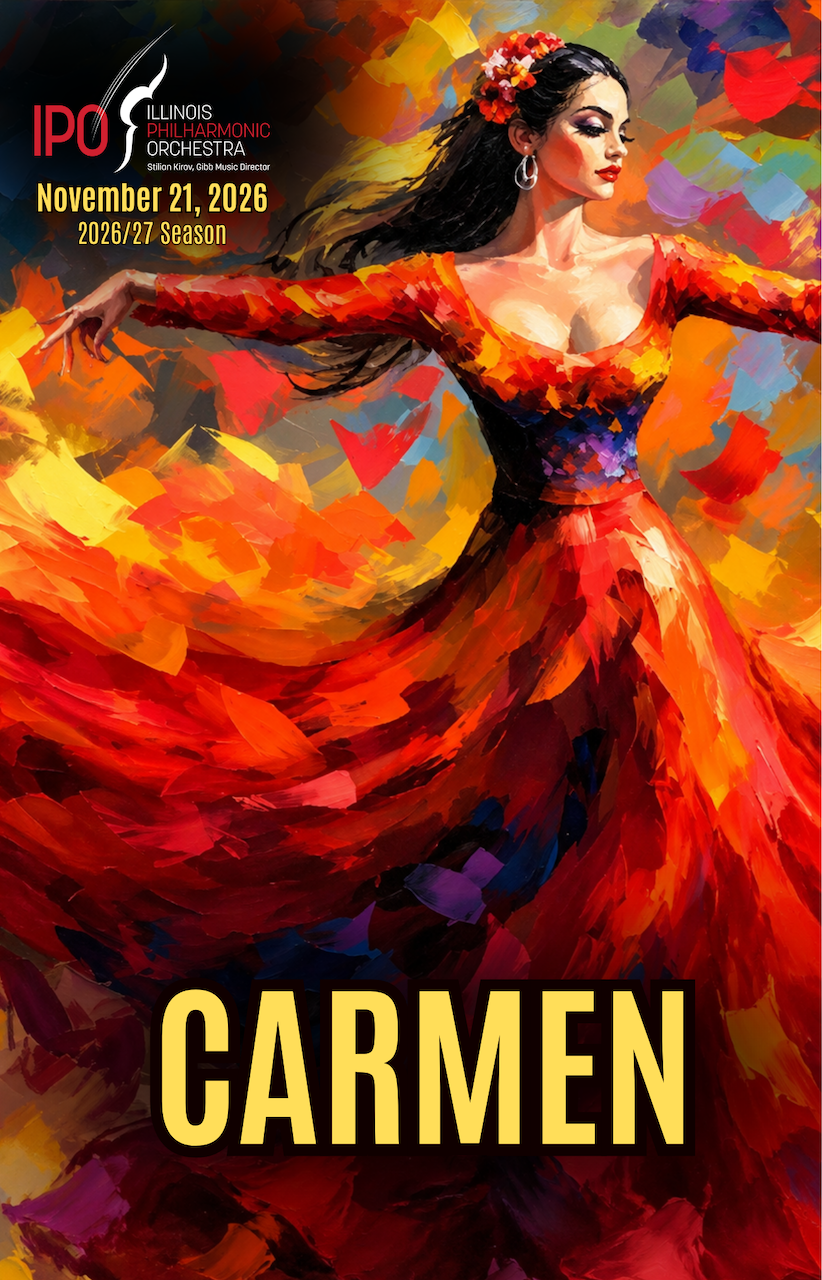

Stilian Kirov, Conductor
Starburst | Jessie Montgomery | |
Symphony No. 1 in C Major I. Allegro vivo | Georges Bizet | |
| INTERMISSION | ||
Carmen Suite (after Georges Bizet) 1. Introduction | Rodion Shchedrin | |
OPENING ACT LOBBY PERFORMERS
Chicago Jazz Philharmonic Jazz Academy
Contact: Jordan Mandela: Program Manager

Opening Act Lobby Performers are sponsored by

Azusa Tashiro, Concertmaster
Stanley and Lois Birer
VIOLIN 1
Elizabeth Huffman, Assistant Concertmaster
Ebedit Fonseca
Lilian Chou
Maria Arrua Gonzalez
Stephane Collopy
Brian Ostrega
Carlos Chacon
Steven Wilkler
Vladimir Gebe
VIOLIN 2
Linda Veleckis, Principal
Grannon Second Violin Chair
Kamen Vatchev, Assistant Principal
Anna Carlson
Caroline Slack
Matthew Weinberg
Munire Mona Mierxiati
Samantha May
Nic Orbovich
VIOLA
Erin Rafferty, Acting Principal
Gerhard Haigis
Oana Tatu, Acting Assistant Principal
Scott Gordon Dowd
Monica Reilly
Lerryn Scheafer
Donatelle
Sara Morrow
CELLO
Emily Lewis Mantell, Acting Principal
Brian and Carolee Samuels
Elizabeth Anderson, Acting Assistant Principal
Ingrid Krizan
Margaret Daly
BASS
Phillip Serna, Acting Principal
Billie and Henry Hauser
James O'Toole, Acting Assistant Principal
FLUTE
Cynthia Fudala, Principal
Dr. Jerri E. Greer
Isabel Evernham
OBOE
Naomi Bensdorf Frisch, Principal
Steve and Joey Buck
Christine Janzow Phillips
CLARINET
Claire Werling, Acting Principal
Leonard Achtenberg and Steven Livesey
William Olsen
BASSOON
Matthew Hogan, Acting Principal
Dr. Mel and Janet Muchnik
Randall Dennler
HORN
Lee Shirer, Principal
Barbara Sturges
Liz Dietemyer
John Schreckengost
Elizabeth Mazur-Johnson
TRUMPET
Jhoan Garcia, Principal
Richard and Andrea Gibb
Ross Beacraft
TIMPANI
Simón Gómez Gallego, Principal
PERCUSSION
Richard Janicki, Acting Principal
Kathleen Field Orr
Yulia Block
Paul Ross
Jeff Handley
Lana Worded
HARP
Yoojin Jung
Patti and John Flanagan
Chair Sponsor indicated
in blue text
Jessie Montgomery (born 1981) has developed a close relationship with Chicago. As the Chicago Symphony Orchestra’s composer-in-residence from 2021 to 2024, she premiered several works with the orchestra. She also served as a mentor during the Illinois Philharmonic Orchestra’s 2024 EarShot weekend, which advanced the careers of young composers Daixuan Ai, Chris Neiner, and Sepehr Pirasteh through rehearsals and performances of their music. The IPO has performed Montgomery’s Strum on the Matthew Mantell Memorial Concert and, most recently, Coincident Dances as part of last season’s “America Turns 250” concert. Tonight’s work, Starburst, was commissioned and premiered by the Sphinx Virtuosi in 2012. Montgomery describes this brief, one-movement work for string orchestra as “a play on imagery of rapidly changing musical colors.”
Carmon DeLeone, Music Director of the Illinois Philharmonic Orchestra for 25 years (1986–2011) and now its Conductor Laureate, loved to pair Mozart’s first symphony with his last. Tonight, Maestro Kirov offers a similar pairing: Georges Bizet’s youthful Symphony in C and his final masterpiece, Carmen. The comparison is especially apt because Bizet and Mozart were both composing prodigies. Mozart completed his Symphony No. 1, K. 16, in 1764 at age eight, but he did not produce a symphony that entered the standard concert repertoire until age 17, with the Symphony No. 25 in G minor, K. 183, in 1773. Bizet (1839–1875) matched that youthful achievement with his Symphony in C, written in 1855 when he was also 17. Now a thoroughly delightful fixture of the concert repertoire, the symphony followed an extraordinary path to recognition.
In 1855, Bizet was a 17-year-old student at the Paris Conservatoire. His composition teacher was Fromental Halévy (whose daughter Bizet would marry). However, it is obvious that Bizet was even more under the influence of Charles Gounod (1818-1893) the famous French composer of Faust (1859) and Roméo et Juliette (1867) – and also the little march that became the theme song of the Alfred Hitchcock TV show in the Bernard Herman arrangement for bassoons. In 1855 Gounod, having a recent operatic failure, decided to write his Symphony No. 1 in D major. The Symphony was successfully launched in February 1855 with several subsequent, acclaimed performances despite its modest, unoperatic proportions, using a very limited, Haydn-esque orchestra. Bizet was tasked with arranging it for piano four hands by Gounod’s publisher. For reasons which can only be the subject of speculation, Bizet also wrote a symphony using the same limited orchestral forces and general proportions as Gounod. Bizet started the Symphony on October 29, 1855, and finished it sometime in November, a mere month later. What we now know as the Symphony in C, was never published or performed in Bizet’s lifetime!
Why not? The sleuthing of Howard Shanet may provide an answer. The parallels he discovered between the Gounod work and that of the young Bizet are numerous, both in organization and even in the family resemblance of some themes. Did these obvious similarities make Bizet uncomfortable because he might be seen as a mere epigone of Gounod? Did Bizet resist stealing thunder from his patron, Gounod, who referred to Bizet as his “son”? Was Gounod critical? Also, a composition student at the Conservatoire would be focused on winning the prestigious Prix de Rome which required successfully completing contrapuntal fugal examinations and composing a cantata, a concert vocal piece. (Bizet won the Prix in 1857 for his cantata Clovis et Clotilde.) A symphony would be irrelevant to this prize and perhaps the fugato in the second movement of the Symphony in C would not be considered “rigorous” enough – possibly prejudicing persnickety faculty members against him. Finally, Bizet aimed to be an opera composer and wrote nine starting in 1858 and finishing with the masterful Carmen in 1875. Opera was “King” at that time, the symphony a sideline. Opera in the 19th century was the artistic equivalent of 20th-21 st century movies in dominance.
The renaissance of the Symphony in C was achieved by some lucky breaks. The “discovery" of the symphony was announced in 1933 by Jean Chantavoine in an article in the periodical Le Ménestrel. He described in some detail the original manuscript in the Library of the Paris Conservatoire and quoted the principal themes in musical notation. But there it slept until D. C. Parker of Glasgow, Bizet’s original biographer in English, called the attention of the conductor Felix Weingartner to the work. Weingartner gave the first performance in Basel in 1935, eighty years after its composition. The Symphony was an immediate, sensational triumph. It was promptly published. Within a year of its premiere the Symphony was played in Vienna, London, Amsterdam, Madrid, Brno, Copenhagen, Prague, Stuttgart, Königsberg, Riga, Capetown, Frankfurt, Cincinnati, and Rochester. The Paris premiere was given by Charles Münch and the Société des Concerts on 29 May 1936. Stravinsky brought the score to the attention of George Balanchine who used it in 1947 to choreograph a superb ballet, now known simply as “Symphony in C,” for the Paris Opera Ballet. It was performed in 1948 as the inaugural performance of the New York City Ballet. The musically sophisticated Balanchine utilized Shanet’s discoveries to choreograph Gounod Symphony as a companion piece to Symphony in C. (Its 1958 premiere included ballet superstars Maria Tallchief and Jacques d’Amboise.)
It is no wonder that Symphony in C was used as a basis for ballet. Its music has a spring, an effervescence, verve, élan, brilliance -- one can exhaust superlatives. The orchestration is masterful – breathtaking for a novice.
The Symphony is in the classic four movements. The first movement Allegro, vivo (fast lively) is in sonata form. The themes, matching the tempo marking, have a vivacious, bouncing audacity. The slow second movement opens with the august stately outline of simple intervals -- thirds, fourths, fifths and octaves which snap to attention. Then, a sinuous, sensuous melody taken by the solo oboe charms with a chromatic line that previews the exoticism of Bizet in his opera The Pearl Fishers. The above-promised fugato, starting in the strings, is the middle section before the return of the solo oboe with the accompaniment of the opening intervals. The off-beat sparkle of the third movement scherzo contrasts with the middle section characterized by bagpiping drone notes. The finale is all perpetual motion and panache with vigorous closing chords.
Another of Carmon DeLeone’s programming proclivities was, “A Night at the Ballet” where the IPO concert would be filled with music composed for the ballet – as it is tonight. Symphony in C was used as the score for a famous Balanchine ballet; the Carmen Suite is a ballet arranged from Bizet melodies by Rodin Shchedrin (1932–2025) for his wife, prima ballerina assoluta of the Bolshoi Ballet, Maya Plisetskaya. Remarkably, Mme. Plisetskaya went to Shostakovich and then Khachaturian before looking closer to home for music for her Carmen project.
Shchedrin very wittily re-composed Bizet for strings and percussion. This score is not a rolling medley of Carmen’s greatest hits as heard in Carmen “Fantasies” like those composed by Pablo Sarasate and Franz Waxman for solo violin and orchestra. Yes, the scenario of the ballet basically follows the opera. But the music is reorganized for the drama, and concert goers who know Carmen well will not always be able to “follow” the action. Yes, when Don Jose arrests Camen, that is the music we hear (in the ballet, Jose means to restrain Carmen and she saucily lifts her foot into his hands). But Jose’s ensuing lovesick solo is performed to the dreamy entr’acte to Act III of Carmen, originally for solo flute.
Carmen’s companions are introduced by the famous “Farandole” from Bizet’s “L'Arlésienne music. Carmen is soon smitten by Escamillo, the matador whose famous entrance music Shchedrin cheekily pares down to the mere accompaniment as Carmen makes eyes at him. The sensual pas de deux between the bullfighter and the gypsy is accompanied by the “Bohemian Dance” from Bizet’s opera The Fair Maid of Perth but at half Bizet’s original tempo – thus intensifying the mood. But Carmen, seemingly torn between two lovers, immediately dances an even more passionate pas de deux with Jose to his aria in the opera. As expected, the music of the final duet accompanies Jose’s murder of Carmen. The Cuban choreographer Alberto Alonso crafted the ballet for the stunning Plisetskaya. But his sister-in-law, the famous Cuban ballerina Alicia Alonso, added even more Latin passion to her performances of Carmen.
Program Notes by
IPO Board Member Charles Amenta, M.D.
"Music has always been the common thread in our family. Our parents, Leo and Anne Michuda, devoted their lives to music and believed deeply in supporting the musicians who bring it to life. The Illinois Philharmonic Orchestra has been part of our family's story for many years, and we are honored to carry their legacy forward. We hope our support helps keep the music playing—and their love of music alive—for generations to come."
-The Michuda and D'Ortenzio families
IPO acknowledges support from