
× Upcoming Events About Us Past Events
Home About Us
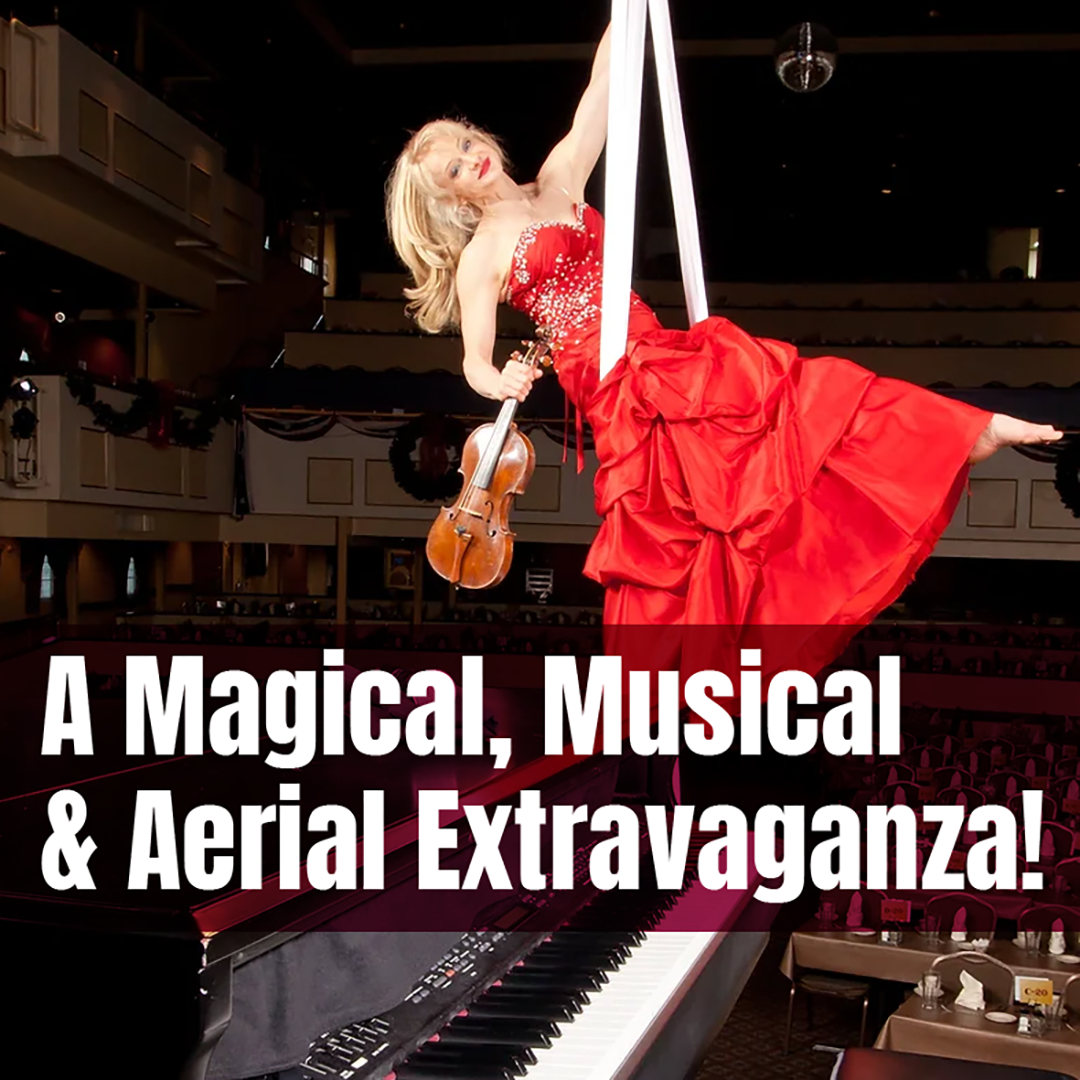
Image for Orchestra Kentucky- A Magical, Musical & Aerial Extravaganza
A Magical, Musical & Aerial Extravaganza

Saturday, August 22, 2026

7:30 PM

Thank You Show Sponsors!

Variety Series Sponsor

Graves Gilbert Clinic

Co-Sponsors

Bell, Orr, Ayers & Moore, P.S.C


The Program

Bernstein, Leonard

Overture to Candide

Sarasate, Pablo de

Medley: Zigeunerweisen / Irish Reel / Pirates of the Caribbean

Schwartz, Stephen

Defying Gravity from Wicked

Vivaldi, Antonio

Winter from The Four Seasons

Bates, Mason

Mothership

Led Zeppelin

Stairway to Heaven

INTERMISSION

Williams, John

Flying Theme from E.T. the Extra-Terrestrial

Barlow, Gary

When Your Feet Don’t Touch the Ground from Finding Neverland

Copland, Aaron

Hoedown from Rodeo

Rouse, Ervin T.

Orange Blossom Special

Debussy, Claude

Clair de lune

Rimsky-Korsakov, Nikolai

Scheherazade, Fourth Movement


About Tonight's Program

Long before anyone built a machine that could do it, human beings were already flying — in dreams, in stories, in music. Every culture has a myth about it: a boy with wax wings, a carpet that rises off the floor. What those stories share is not really the sky. It is the moment just before it, when a person decides the ground is no longer the only place they are willing to live. That decision is the thread running through tonight's concert. You will hear a Venetian priest painting ice storms with a violin, a Russian sailor turning the Arabian Nights into an ocean, an American composer sending a techno pulse into orbit around an orchestra, and four British musicians building a staircase out of an acoustic guitar. Some are literally about flight; others are about the restlessness that comes just before it. And tonight the metaphor is not only a metaphor: Janice Martin will leave the stage floor entirely, playing her violin suspended in the air. Music has always been the art form that refuses to stay put. So settle in, look up, and let the evening lift you slightly out of your seat and set you down somewhere you have never been.

Leonard Bernstein (1918–1990)

Overture to Candide

Leonard Bernstein was an impossible person to categorize, and it nearly cost him his career. Born in Lawrence, Massachusetts, to immigrant parents who wanted nothing to do with a musical son, he became famous overnight in November 1943 when, at twenty-five, he substituted for an ailing Bruno Walter and conducted a nationally broadcast New York Philharmonic concert without rehearsal. But he also wanted to compose — for Broadway, for ballet, for film — and the classical establishment treated that range as a flaw rather than a gift. The 1950s brought West Side Story, enormous success, and a private worry that he was squandering his serious talent on entertainment.

Candide came out of that tension, and it came out badly. Bernstein and playwright Lillian Hellman turned Voltaire's savage 1759 novella into a Broadway operetta. Voltaire had mocked the optimism insisting this was "the best of all possible worlds"; Hellman saw a parallel in McCarthy-era America. The show opened on December 1, 1956, and closed after seventy-three performances. Critic Walter Kerr called it "a really spectacular disaster."

The Overture survived, and then some — a four-minute anthology of the show's best tunes. Listen for how much it packs in: a brass fanfare that leaps out of the gate; a soaring melody from the duet "Oh, Happy We"; a chattering strain from Cunegonde's "Glitter and Be Gay." It ends in joyous overload — four minutes of music that never once touches the ground.

Pablo de Sarasate (1844–1908)

Medley: Zigeunerweisen / Irish Reel / Pirates of the Caribbean

Pablo de Sarasate was the son of an artillery bandmaster in Pamplona, and he was playing in public by the age of eight. A patron sent him to Madrid, where he charmed Queen Isabella II; at twelve he went to the Paris Conservatoire. The journey nearly killed him — his mother suffered a fatal heart attack at the French border, and Sarasate arrived sick with cholera. He recovered, won the Conservatoire's highest prize at seventeen, and spent four decades as one of the most beloved touring musicians on earth. Lalo's Symphonie espagnole, Saint-Saëns's Third Violin Concerto and Bruch's Scottish Fantasy were all written for his hands.

Zigeunerweisen — "Gypsy Airs," Op. 20 — was written in 1878 and premiered that year in Leipzig, and it is the piece that made him immortal as a composer rather than merely a performer. It unfolds in four linked sections: a swaggering orchestral introduction; a rhapsodic slow passage of sighing slides and harmonics imitating café violinists; a muted, heartbreakingly simple song; and a finale that takes off like a rocket. The melodies Sarasate labeled "gypsy" were in fact largely Hungarian, and the slow tune came from the composer Elemér Szentirmay — a borrowing that raised eyebrows at the time.

Tonight's medley departs from there and keeps traveling: an Irish reel and the Pirates of the Caribbean theme carry the violin from a Hungarian café to a fiddler's kitchen to the open sea. What ties the three together is not a country but a way of playing — great fiddling, in the oldest and best sense of the word.

Stephen Schwartz (b. 1948)

Defying Gravity from Wicked

Stephen Schwartz was a prodigy of a particular kind: a Broadway composer who arrived early and then had to survive his own success. He studied at Juilliard's Preparatory Division while still in high school, and by twenty-three had Godspell running off-Broadway; Pippin and The Magic Show followed so quickly that he briefly had three shows playing at once. Then came harder years, and a second career in film that brought him three Academy Awards. He was in his fifties when he read Gregory Maguire's novel Wicked and recognized the show of his life.

Wicked opened at the Gershwin Theatre on October 30, 2003, and "Defying Gravity" is its Act One curtain — the moment Elphaba discovers the Wizard is a fraud, refuses to be complicit, and takes flight. He hid the first seven notes of "Over the Rainbow" inside the "Unlimited" motif that recurs through the score, so an audience feels a connection to Oz without being able to name it. He wrote the opening argument with shifting key centers and overlapping phrases, so the two women sound like real people quarreling.

Then he does the simplest and most effective thing in the songwriter's toolkit: he goes up. The song climbs through key change after key change, each nudging the voice higher, until Elphaba's line is lifted a full octave and the sound itself seems to leave the ground. (Onstage, the original production hid a hydraulic lift behind billowing fabric, smoke and wind — the illusion sold by the music more than the machinery.) The number lands because it is not about magic. It is about the terror and elation of deciding you would rather be free and hated than safe and approved of.

Antonio Vivaldi (1678–1741)

Winter from The Four Seasons

Antonio Vivaldi was ordained a priest in Venice in 1703 and excused from saying Mass within a year, apparently on account of a chest complaint — though his mind may simply have been elsewhere. Red-haired and famously restless, il Prete Rosso, the Red Priest, spent most of his working life at the Ospedale della Pietà, a Venetian institution for orphaned and illegitimate girls with one of the most remarkable music programs in Europe. Vivaldi wrote hundreds of concertos for that ensemble, at industrial speed, for players he knew intimately.

The Four Seasons was published in Amsterdam in 1725 as the first four of twelve concertos titled Il cimento dell'armonia e dell'inventione — "The Contest Between Harmony and Invention." He printed a descriptive sonnet at the head of each concerto, almost certainly writing them himself, then scattered the lines through the orchestral parts, so a violist could read "the icy breath of the horrid wind" directly above the notes. Instrumental music depicting the world minute by minute was genuinely new.

Winter is the wildest of the four. It begins with a frozen, shivering texture — repeated notes in grinding dissonances, the sound of cold itself — before the solo violin cuts across as a knife-edged wind. Listen for the moment the orchestra stamps its feet to keep warm, and for the double-stops that are unmistakably chattering teeth. The finale keeps us out on the ice to walk cautiously, slip, fall, and hear the south and north winds do open battle — before Vivaldi ends, remarkably, on a note of pleasure.

Mason Bates (b. 1977)

Mothership

Mason Bates leads a double life that would have been unthinkable a generation ago and now looks like the future. Raised in Virginia, he took the most orthodox training available — Columbia and Juilliard, then a doctorate at Berkeley — while simultaneously working as a club DJ in San Francisco. Rather than treat these as separate selves, he fused them, writing for full orchestra with a laptop and electronic percussion in the ensemble, using field recordings and synthesized beats as though they were instruments in the back row. His aim, he says, is "a revival of the narrative symphonies of the nineteenth century using twenty-first-century sounds."

Mothership was written for an occasion that could hardly have suited him better. On March 20, 2011, the YouTube Symphony Orchestra — assembled from musicians worldwide who auditioned by video — gave its concert at the Sydney Opera House under Michael Tilson Thomas. His brief was to write for a global orchestra of strangers, and his solution was elegantly literal: the orchestra becomes "a mothership that is docked by several visiting soloists," who fly in, improvise, and depart.

Underneath the science-fiction imagery is a classical structure: a scherzo with two trios, the architecture Schumann used in his Second Symphony, with the waltz pulse replaced by a driving electronic beat. The piece launches with hurtling, glittering energy — strings and winds in rapid figuration over a pulse that feels less like a drum machine than the hum of an enormous engine — then opens twice for the soloists before accelerating into its final ascent. It carries an idea worth taking home: the orchestra is not a museum but a vessel, capacious enough to dock with anything.

Led Zeppelin

Stairway to Heaven

By 1970, Led Zeppelin were the biggest live act in the world and thoroughly exhausted by it. Jimmy Page — a former London session guitarist who had played on more hit records than he could count before forming the band in 1968 — retreated with singer Robert Plant to Bron-Yr-Aur, a Welsh cottage with no electricity and no running water. What emerged from that stay, and from later sessions at Headley Grange, was a body of songs far more acoustic and strange than the thunder that had made them famous. Page had been building the music of "Stairway to Heaven" in pieces for a long time; Plant, sitting by the fire with a pencil, wrote most of the lyric in a single rush.

The song appeared in November 1971 on an album so deliberately unmarketable that it carried no title and no band name — only four runic symbols. It became the most-requested track in the history of American FM radio anyway. The reason is architectural: eight minutes functioning as one unbroken accelerando.

That slow burn is why the song belongs on a program about flight. It is one of the very few pieces in popular music that behaves like a symphonic movement — a patient gathering of forces from near-silence to Page's incandescent solo and Plant's final ascending cry, then a sudden drop to a single unaccompanied voice. Listeners have argued for fifty years about the lyrics. But the trajectory needs no annotation: something small and mysterious grows past the point where you expected it to stop, then sets you down gently.

INTERMISSION

John Williams (b. 1932)

Flying Theme from E.T. the Extra-Terrestrial

John Williams was a jazz drummer's son from Queens who studied at UCLA and Juilliard and spent years writing television scores before Steven Spielberg — then a twenty-something with one feature to his name — asked him to score The Sugarland Express. The partnership that followed is the most consequential in the history of film music: JawsClose Encounters of the Third KindJurassic ParkSchindler's List. Against a 1970s fashion for pop songs and sparse atmospheric scoring, he wrote big, tonal, unashamedly melodic music for full orchestra, in a Romantic idiom descended from Wagner, Korngold and Richard Strauss.

E.T. the Extra-Terrestrial arrived in 1982. The famous "Flying Theme" accompanies the sequence in which Elliott's bicycle lifts off the ground and sails across the face of the moon. The writing is deceptively simple: a rising line built on wide, open leaps — intervals that feel like reaching upward — carried by strings and horns over shimmering harp and woodwind. He does not write a fanfare of triumph. He writes something closer to breathlessness.

A wonderful story attaches to the recording. Williams struggled to fit the music precisely to the timings of the final chase, and Spielberg — in a reversal of every rule in the business — switched off the projector, told him to record the music as he wanted it, and re-cut the picture to match. Anyone who has seen the film understands why: the score is not accompanying that sequence, it is causing it. He does not illustrate emotion, he generates it, so directly that adults who consider themselves immune are undone by eight bars of horn melody.

Gary Barlow (b. 1971)

When Your Feet Don't Touch the Ground from Finding Neverland

Gary Barlow's route to the musical theater stage was not the conventional one. He grew up in Frodsham, Cheshire, playing keyboards in working men's clubs as a teenager, and in 1990 became the principal songwriter of Take That, the boy band that dominated British pop for a decade. When the group dissolved in 1996, Barlow endured a long slump before reinventing himself — architect of Take That's comeback, television fixture, and eventually a composer for the stage. He came to Finding Neverland with his songwriting partner Eliot Kennedy; their version opened on Broadway in April 2015.

The show tells the story of J. M. Barrie in London in 1903 — a playwright out of ideas who meets the widowed Sylvia Llewelyn Davies and her four sons in Kensington Gardens, and finds in their company both the material and the permission to write Peter Pan. "When Your Feet Don't Touch the Ground" belongs to the most tender thread in the story: Barrie and Peter, the grieving boy who has decided make-believe is a childish thing he no longer has time for, and who is obviously wrong. Barrie sings it as a gentle argument. Life is going to be hard, the song concedes; imagination will not fix that, but it will lift you off the floor for a while.

Barlow keeps the melody plain enough to be sung by a child and hangs everything on the harmony underneath it. The verse hovers, almost hesitant, and then the chorus opens outward on a phrase that rises exactly where the words say it should. It is a lullaby with an updraft. On a program full of spacecraft, storms and shipwrecks, this is the quiet one, and it may be the one that stays with you.

Aaron Copland (1900–1990)

Hoedown from Rodeo

Aaron Copland — Brooklyn-born son of Lithuanian-Jewish immigrants, trained in Paris by Nadia Boulanger, an early experimenter in thorny modernist abstraction — is an unlikely candidate for the title of America's most recognizable musical voice. But in the mid-1930s he made a deliberate turn. Radicalized by the Depression, he set out to write music "in the simplest possible terms" for the widest possible audience. The result — Billy the KidRodeoAppalachian SpringFanfare for the Common Man — invented the sound Americans now hear as "American": wide-spaced open harmonies, clean orchestration, a sense of enormous distance.

Rodeo was written in 1942 for the choreographer Agnes de Mille, who danced the lead herself at the premiere with Ballet Russe de Monte Carlo at the Metropolitan Opera House that October. The scenario is slight and charming — a tomboyish Cowgirl tries and fails to win attention by riding with the men, and finally gets it at the Saturday night dance. Hoedown is the finale: the moment the whole community stops working and starts stamping.

Its central tune has a marvelous lineage. In 1937, a Library of Congress field recorder captured a Kentucky fiddler named William Hamilton Stepp playing "Bonaparte's Retreat" in a syncopated, driving version. Ruth Crawford Seeger — a formidable modernist composer herself — transcribed it for the Lomaxes' 1941 collection Our Singing Country, and from that page Copland took his theme. The melody that now sells trucks on television reached the concert hall by way of an eastern Kentucky front porch and a woman writing out notes in New York.

Ervin T. Rouse (1917–1981)

Orange Blossom Special

Ervin Thomas Rouse was born in Craven County, North Carolina, into a family of tenant farmers, and was performing on the vaudeville circuit as a child fiddler with his brothers. He was a brilliant player and a profoundly private man. After writing one of the most famous fiddle tunes ever composed, he retreated to the Florida Everglades, living for decades in obscurity, playing small roadhouses and reportedly paid in whiskey as often as cash. When another fiddler publicly claimed authorship for years, Rouse — who held the copyright — mostly declined to argue about it.

He copyrighted "Orange Blossom Special" in 1938 and recorded it with his brother Gordon the following year. Its subject was a real object of desire: a luxury all-Pullman train running from New York down to Florida, a symbol of escape in the depths of the Depression. What followed is not in dispute: Bill Monroe recorded it, it became a bluegrass standard, and by Johnny Cash's 1965 version it was American folklore. Cash sought Rouse out and brought him onstage in Miami so audiences would know who had written it.

The tune is a train, and the fiddle is the whole locomotive. The opening figure is the whistle; the relentless sawing that follows is the wheels; the long sliding wails are the Doppler shift of the thing tearing past a crossing. It is played fast, and then faster, and the point is that a good fiddler makes you believe you are watching something enormous go by at speed. Note what it is doing on a program about flight: before rockets, before airliners, the machine that promised to take you somewhere better was a train.

Claude Debussy (1862–1918)

Clair de lune

Claude Debussy grew up above his father's china shop in a Paris suburb, in a family with no musical background and little money, and entered the Paris Conservatoire at ten. He was a difficult student in the most productive way — impatient with the rules of harmony he was taught, drawn instead to the Javanese gamelan he heard at the 1889 Paris Exposition, to anything suggesting an alternative to the German tradition dominating European music. What he built was a new grammar in which chords no longer function as steps in a progression but exist for their color, hanging in the air like light on water.

Clair de lune is the third movement of the Suite bergamasque, composed around 1890 when Debussy was twenty-eight, and then set aside. Embarrassed by his early work, he agreed to release the suite only in 1905 — by which time Pelléas et Mélisande had made him famous — and revised it substantially first. The title comes from Paul Verlaine's poem, which describes the soul as a landscape where masked figures dance in a minor key beneath "the calm moonlight, sad and beautiful, that sets the birds dreaming in the trees."

In D-flat major, in a lilting compound meter marked andante très expressif, it begins with a melody in falling thirds, so quiet and unhurried that many listeners hold their breath through it. The middle section opens into rippling broken chords that rise and fall like breathing, builds to one warm climax, then dissolves — the closing bars thinning into air, the harmony never quite resolving where the ear expects. On tonight's program it is the still point: not the exhilaration of flight but the weightlessness of it.

Nikolai Rimsky-Korsakov (1844–1908)

Fourth Movement from Scheherazade

Nikolai Rimsky-Korsakov spent his early adulthood as an officer in the Imperial Russian Navy, and composed his First Symphony largely while at sea on a two-and-a-half-year cruise. He was, at the time, essentially self-taught — a member of the nationalist circle known as "The Five." Then he was appointed professor of composition at the St. Petersburg Conservatory and had to frantically teach himself the harmony and counterpoint he was meant to be teaching others. He became the greatest orchestrator Russia produced, and the man who taught Stravinsky.

Scheherazade was written in a single burst between June and August of 1888 and premiered in St. Petersburg that October under the composer's baton. Its premise comes from One Thousand and One Nights: the Sultan Shahriar, convinced of the faithlessness of all women, executes each new wife at dawn, until Scheherazade begins telling him a story each night and stops before the ending. The music encodes this directly. A stern unison theme in the low strings and brass is the Sultan; a solo violin, accompanied only by harp, is Scheherazade, spinning her winding melody. Every time the storytelling resumes, that violin returns.

The finale carries the longest of the work's titles: "Festival at Baghdad — The Sea — The Ship Breaks against a Cliff Surmounted by a Bronze Horseman." The festival whirls up out of nothing, gathering speed until the whole orchestra is spinning and earlier themes come tumbling back in new guises — and then, without warning, the sea takes over. The great wave-motif returns at full force, the ship is driven onto the rocks in a crash capped by the tam-tam, and the storm subsides. What remains is the solo violin, alone, climbing to a single sustained harmonic at the top of its range — the storyteller, having survived one more night, disappearing into the morning.

Orchestra Personnel

ORCHESTRA STAFF

Orchestra Manager

Lee Blakeman

Orchestra Librarian

Melissa Keeling

WOODWINDS

Flute

Jessica Dunnavant, Principal


Heidi Alvarez, Alto Flute


Julie Ditzel, Piccolo

Oboe

Jennifer Potochnic, Principal


Diana Dunn


ToniMarie Marchioni, English Horn

Clarinet

Kirsten Ahnell, Principal & E-flat Clarinet


Marilyn Nije


John Cipolla, Bass Clarinet & Soprano Saxophone

Bassoon

Andrew Witherington, Principal


Harold Skelton


Andrew Favorito, Contrabassoon

BRASS

Horn

Harry Ditzel, Principal


Colin Dorman, Assistant


Joey Demko


Sarah Robinson


Isaac Ferrell

Trumpet

Reese Land, Principal


Jonathan Stites


Caden Holmes

Trombone

Brett Shuster, Principal


Bill Huber


Joshua Britton, Bass Trombone

Tuba

Seth Clancey

PERCUSSION

Timpani

Mark Berry

Percussion

Marty Sharer, Principal & Drum Set


Chad Floyd


Kaleb Haskell


Cole Gregory

KEYBOARD, HARP & GUITAR

Piano / Celesta

Ryan Jones

Harp

Kate Rogers

Guitar

John McCracken, Electric & Acoustic

STRINGS

Violin I

Kameron Myers, Concertmaster


Melissa Bull


Jocelyn Sprouse


Isabel Bartles


Genesis Aguilar


Jennifer Warren


Henry MacAfee


Caroline Fleming


Elizabeth Johnson


Reagan Ballard

Violin II

Julianna Waller-Martinez, Principal


Julie Lastinger


Saelim Jung Henderson


Malika Brower


Todd Bornstein


Morgan Maassel


Marina Fisher


Becca Major

Viola

Idalynn Besser, Principal


Bruce Christensen


Clare Yang


Audrey Swank


Mary Meyers


Henry Haffner

Cello

Sarah Berry, Principal


Ian Schroeder


Rebecca Price


Jessica Lee


John Marietta


Eva Rouse

Bass

Paul Reich, Principal & Electric Bass


Patrick O'Rourke


Tiffany Freeman

Image for Orchestra Kentucky- A Magical, Musical & Aerial Extravaganza
A Magical, Musical & Aerial Extravaganza

Saturday, August 22, 2026

7:30 PM

Thank You Show Sponsors!

Variety Series Sponsor

Graves Gilbert Clinic

Co-Sponsors

Bell, Orr, Ayers & Moore, P.S.C


The Program

Bernstein, Leonard

Overture to Candide

Sarasate, Pablo de

Medley: Zigeunerweisen / Irish Reel / Pirates of the Caribbean

Schwartz, Stephen

Defying Gravity from Wicked

Vivaldi, Antonio

Winter from The Four Seasons

Bates, Mason

Mothership

Led Zeppelin

Stairway to Heaven

INTERMISSION

Williams, John

Flying Theme from E.T. the Extra-Terrestrial

Barlow, Gary

When Your Feet Don’t Touch the Ground from Finding Neverland

Copland, Aaron

Hoedown from Rodeo

Rouse, Ervin T.

Orange Blossom Special

Debussy, Claude

Clair de lune

Rimsky-Korsakov, Nikolai

Scheherazade, Fourth Movement


About Tonight's Program

Long before anyone built a machine that could do it, human beings were already flying — in dreams, in stories, in music. Every culture has a myth about it: a boy with wax wings, a carpet that rises off the floor. What those stories share is not really the sky. It is the moment just before it, when a person decides the ground is no longer the only place they are willing to live. That decision is the thread running through tonight's concert. You will hear a Venetian priest painting ice storms with a violin, a Russian sailor turning the Arabian Nights into an ocean, an American composer sending a techno pulse into orbit around an orchestra, and four British musicians building a staircase out of an acoustic guitar. Some are literally about flight; others are about the restlessness that comes just before it. And tonight the metaphor is not only a metaphor: Janice Martin will leave the stage floor entirely, playing her violin suspended in the air. Music has always been the art form that refuses to stay put. So settle in, look up, and let the evening lift you slightly out of your seat and set you down somewhere you have never been.

Leonard Bernstein (1918–1990)

Overture to Candide

Leonard Bernstein was an impossible person to categorize, and it nearly cost him his career. Born in Lawrence, Massachusetts, to immigrant parents who wanted nothing to do with a musical son, he became famous overnight in November 1943 when, at twenty-five, he substituted for an ailing Bruno Walter and conducted a nationally broadcast New York Philharmonic concert without rehearsal. But he also wanted to compose — for Broadway, for ballet, for film — and the classical establishment treated that range as a flaw rather than a gift. The 1950s brought West Side Story, enormous success, and a private worry that he was squandering his serious talent on entertainment.

Candide came out of that tension, and it came out badly. Bernstein and playwright Lillian Hellman turned Voltaire's savage 1759 novella into a Broadway operetta. Voltaire had mocked the optimism insisting this was "the best of all possible worlds"; Hellman saw a parallel in McCarthy-era America. The show opened on December 1, 1956, and closed after seventy-three performances. Critic Walter Kerr called it "a really spectacular disaster."

The Overture survived, and then some — a four-minute anthology of the show's best tunes. Listen for how much it packs in: a brass fanfare that leaps out of the gate; a soaring melody from the duet "Oh, Happy We"; a chattering strain from Cunegonde's "Glitter and Be Gay." It ends in joyous overload — four minutes of music that never once touches the ground.

Pablo de Sarasate (1844–1908)

Medley: Zigeunerweisen / Irish Reel / Pirates of the Caribbean

Pablo de Sarasate was the son of an artillery bandmaster in Pamplona, and he was playing in public by the age of eight. A patron sent him to Madrid, where he charmed Queen Isabella II; at twelve he went to the Paris Conservatoire. The journey nearly killed him — his mother suffered a fatal heart attack at the French border, and Sarasate arrived sick with cholera. He recovered, won the Conservatoire's highest prize at seventeen, and spent four decades as one of the most beloved touring musicians on earth. Lalo's Symphonie espagnole, Saint-Saëns's Third Violin Concerto and Bruch's Scottish Fantasy were all written for his hands.

Zigeunerweisen — "Gypsy Airs," Op. 20 — was written in 1878 and premiered that year in Leipzig, and it is the piece that made him immortal as a composer rather than merely a performer. It unfolds in four linked sections: a swaggering orchestral introduction; a rhapsodic slow passage of sighing slides and harmonics imitating café violinists; a muted, heartbreakingly simple song; and a finale that takes off like a rocket. The melodies Sarasate labeled "gypsy" were in fact largely Hungarian, and the slow tune came from the composer Elemér Szentirmay — a borrowing that raised eyebrows at the time.

Tonight's medley departs from there and keeps traveling: an Irish reel and the Pirates of the Caribbean theme carry the violin from a Hungarian café to a fiddler's kitchen to the open sea. What ties the three together is not a country but a way of playing — great fiddling, in the oldest and best sense of the word.

Stephen Schwartz (b. 1948)

Defying Gravity from Wicked

Stephen Schwartz was a prodigy of a particular kind: a Broadway composer who arrived early and then had to survive his own success. He studied at Juilliard's Preparatory Division while still in high school, and by twenty-three had Godspell running off-Broadway; Pippin and The Magic Show followed so quickly that he briefly had three shows playing at once. Then came harder years, and a second career in film that brought him three Academy Awards. He was in his fifties when he read Gregory Maguire's novel Wicked and recognized the show of his life.

Wicked opened at the Gershwin Theatre on October 30, 2003, and "Defying Gravity" is its Act One curtain — the moment Elphaba discovers the Wizard is a fraud, refuses to be complicit, and takes flight. He hid the first seven notes of "Over the Rainbow" inside the "Unlimited" motif that recurs through the score, so an audience feels a connection to Oz without being able to name it. He wrote the opening argument with shifting key centers and overlapping phrases, so the two women sound like real people quarreling.

Then he does the simplest and most effective thing in the songwriter's toolkit: he goes up. The song climbs through key change after key change, each nudging the voice higher, until Elphaba's line is lifted a full octave and the sound itself seems to leave the ground. (Onstage, the original production hid a hydraulic lift behind billowing fabric, smoke and wind — the illusion sold by the music more than the machinery.) The number lands because it is not about magic. It is about the terror and elation of deciding you would rather be free and hated than safe and approved of.

Antonio Vivaldi (1678–1741)

Winter from The Four Seasons

Antonio Vivaldi was ordained a priest in Venice in 1703 and excused from saying Mass within a year, apparently on account of a chest complaint — though his mind may simply have been elsewhere. Red-haired and famously restless, il Prete Rosso, the Red Priest, spent most of his working life at the Ospedale della Pietà, a Venetian institution for orphaned and illegitimate girls with one of the most remarkable music programs in Europe. Vivaldi wrote hundreds of concertos for that ensemble, at industrial speed, for players he knew intimately.

The Four Seasons was published in Amsterdam in 1725 as the first four of twelve concertos titled Il cimento dell'armonia e dell'inventione — "The Contest Between Harmony and Invention." He printed a descriptive sonnet at the head of each concerto, almost certainly writing them himself, then scattered the lines through the orchestral parts, so a violist could read "the icy breath of the horrid wind" directly above the notes. Instrumental music depicting the world minute by minute was genuinely new.

Winter is the wildest of the four. It begins with a frozen, shivering texture — repeated notes in grinding dissonances, the sound of cold itself — before the solo violin cuts across as a knife-edged wind. Listen for the moment the orchestra stamps its feet to keep warm, and for the double-stops that are unmistakably chattering teeth. The finale keeps us out on the ice to walk cautiously, slip, fall, and hear the south and north winds do open battle — before Vivaldi ends, remarkably, on a note of pleasure.

Mason Bates (b. 1977)

Mothership

Mason Bates leads a double life that would have been unthinkable a generation ago and now looks like the future. Raised in Virginia, he took the most orthodox training available — Columbia and Juilliard, then a doctorate at Berkeley — while simultaneously working as a club DJ in San Francisco. Rather than treat these as separate selves, he fused them, writing for full orchestra with a laptop and electronic percussion in the ensemble, using field recordings and synthesized beats as though they were instruments in the back row. His aim, he says, is "a revival of the narrative symphonies of the nineteenth century using twenty-first-century sounds."

Mothership was written for an occasion that could hardly have suited him better. On March 20, 2011, the YouTube Symphony Orchestra — assembled from musicians worldwide who auditioned by video — gave its concert at the Sydney Opera House under Michael Tilson Thomas. His brief was to write for a global orchestra of strangers, and his solution was elegantly literal: the orchestra becomes "a mothership that is docked by several visiting soloists," who fly in, improvise, and depart.

Underneath the science-fiction imagery is a classical structure: a scherzo with two trios, the architecture Schumann used in his Second Symphony, with the waltz pulse replaced by a driving electronic beat. The piece launches with hurtling, glittering energy — strings and winds in rapid figuration over a pulse that feels less like a drum machine than the hum of an enormous engine — then opens twice for the soloists before accelerating into its final ascent. It carries an idea worth taking home: the orchestra is not a museum but a vessel, capacious enough to dock with anything.

Led Zeppelin

Stairway to Heaven

By 1970, Led Zeppelin were the biggest live act in the world and thoroughly exhausted by it. Jimmy Page — a former London session guitarist who had played on more hit records than he could count before forming the band in 1968 — retreated with singer Robert Plant to Bron-Yr-Aur, a Welsh cottage with no electricity and no running water. What emerged from that stay, and from later sessions at Headley Grange, was a body of songs far more acoustic and strange than the thunder that had made them famous. Page had been building the music of "Stairway to Heaven" in pieces for a long time; Plant, sitting by the fire with a pencil, wrote most of the lyric in a single rush.

The song appeared in November 1971 on an album so deliberately unmarketable that it carried no title and no band name — only four runic symbols. It became the most-requested track in the history of American FM radio anyway. The reason is architectural: eight minutes functioning as one unbroken accelerando.

That slow burn is why the song belongs on a program about flight. It is one of the very few pieces in popular music that behaves like a symphonic movement — a patient gathering of forces from near-silence to Page's incandescent solo and Plant's final ascending cry, then a sudden drop to a single unaccompanied voice. Listeners have argued for fifty years about the lyrics. But the trajectory needs no annotation: something small and mysterious grows past the point where you expected it to stop, then sets you down gently.

INTERMISSION

John Williams (b. 1932)

Flying Theme from E.T. the Extra-Terrestrial

John Williams was a jazz drummer's son from Queens who studied at UCLA and Juilliard and spent years writing television scores before Steven Spielberg — then a twenty-something with one feature to his name — asked him to score The Sugarland Express. The partnership that followed is the most consequential in the history of film music: JawsClose Encounters of the Third KindJurassic ParkSchindler's List. Against a 1970s fashion for pop songs and sparse atmospheric scoring, he wrote big, tonal, unashamedly melodic music for full orchestra, in a Romantic idiom descended from Wagner, Korngold and Richard Strauss.

E.T. the Extra-Terrestrial arrived in 1982. The famous "Flying Theme" accompanies the sequence in which Elliott's bicycle lifts off the ground and sails across the face of the moon. The writing is deceptively simple: a rising line built on wide, open leaps — intervals that feel like reaching upward — carried by strings and horns over shimmering harp and woodwind. He does not write a fanfare of triumph. He writes something closer to breathlessness.

A wonderful story attaches to the recording. Williams struggled to fit the music precisely to the timings of the final chase, and Spielberg — in a reversal of every rule in the business — switched off the projector, told him to record the music as he wanted it, and re-cut the picture to match. Anyone who has seen the film understands why: the score is not accompanying that sequence, it is causing it. He does not illustrate emotion, he generates it, so directly that adults who consider themselves immune are undone by eight bars of horn melody.

Gary Barlow (b. 1971)

When Your Feet Don't Touch the Ground from Finding Neverland

Gary Barlow's route to the musical theater stage was not the conventional one. He grew up in Frodsham, Cheshire, playing keyboards in working men's clubs as a teenager, and in 1990 became the principal songwriter of Take That, the boy band that dominated British pop for a decade. When the group dissolved in 1996, Barlow endured a long slump before reinventing himself — architect of Take That's comeback, television fixture, and eventually a composer for the stage. He came to Finding Neverland with his songwriting partner Eliot Kennedy; their version opened on Broadway in April 2015.

The show tells the story of J. M. Barrie in London in 1903 — a playwright out of ideas who meets the widowed Sylvia Llewelyn Davies and her four sons in Kensington Gardens, and finds in their company both the material and the permission to write Peter Pan. "When Your Feet Don't Touch the Ground" belongs to the most tender thread in the story: Barrie and Peter, the grieving boy who has decided make-believe is a childish thing he no longer has time for, and who is obviously wrong. Barrie sings it as a gentle argument. Life is going to be hard, the song concedes; imagination will not fix that, but it will lift you off the floor for a while.

Barlow keeps the melody plain enough to be sung by a child and hangs everything on the harmony underneath it. The verse hovers, almost hesitant, and then the chorus opens outward on a phrase that rises exactly where the words say it should. It is a lullaby with an updraft. On a program full of spacecraft, storms and shipwrecks, this is the quiet one, and it may be the one that stays with you.

Aaron Copland (1900–1990)

Hoedown from Rodeo

Aaron Copland — Brooklyn-born son of Lithuanian-Jewish immigrants, trained in Paris by Nadia Boulanger, an early experimenter in thorny modernist abstraction — is an unlikely candidate for the title of America's most recognizable musical voice. But in the mid-1930s he made a deliberate turn. Radicalized by the Depression, he set out to write music "in the simplest possible terms" for the widest possible audience. The result — Billy the KidRodeoAppalachian SpringFanfare for the Common Man — invented the sound Americans now hear as "American": wide-spaced open harmonies, clean orchestration, a sense of enormous distance.

Rodeo was written in 1942 for the choreographer Agnes de Mille, who danced the lead herself at the premiere with Ballet Russe de Monte Carlo at the Metropolitan Opera House that October. The scenario is slight and charming — a tomboyish Cowgirl tries and fails to win attention by riding with the men, and finally gets it at the Saturday night dance. Hoedown is the finale: the moment the whole community stops working and starts stamping.

Its central tune has a marvelous lineage. In 1937, a Library of Congress field recorder captured a Kentucky fiddler named William Hamilton Stepp playing "Bonaparte's Retreat" in a syncopated, driving version. Ruth Crawford Seeger — a formidable modernist composer herself — transcribed it for the Lomaxes' 1941 collection Our Singing Country, and from that page Copland took his theme. The melody that now sells trucks on television reached the concert hall by way of an eastern Kentucky front porch and a woman writing out notes in New York.

Ervin T. Rouse (1917–1981)

Orange Blossom Special

Ervin Thomas Rouse was born in Craven County, North Carolina, into a family of tenant farmers, and was performing on the vaudeville circuit as a child fiddler with his brothers. He was a brilliant player and a profoundly private man. After writing one of the most famous fiddle tunes ever composed, he retreated to the Florida Everglades, living for decades in obscurity, playing small roadhouses and reportedly paid in whiskey as often as cash. When another fiddler publicly claimed authorship for years, Rouse — who held the copyright — mostly declined to argue about it.

He copyrighted "Orange Blossom Special" in 1938 and recorded it with his brother Gordon the following year. Its subject was a real object of desire: a luxury all-Pullman train running from New York down to Florida, a symbol of escape in the depths of the Depression. What followed is not in dispute: Bill Monroe recorded it, it became a bluegrass standard, and by Johnny Cash's 1965 version it was American folklore. Cash sought Rouse out and brought him onstage in Miami so audiences would know who had written it.

The tune is a train, and the fiddle is the whole locomotive. The opening figure is the whistle; the relentless sawing that follows is the wheels; the long sliding wails are the Doppler shift of the thing tearing past a crossing. It is played fast, and then faster, and the point is that a good fiddler makes you believe you are watching something enormous go by at speed. Note what it is doing on a program about flight: before rockets, before airliners, the machine that promised to take you somewhere better was a train.

Claude Debussy (1862–1918)

Clair de lune

Claude Debussy grew up above his father's china shop in a Paris suburb, in a family with no musical background and little money, and entered the Paris Conservatoire at ten. He was a difficult student in the most productive way — impatient with the rules of harmony he was taught, drawn instead to the Javanese gamelan he heard at the 1889 Paris Exposition, to anything suggesting an alternative to the German tradition dominating European music. What he built was a new grammar in which chords no longer function as steps in a progression but exist for their color, hanging in the air like light on water.

Clair de lune is the third movement of the Suite bergamasque, composed around 1890 when Debussy was twenty-eight, and then set aside. Embarrassed by his early work, he agreed to release the suite only in 1905 — by which time Pelléas et Mélisande had made him famous — and revised it substantially first. The title comes from Paul Verlaine's poem, which describes the soul as a landscape where masked figures dance in a minor key beneath "the calm moonlight, sad and beautiful, that sets the birds dreaming in the trees."

In D-flat major, in a lilting compound meter marked andante très expressif, it begins with a melody in falling thirds, so quiet and unhurried that many listeners hold their breath through it. The middle section opens into rippling broken chords that rise and fall like breathing, builds to one warm climax, then dissolves — the closing bars thinning into air, the harmony never quite resolving where the ear expects. On tonight's program it is the still point: not the exhilaration of flight but the weightlessness of it.

Nikolai Rimsky-Korsakov (1844–1908)

Fourth Movement from Scheherazade

Nikolai Rimsky-Korsakov spent his early adulthood as an officer in the Imperial Russian Navy, and composed his First Symphony largely while at sea on a two-and-a-half-year cruise. He was, at the time, essentially self-taught — a member of the nationalist circle known as "The Five." Then he was appointed professor of composition at the St. Petersburg Conservatory and had to frantically teach himself the harmony and counterpoint he was meant to be teaching others. He became the greatest orchestrator Russia produced, and the man who taught Stravinsky.

Scheherazade was written in a single burst between June and August of 1888 and premiered in St. Petersburg that October under the composer's baton. Its premise comes from One Thousand and One Nights: the Sultan Shahriar, convinced of the faithlessness of all women, executes each new wife at dawn, until Scheherazade begins telling him a story each night and stops before the ending. The music encodes this directly. A stern unison theme in the low strings and brass is the Sultan; a solo violin, accompanied only by harp, is Scheherazade, spinning her winding melody. Every time the storytelling resumes, that violin returns.

The finale carries the longest of the work's titles: "Festival at Baghdad — The Sea — The Ship Breaks against a Cliff Surmounted by a Bronze Horseman." The festival whirls up out of nothing, gathering speed until the whole orchestra is spinning and earlier themes come tumbling back in new guises — and then, without warning, the sea takes over. The great wave-motif returns at full force, the ship is driven onto the rocks in a crash capped by the tam-tam, and the storm subsides. What remains is the solo violin, alone, climbing to a single sustained harmonic at the top of its range — the storyteller, having survived one more night, disappearing into the morning.

Orchestra Personnel

ORCHESTRA STAFF

Orchestra Manager

Lee Blakeman

Orchestra Librarian

Melissa Keeling

WOODWINDS

Flute

Jessica Dunnavant, Principal


Heidi Alvarez, Alto Flute


Julie Ditzel, Piccolo

Oboe

Jennifer Potochnic, Principal


Diana Dunn


ToniMarie Marchioni, English Horn

Clarinet

Kirsten Ahnell, Principal & E-flat Clarinet


Marilyn Nije


John Cipolla, Bass Clarinet & Soprano Saxophone

Bassoon

Andrew Witherington, Principal


Harold Skelton


Andrew Favorito, Contrabassoon

BRASS

Horn

Harry Ditzel, Principal


Colin Dorman, Assistant


Joey Demko


Sarah Robinson


Isaac Ferrell

Trumpet

Reese Land, Principal


Jonathan Stites


Caden Holmes

Trombone

Brett Shuster, Principal


Bill Huber


Joshua Britton, Bass Trombone

Tuba

Seth Clancey

PERCUSSION

Timpani

Mark Berry

Percussion

Marty Sharer, Principal & Drum Set


Chad Floyd


Kaleb Haskell


Cole Gregory

KEYBOARD, HARP & GUITAR

Piano / Celesta

Ryan Jones

Harp

Kate Rogers

Guitar

John McCracken, Electric & Acoustic

STRINGS

Violin I

Kameron Myers, Concertmaster


Melissa Bull


Jocelyn Sprouse


Isabel Bartles


Genesis Aguilar


Jennifer Warren


Henry MacAfee


Caroline Fleming


Elizabeth Johnson


Reagan Ballard

Violin II

Julianna Waller-Martinez, Principal


Julie Lastinger


Saelim Jung Henderson


Malika Brower


Todd Bornstein


Morgan Maassel


Marina Fisher


Becca Major

Viola

Idalynn Besser, Principal


Bruce Christensen


Clare Yang


Audrey Swank


Mary Meyers


Henry Haffner

Cello

Sarah Berry, Principal


Ian Schroeder


Rebecca Price


Jessica Lee


John Marietta


Eva Rouse

Bass

Paul Reich, Principal & Electric Bass


Patrick O'Rourke


Tiffany Freeman