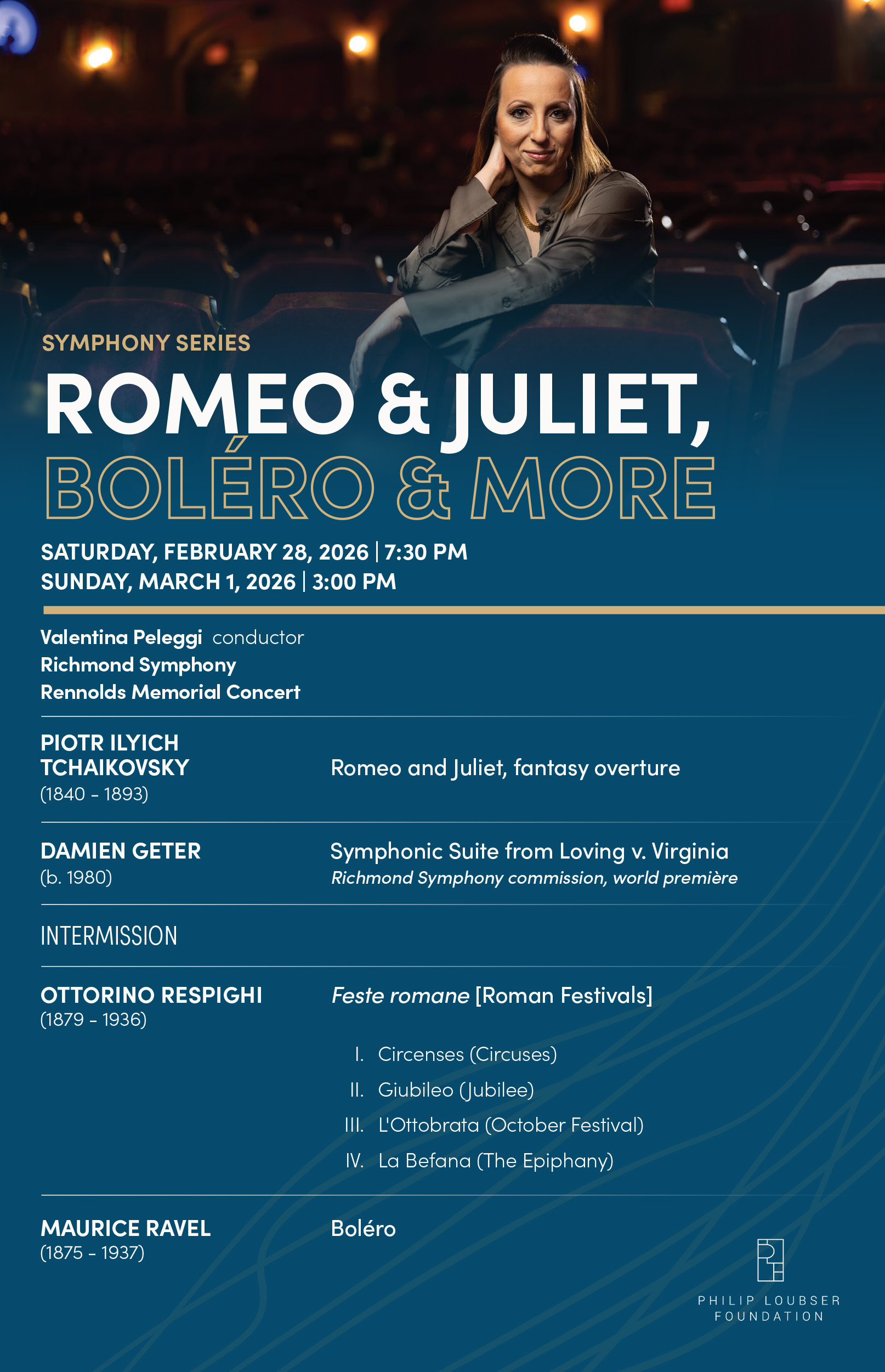
LOVE STORIES: ROMEO & JULIET,
BOLÉRO & MORE!
Valentina Peleggi | conductor
RICHMOND SYMPHONY
Rennolds Memorial Concert
Each Richmond Symphony season includes a program that places the orchestra — without a soloist — at center stage. “It’s our chance to celebrate the full ensemble,” says Music Director Valentina Peleggi. This concert pairs two contrasting love stories on the first half: the world premiere of Damien Geter’s Suite from Loving v. Virginia and Tchaikovsky’s Romeo and Juliet – Overture-Fantasy.
The second half revels in orchestral color with Respighi’s riotously scored Feste Romane and Ravel’s hypnotic Boléro. “Respighi stretches the orchestra to its limits,” Peleggi says, “and both he and Ravel draw on folk roots to create extraordinary lines and sonorities.”
Damien Geter / Suite from Loving v. Virginia
Damien Geter has emerged as a major compositional voice whose work often engages questions of social justice while remaining grounded in lyricism and dramatic expression. Geter’s opera Loving v. Virginia premiered in April 2025 and is the source of this new orchestral suite.
With a libretto by Jessica Murphy Moo, the opera recounts the story of Mildred and Richard Loving, the interracial couple from Caroline County whose quiet resolve led to the Supreme Court’s 1967 decision striking down bans on interracial marriage. Forced to marry in Washington, D.C. because their union was illegal in Virginia, they yearned simply to return home. “To me, the longing for home lies at the heart of the story,” Geter says.
The opera is built around recurring musical ideas: the central “home theme”; stern, inflexible music for the Sheriff and Judge; the rhythmically rigid “law chorus”; and themes of love and dreamlike aspiration. In shaping the Suite, Geter distilled these elements into a purely orchestral journey that preserves the opera’s dramatic arc.
He wrote no substantial new music — only “one or two measures” to link sections — while expanding the orchestration for the Symphony’s full forces. Brass instruments even take up former vocal lines.
The Suite unfolds in one continuous movement framed by the home theme, which “follows many winding paths and challenges until Richard and Mildred finally return home in the end.” Along the way, music of love, fear, hope, and confrontation comes into sharp relief as themes of the state collide with more intimate strains. “Hopefully the story is in the music,” Geter says, “particularly the points of high drama.”
Tchaikovsky / Romeo and Juliet – Overture-Fantasy
The impulse to translate Shakespeare’s Romeo and Juliet into music seemed almost destined for Tchaikovsky. Only a few years out of the conservatory, in 1869 he followed a suggestion from his mentor Mily Balakirev to retell the tragedy in musical terms — a project that became his first major orchestral breakthrough.
Tchaikovsky seized on the story’s emotional contrasts: the innocence of first love, the guidance of Friar Laurence, and the violence of the feud surrounding the young couple. He shaped these episodes into a single sweeping arc that gives the score its narrative clarity and lasting appeal.
The work distills Shakespeare’s drama into an outpouring of feeling that foreshadows the composer’s later symphonies. The music of Friar Laurence opens the piece in quiet, chorale-like phrases. Tension soon erupts in sharply etched gestures for the Montagues and Capulets. Out of this turmoil emerges the famous love theme — tenderly phrased by English horn and viola — its long, arching lines capturing the yearning and vulnerability of the lovers. The final section turns elegiac, ending with one last radiant statement of the theme before the music returns to a world too fractured to sustain it.
Respighi / Feste Romane (“Roman Festivals”)
Completed in 1928, Feste Romane is the most spectacular yet least often performed installment in Respighi’s trilogy of Roman tone poems — works that paint an epic, time-spanning portrait of the Eternal City. Raised in Bologna, Respighi studied abroad with Rimsky-Korsakov, whose mastery of orchestration helped shape his own dazzling style. After settling in Rome in 1913, he joined the faculty of the Accademia Nazionale di Santa Cecilia, whose orchestra premiered Fountains of Rome and Pines of Rome.
But Feste Romane demanded such immense forces that it premiered instead in New York, with Toscanini conducting. “The orchestration is so gigantic — including nine percussionists, piano four hands, organ, mandolin, and even three offstage trumpets,” Peleggi notes. “It’s the only one in the trilogy I have never done before.”
The four movements unfold as cinematic tableaux across Rome’s history. “Circenses” (“The Games”) plunges us into gladiatorial spectacles meant to keep the populace satisfied — panem et circenses, “bread and circuses.” “Il Giubileo” (“The Jubilee”) follows pilgrims approaching St. Peter’s to tolling bells and radiant brass. “L’Ottobrata” (“The October Festival”) celebrates a secular autumn holiday with dances, serenades, and pastoral warmth. The finale, “La Befana,” evokes the raucous Epiphany fair in Piazza Navona, hurtling forward in street cries, folk tunes, and dazzling effects — and bringing back the offstage trumpets like fragments of a roaming festival band.
Ravel / Boléro
With Boléro, Ravel transforms a single melody and an unchanging rhythm into a kaleidoscope of orchestral color. Originally conceived as a ballet for Ida Rubinstein in 1928, it has long since claimed a life of its own in concert halls and popular culture.
Ravel wrote the score to a scenario Rubinstein proposed, involving a Carmen-like flamenco dancer in a Spanish tavern, while privately imagining an alternative factory backdrop that helped shape the music’s famously mechanical, unyielding rhythm.
The two-measure Andalusian bolero pattern repeats throughout, played by the snare drum, while the melody — laid out in two repeated sections — passes from solo instruments to larger groups. The music grows steadily in color and intensity, emerging as a radical take on variation form: the tune never changes, but everything around it does. Its relentless repetition anticipates Minimalism, and its final, explosive modulation remains one of the great shocks in orchestral music.
Program notes (c)2026 Thomas May