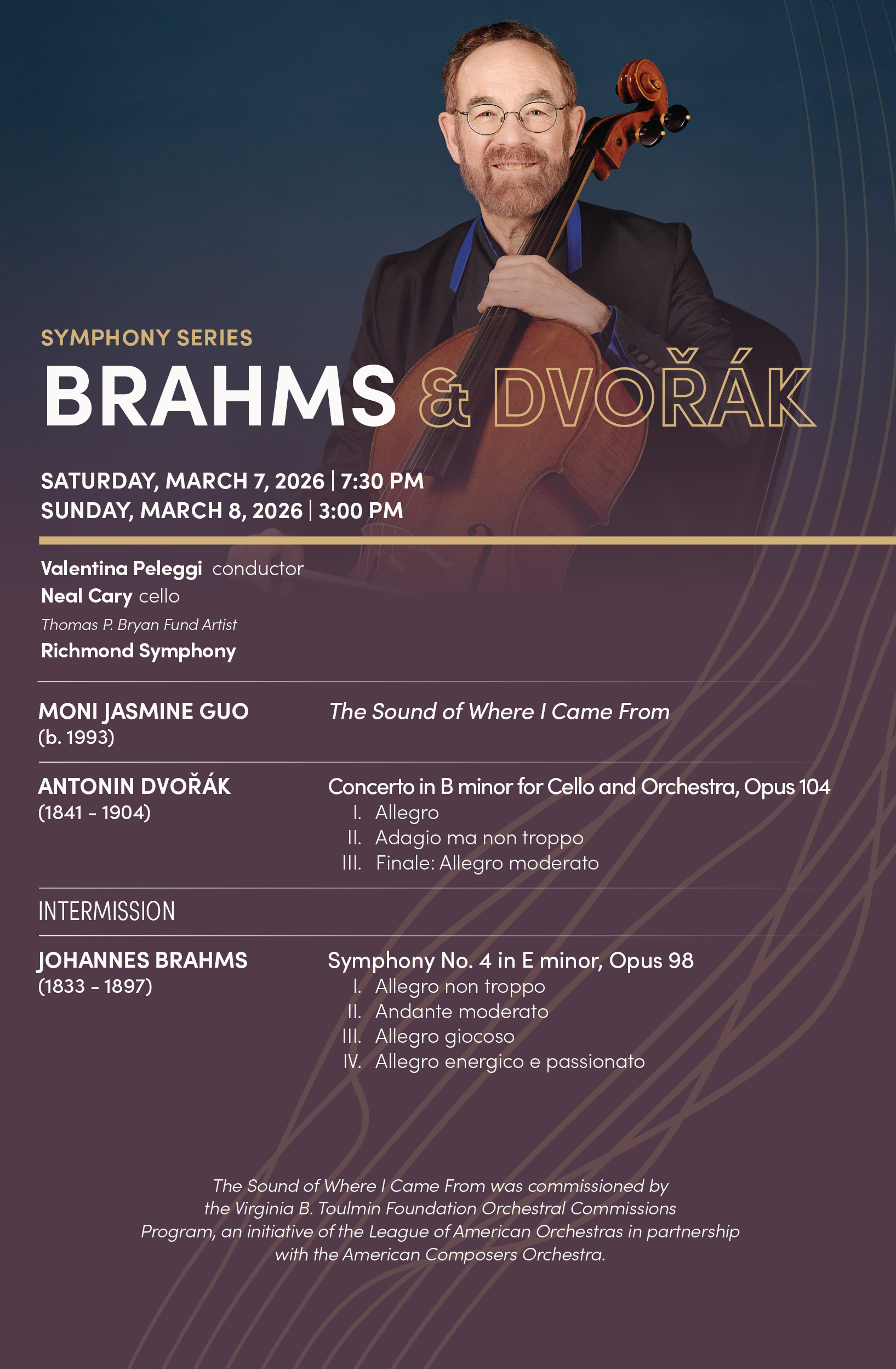
BRAHMS & DVOŘÁK
This program moves from a young voice shaped by a global career to two towering figures of the symphonic tradition. Still early in her career, Moni (Jasmine) Guo, has already earned international recognition, including being named one of Forbes China’s 100 Most Influential Chinese in 2023.
From there, the program turns to two Romantic masterpieces bound by one of music history’s most meaningful friendships. “I love pairing Dvořák and Brahms,” says Music Director Valentina Peleggi, “not only because of their music, but because of their friendship — the human relationship and the artistic respect they had for one another.”
Moni (Jasmine) Guo / The Sound
of Where I Came From 乡音 / 8 minutes
The Sound of Where I Came From is a deeply personal meditation on memory, voice, and the meaning of home. For Guo, the work grew out of a moment of reflection that stirred a powerful sense
of “coming home,” both musically
and emotionally.
Born in 1993 and raised in Taiyuan, in China’s Shanxi province, Guo began piano study at the age of three and was soon reshaping the music she played, instinctively imagining new rhythms and harmonies. Her path eventually led her to the United States, where she studied composition and piano at Interlochen Arts Academy and later continued her studies on both coasts. Alongside her concert work, she has developed an active career as a film composer.
When Guo began planning this piece, she initially considered drawing on the historical music and folk traditions of her hometown. But as she composed, her focus shifted inward. The turning point came during a period when her grandmother — the person with whom she spent much of her childhood — was diagnosed with Alzheimer’s. Her grandmother is the only member of Guo’s family who speaks their local dialect, a language shaped by falling inflections and calling gestures. During that time, Guo found herself repeatedly hearing the sound of her grandmother calling her name, and of her younger self answering back.
Those remembered calls became the “seed” of the piece. Guo translated the call-and-response into pitch, rhythm, and contour, shaping a recurring motif that runs throughout the work. While the orchestration reflects her long immersion in the Western symphonic tradition, the emotional center remains intimate
and human.
“My grandmother is home,” Guo says. “She can no longer call my name, but the sound of her voice will always stay with me.” In that sense, The Sound of Where I Came From becomes both a musical letter and a reflection — returning listeners to the voices and memories that shaped their own beginnings.
Dvořák / Cello Concerto in
B minor, Op. 104 / 40 minutes
The friendship between Johannes Brahms and Antonín Dvořák was one of the most generous and consequential artistic relationships of the 19th century. Brahms, eight years Dvořák’s senior, played a decisive role in launching the younger composer’s international career, serving on the jury of the Austrian State Prize committee that awarded Dvořák a stipend in 1875 and later introducing his music to the publisher Franz Simrock. Their relationship grew into a genuine friendship grounded in mutual respect and shared artistic values.
“I love pairing Dvořák and Brahms,” says Music Director Valentina Peleggi, “not only because of their music, but because of their friendship — the human relationship and the artistic respect they had for one another.
With his international standing secure, Dvořák embarked on a new chapter in the 1890s, spending the years 1892 to 1895 in the United States. He had been invited to lead the National Conservatory of Music in New York by its visionary founder, Jeannette Thurber.
Both the Cello Concerto and the Symphony No. 9 (“From the New World”) emerged from this period and have since become cornerstones of the repertoire. Dvořák composed the concerto near the end of his stay, between November 1894 and February 1895, during a period marked by creative curiosity and intense homesickness.
At the time, the cello was still regarded as an unlikely vehicle for virtuosity. But Dvořák, who had practical experience as a violist from his early years in Prague’s opera orchestra, mapped out a new path for the instrument. Personal circumstances also shaped the work. While composing, he learned that his sister-in-law Josefina, for whom he had once harbored deep feelings, was gravely ill. After her death in 1895, Dvořák revised the concerto’s ending, lending it an added layer of emotional gravity.
Despite its American origins, the concerto avoids easy optimism. Its sound world is suffused with longing and tragic pathos. The expansive first movement unfolds on a symphonic scale, balancing lyrical warmth with structural rigor. A serene Adagio, delicately colored by the woodwinds, frames an impassioned central episode that quotes a song especially dear to Josefina. In the finale, a buoyant rondo gives way to one of the concerto’s most poetic moments, as earlier memories return and fade “like a sigh,” before the orchestra
rises to bring the work to its
powerful close.
Brahms / Symphony No. 4 /
40 minutes
“I’m rather afraid that it tastes like the climate here,” Brahms wrote while working on his Fourth Symphony during the summer of 1884. “The cherries don’t ripen in these parts; you wouldn’t eat them!” The metaphor proved apt. Although the symphony contains some of the most impassioned passages in Brahms’s output, it is framed by an unflinching tragic language, in which even moments of brightness arrive more as surprise than relief.
The symphony grows organically from the simplest material. Its opening theme is built from a small musical interval, allowing large-scale structures to unfold with a sense of inevitability. The first movement presses forward with restless momentum; the Andante moderato unfolds as a solemn procession; and the third movement offers a brief, nervous release (including the sound of a tinkling triangle).
The finale looks back to the Baroque form of the passacaglia, built on a repeating bass line. Over 30 variations, Brahms transforms this “archaic” procedure into a symphonic argument of relentless force. The tension between repetition and forward momentum generates a sense of tragic inevitability, as the music drives toward its grim, uncompromising close.
Did you know?
Dvořák was an avid train enthusiast and scheduled his composing days around visiting Prague’s railway stations to watch trains arrive and depart.
- Dr. Julie Bemis
(c)2026 Thomas May
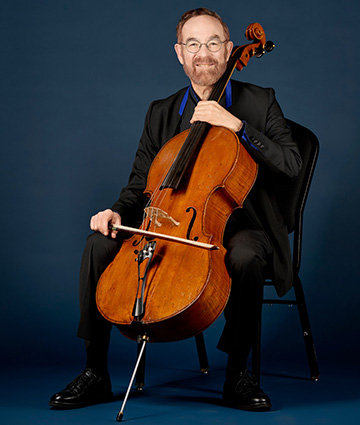
CELLIST
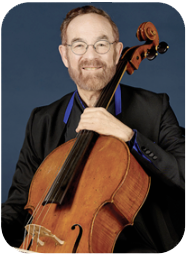 Neal Cary has been praised for his “robust tone and high-romantic phrasing,” and the “tremendous amount of emotion and heart” he brings to his performances.
He has been principal cellist with the Richmond Symphony since 1988, and served as principal cellist of the Williamsburg Symphony from 2002-2024. In 1984, he joined the faculty of the Eastern Music Festival in Greensboro, North Carolina, and served as principal cellist each summer from 1988 until its unnecessary dissolution in 2025. Neal Cary will continue the important educational mission of EMF as envisioned by Sheldon Morgenstern, its founder, as principal cellist along with former EMF Faculty beginning in the summer of 2026 under the newly formed Eastern Festival of Music. Neal Cary has performed with the All-Star Orchestra—an orchestra comprised of some of the finest musicians in the United States for five of its six seasons. This orchestra was created for the production of television programs airing on various PBS stations throughout the country. Read more at richmondsymphony.com