COPLAND & Beethoven
Concert programs often take on a kind of inner weather — an emotional climate that sets the tone before a note is played. For this evening, Music Director Valentina Peleggi shapes the first half around a feeling of warmth and connection. She explains: “I wanted to open with a piece by Jessie Montgomery that creates the atmosphere for entering the Fourth Piano Concerto — something that gives a sense of a big embrace.”
Montgomery’s Hymn for Everyone arose from a moment of personal and collective upheaval. Its blend of simplicity and spaciousness offered Peleggi a natural prelude to Beethoven’s most introspective concerto — music born in solitude yet reaching outward. The mood then expands toward the broader landscape of American orchestral sound with Copland’s Symphony No. 3.
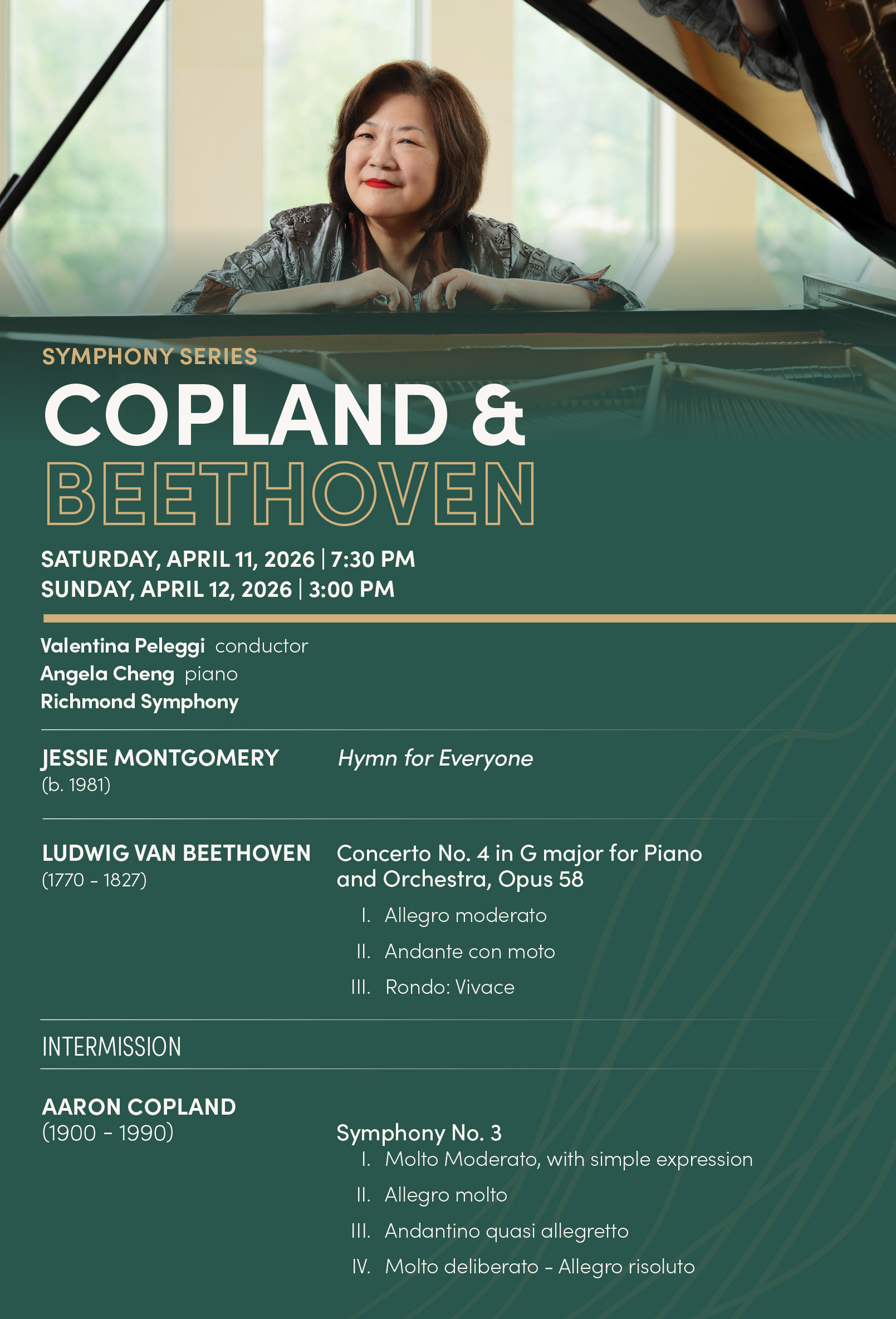
Jessie Montgomery / Hymn for Everyone / 12 minutes
Jessie Montgomery grew up in an unusually vibrant artistic world, experiencing experimental theater alongside improvised jazz and classical training as natural elements of her creative environment. She studied violin from childhood, began composing young, and developed a career that blends performing, teaching, and writing music shaped by many traditions.
Hymn for Everyone is the first orchestra piece Montgomery completed as part of her Chicago Symphony Orchestra residency. She wrote it during the pandemic — a period that coincided with her 40th birthday and with her mother’s death in 2021 — and describes the work emerging during a time of rethinking and renewal. Montgomery had initially imagined a multi-movement suite but instead found herself drawn to a single hymn-like melody, which came to her after a long hike, a rare moment of effortless inspiration during a period of writer’s block.
Although the piece has no text, Montgomery draws on the hymn as a symbol of solace and community. Its opening outline subtly recalls “Lift Every Voice and Sing,” which was taken up by the NAACP as a national anthem — not as a quotation but as a gesture of lineage. She passes the melody among different parts of the orchestra, exploring it through shifting colors and textures; a brass chorale anchors the center of the work, and tolling chimes underline its elegiac strain. Montgomery has described the score as “a kind of meditation for orchestra,” and its reflective character provides a gentle path toward the Beethoven concerto that follows.
Beethoven / Piano Concerto No. 4 /
34 minutes
Composed in 1805–06, Beethoven’s Fourth Piano Concerto belongs to the same creative era as the Eroica Symphony, the Fifth, Fidelio, and the Appassionata Sonata — works often grouped under the composer’s “heroic” style. Yet the Fourth charts a quieter path. Its heroism is inward, poised between lyricism and strength rather than driven by the stormy urgency of its famous companions.
Beethoven’s opening gesture remains one of the boldest in any concerto: the piano begins alone, softly, almost as though thinking aloud. What seems spontaneous is tightly woven, introducing the subtle rhythmic cell that underlies the first movement. When the orchestra enters, it restates the idea in a different key, creating the gentle sensation that the music has shifted its footing — a tiny harmonic surprise that opens a world of possibility. Much of the movement’s drama grows from these understated changes of light and color rather than from overt confrontation.
The second movement, marked Andante con moto, heightens that sense of dialogue. The strings begin with firm, almost unyielding phrases; the piano answers quietly, with a steady insistence that seems to soothe rather than challenge. Little by little, the tension unwinds. The orchestra softens, the piano gains expressive warmth, and the two gradually reach a shared stillness. Listeners have long connected this exchange with the myth of Orpheus calming the forces of the underworld — a metaphor Beethoven never confirmed but one the music itself invites.
The finale releases the accumulated energy in a movement that is lively, clear, and full of sunlight. For the first time in the concerto, Beethoven adds trumpets and drums, brightening the sound with a burst of outward confidence. Yet even here he balances boldness with lyricism: a gentle, reflective idea slips into the flow, enriching the more extroverted theme.
Copland / Symphony No. 3 /
38 minutes
Copland’s Symphony No. 3 (1944–46) is his largest orchestral work and one of his defining achievements. It unites two sides of his musical personality: the modernist experimenter of the 1920s and early ’30s and the populist voice behind the ballet scores Billy the Kid, Appalachian Spring, and Rodeo. Commissioned by the Koussevitzky Foundation and written for the Boston Symphony, the work reflects both the wartime mood and Copland’s desire to speak with clarity to a broad audience.
A major turning point was his decision to weave Fanfare for the Common Man — composed in 1942 — into the finale. The familiar melody becomes a thematic anchor that links the symphony’s expansive landscapes with its ceremonial close.
The first movement unfolds with the open, widely spaced sonorities that had become associated with Copland’s “American” sound, moving from calm breadth to moments of rhythmic urgency. The second movement is a vigorous scherzo, full of bright brass, kinetic energy, and the physical drive reminiscent of Rodeo. The slow third movement offers introspection: a long, searching line grows, brightens, and finally returns to quiet. The finale follows without pause, beginning with a hushed outline of the Fanfare before expanding into a sweeping, affirmative conclusion. The effect is both grand and deeply human — a fitting culmination to an evening that traces a path from intimate reflection to expansive hope.
(c)2026 Thomas May
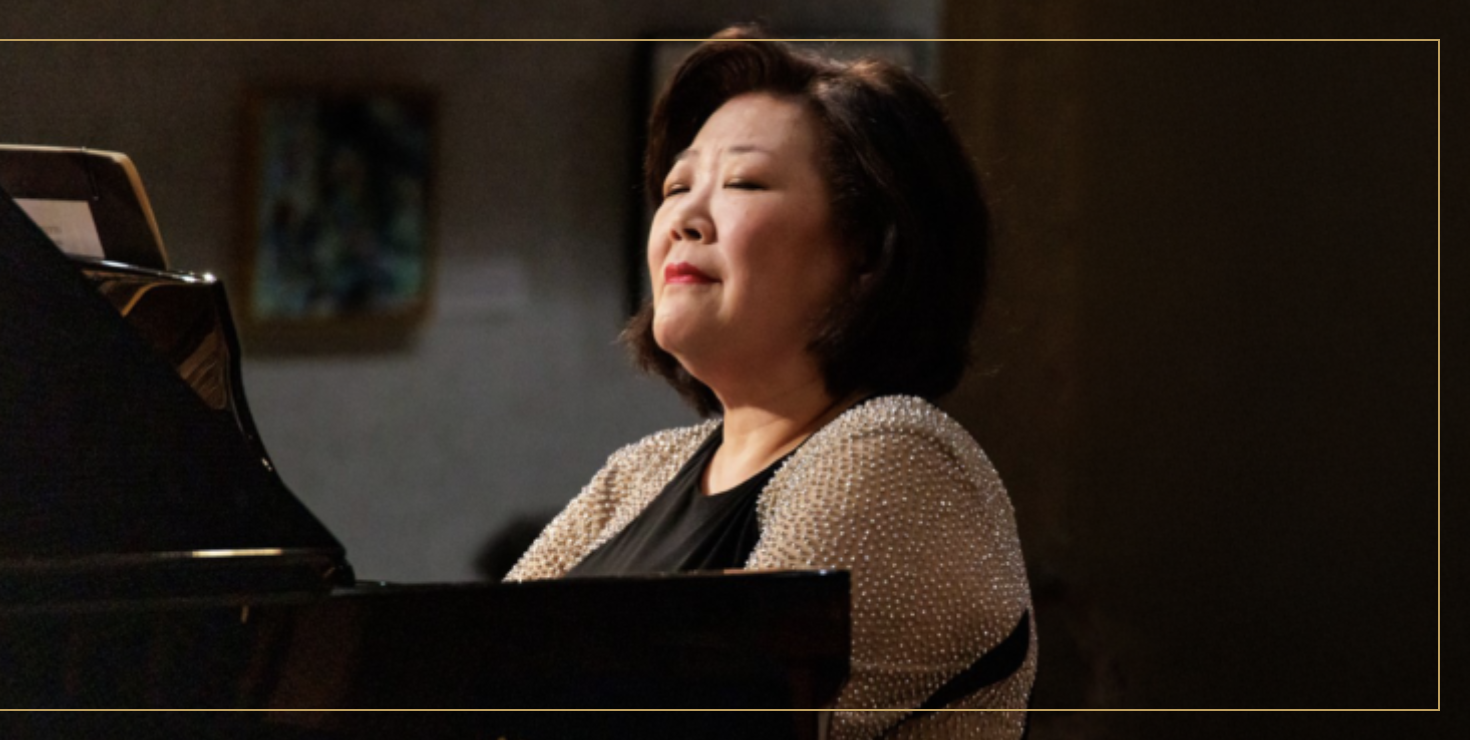
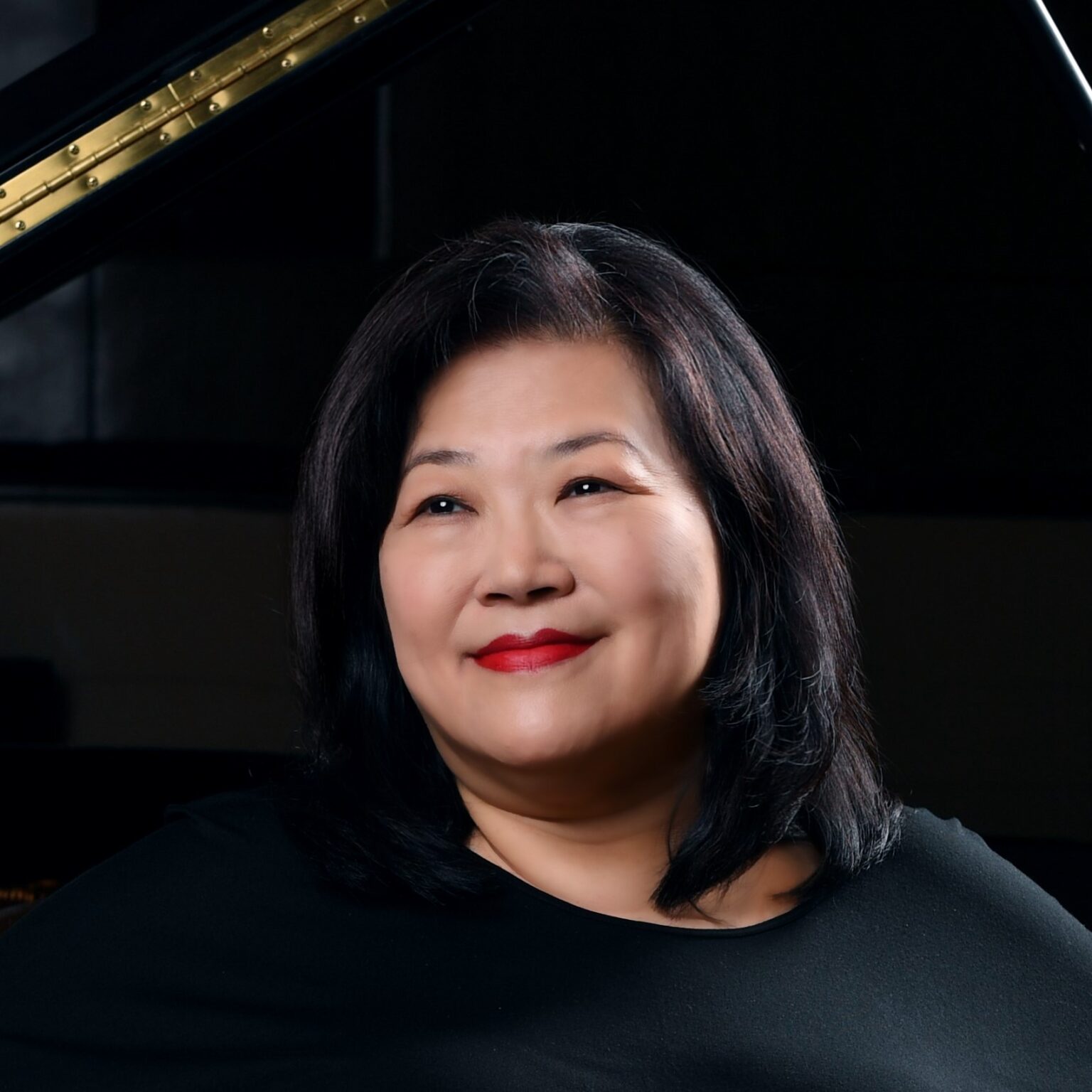 Pianist
Consistently praised for her brilliant technique, tonal beauty, and superb musicianship, Canadian pianist Angela Cheng is one of her country’s national treasures. In addition to regular guest appearances with virtually every orchestra in Canada, she has performed with the symphonies of Saint Louis, Houston, Indianapolis, Colorado, Utah, San Diego, Fort Worth, and Jacksonville, as well as the philharmonic orchestras of Buffalo, Louisiana, Rhode Island, London, Israel and Minas Gerais in Brazil.
Recent performances include a return to the Edmonton Symphony, Boulder Philharmonic, Minas Gerais Philharmonic, Music Toronto and the Vancouver Recital Society for the Brahms Festival. Next season will include the Richmond Symphony, Akron Symphony, Regina Symphony, and a recital at Art Spring, among others. Learn more at schmidtart.com/angela-cheng