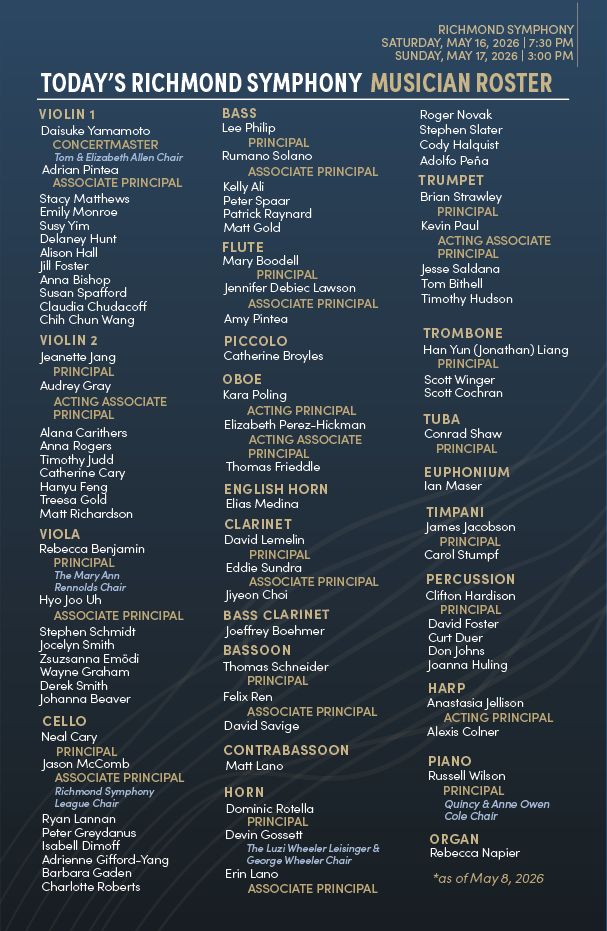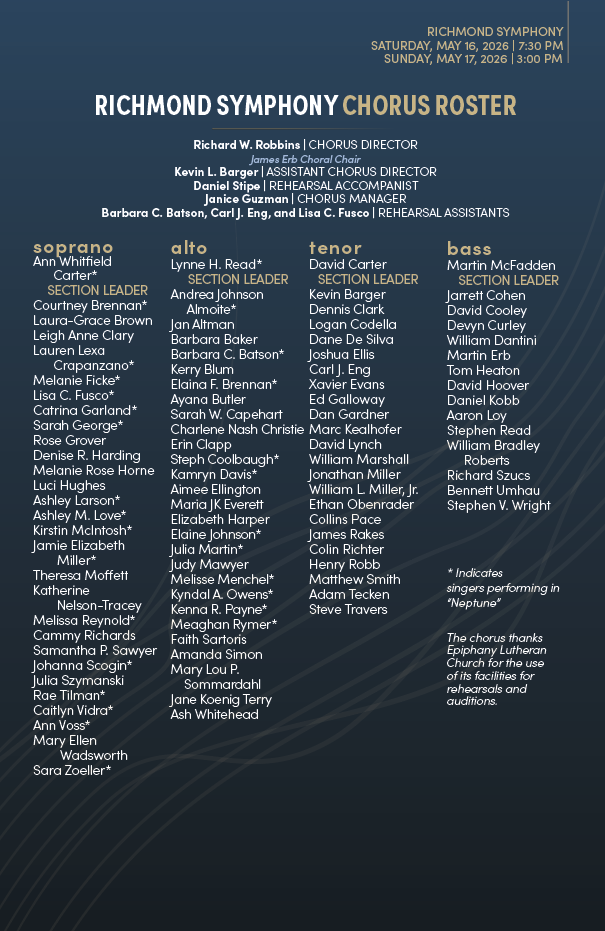
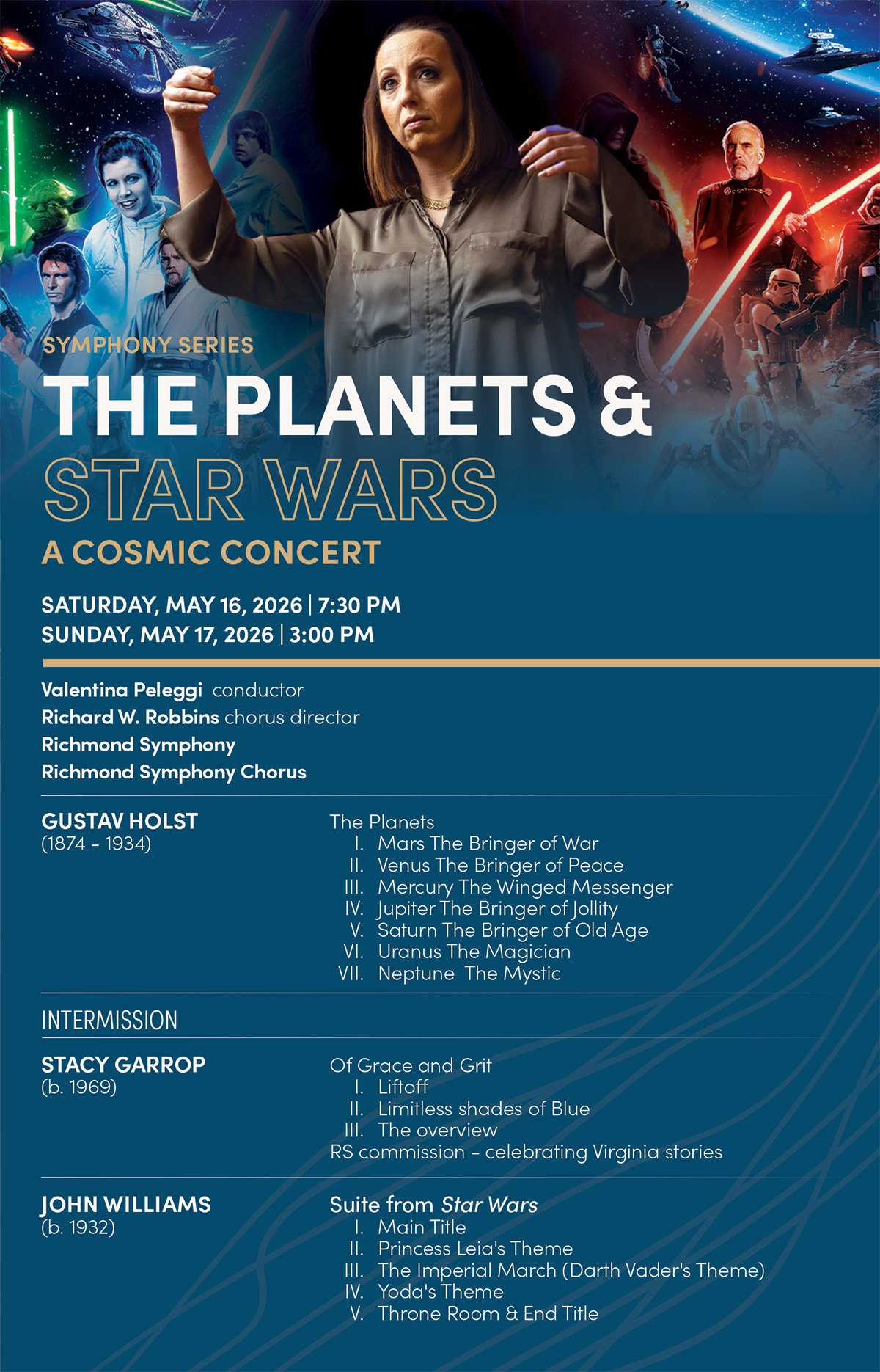
The Richmond Symphony closes its season by turning its gaze upward. Uniting the orchestra with the Richmond Symphony Chorus, the program explores music inspired by the cosmos, from Gustav Holst’s The Planets to a symphonic suite drawn from Star Wars. As Music Director Valentina Peleggi
puts it, “we want to end by looking at
the stars.”
In that spirit, the program places John Williams squarely within the symphonic tradition. “He is one of the greatest composers of all time,” Peleggi observes, noting that his music is too often relegated to a “pops” category.
Balancing that expansive, mythic vision is a new orchestral work by Stacy Garrop, commissioned by the Richmond Symphony as part of its ongoing commitment to telling Virginia stories. Inspired by the life and reflections of astronaut Leland Melvin—a local hero and one of the first African American astronauts—Of Grace and Grit reflects on space not as fantasy, but as
lived experience.
Holst / The Planets / 48 minutes
Gustav Holst drew on influences ranging from Romanticism to early Modernism for The Planets, creating an orchestral epic that would go on to influence countless film scores. “These pieces were suggested by the astrological significance of the planets,” he wrote, with each movement shaped by the symbolic character associated with the planet in question.
Holst took liberties with traditional astrology, opening the suite with “Mars, the Bringer of War,” whose musical material made a spectacular beginning. The first three movements appear “out of order,” while the remaining four proceed according to distance from the sun. (Pluto had not yet been discovered.)
Early audiences associated “Mars” with the First World War, which officially ended shortly after the suite’s premiere, though Holst composed the movement in the summer of 1914, before the full outbreak of war. The opening unfolds with aggressive brass, expanded woodwinds, low harp, and strings played with the wood of the bow. A relentless, uneven rhythmic pulse suggests an inhuman, mechanizing force that intensifies the menace of the looming three-note motif.
“Venus, the Bringer of Peace” offers a contrasting pastoral calm, while “Mercury, the Winged Messenger,” the briefest movement, darts by in gossamer textures and shifting rhythms. At the suite’s center, “Jupiter, the Bringer of Jollity” balances exuberance with a hymn-like tune of stately dignity. “Saturn, the Bringer of Old Age” transforms earlier oscillating harmonies into something colder and more enigmatic, moving from funereal weight toward what Holst described as “a vision of fulfillment.” “Uranus, the Magician” revels in theatrical swagger before dissolving into fragments.
“Neptune, the Mystic” turns inward, focusing on texture rather than thematic development. Holst asks for pianissimo throughout, shifting instrumental color as a wordless female chorus—placed out of sight—enters near the close. The final bars fade gradually, leaving the music in eternal suspense.
Garrop / Of Grace and Grit / 18 minutes
Stacy Garrop approaches composition as a form of storytelling. Her music traces journeys shaped by effort, risk, and discovery, unfolding in sounds that can be radiant or unsettling, intimate or expansive.
Of Grace and Grit, commissioned by the Richmond Symphony, draws directly on that sensibility. The work is inspired by the life of astronaut Leland Melvin, born in 1964 in Lynchburg and an alumnus of the University of Richmond. His path from student-athlete to NASA astronaut carried him far beyond the region, and as one of the first African American astronauts, his career places a deeply personal story within a broader history of barriers broken and possibilities expanded.
The title comes from Melvin’s memoir and reflects a duality that resonated deeply with the composer. His journey was shaped not only by extraordinary accomplishment, but by formidable obstacles, including a training accident that left him permanently deaf in one ear. It is, Garrop notes, a story of relentless determination paired with moments of profound wonder: grit, sustained by grace.
Rather than compose a literal depiction of spaceflight, Garrop set out to imagine the experience of leaving Earth—the physical intensity, the visual astonishment, and the transformation of perspective that follows. “Liftoff” begins with surging energy before a theme emerges once ascent becomes flight. “Limitless Shades of Blue,” described by the composer as “basically joyous,” reflects Melvin’s descriptions of looking back at Earth and its astonishing variants of the color blue.
The final movement, “The Overview Effect,” takes its title from the shift in perspective astronauts often describe when viewing Earth from space, a moment of awe that can reshape our sense of responsibility toward the planet.
Williams / Star Wars Extended Suite / 36 minutes
It is hard to imagine contemporary cultural life without the music of John Williams somewhere in the background. Few listeners could claim not to have heard themes from at least one of his films over the past several decades, from Star Wars and Jaws to E.T., Indiana Jones, Schindler’s List, or Harry Potter.
Williams grew up immersed in jazz, the son of a percussionist with the Raymond Scott Quintette. After studying in Los Angeles, serving with the U.S. Air Force Band, and continuing his training at Juilliard, he built a career spanning more than six decades. Alongside his work for Hollywood, he has maintained a parallel life as a concert composer and conductor, including a long association with the Boston Pops Orchestra. Late last year, the Hollywood Bowl dedicated its iconic stage in Williams’s honor, recognizing his cultural significance at a moment when, now in his nineties, he remains creatively active.
In 2005, the American Film Institute ranked Williams’s score for Star Wars (1977) first on its list of the greatest American film scores of all time. Conceived as a modern space myth, Star Wars uses Williams’s symphonically scaled music to amplify a sweeping galactic narrative centered on the struggle between light and dark.
The Star Wars: Extended Suite draws music from across the saga, allowing familiar themes to appear in new proximity and dramatic context. The Main Title establishes the ceremonial tone of the franchise, while character themes and climactic sections such as “Duel of the Fates,” with its choral writing, demonstrate Williams’s command of large-scale forces. Heard without the narrative context of the films it originally accompanied, this music holds the listener’s attention as fully as other great concert works on the program, drawing on a late-Romantic orchestral imagination while remaining unmistakably his own.
Program notes (c)
2026 Thomas May