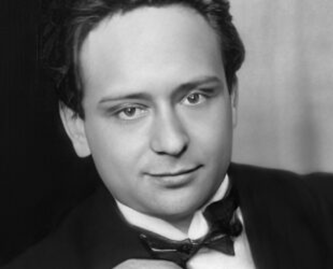
Viktor Ullmann was a prominent Jewish Czech composer of the period who was a protege of the serialist composer Arnold Schoenberg. Like Schullhoff, he found success with his work in Germany in the 1920’s but was forced to relocate to Prague after the Nazis seized power. In the 1930s, his style evolved to bridge between 12-tone composition and traditional tonality. His career came to a halt in 1939, when performances of Jewish composers’ music was banned after the Nazi occupation began, and much of his previous work was destroyed by the authorities. In 1942, Ullmann was deported to the Theresienstadt Ghetto, where most Czech Jews were imprisoned during the Nazi occupation, usually as a waystation before being sent to a concentration camp. Of the 140,000 Jews that spent time in Theresienstadt, only 20,000 survived.
In spite of the grim reality of Theresienstadt, there were attempts to maintain a sense of normalcy, which included a large number of musical performances. During his time there, Ullmann composed 16 works, including the opera Der Kaiser von Atlantis, wrote musical reviews, and helped organize musical performances.
"I have written a fair amount of new music in Theresienstadt…. All that I would stress is that Theresienstadt has helped, not hindered, me in my musical work, that we certainly did not sit down by the waters of Babylon and weep, and that our desire for culture was matched by our desire for life." -Viktor Ullmann
Written during his captivity, String Quartet No. 3 is one continuous movement comprising 4 main sections. The opening exposition begins with a melancholic melody and expressive swells of accompaniment. This transitions to an abrupt Presto that ruminates on a half-step fragment of the opening melody devolving into a macabre waltz that eventually relaxes into a recap of the opening theme before fading to nothingness. From the silence, the viola enters with the subject of an eerie 12-tone fugue travels and develops through the rest of the quartet. The sighing end of the fugue is interrupted by a strident unison melody that begins the “Rondo” section, which culminates with a triumphant return of the opening melody in the major mode.
After several years in Theresienstadt, Ullmann and his wife were transferred to Auschwitz in October 1944. While he initially planned to bring his scores with him, he ultimately decided to entrust them to a friend for safekeeping. Ullmann and his wife were murdered in Auschwitz’s gas chambers on October 16th, 1944.