× Podcast Conductor Biographies Bill Hemminger Biography Photos Videos Articles and Reviews Radio Broadcast Schedule History of the EPO Mission and Values Board of Directors 2025-2026 Sponsors 2025-2026 Philharmonic Gives Back Donors 10/1/2024 - 10/1/2025 Thoughtful Tributes 10/1/2024 - 10/1/2025 Past Events
Home Podcast Conductor Biographies Bill Hemminger Biography Photos Videos Articles and Reviews Radio Broadcast Schedule History of the EPO Mission and Values Board of Directors 2025-2026 Sponsors 2025-2026 Philharmonic Gives Back Donors 10/1/2024 - 10/1/2025 Thoughtful Tributes 10/1/2024 - 10/1/2025
Five Pieces for String Quartet (1924)
By Erwin Schullhoff (1894-1942)

Conrad Felixmüller’s Woodcut of the composer Erwin Schulhoff, Prague 1924
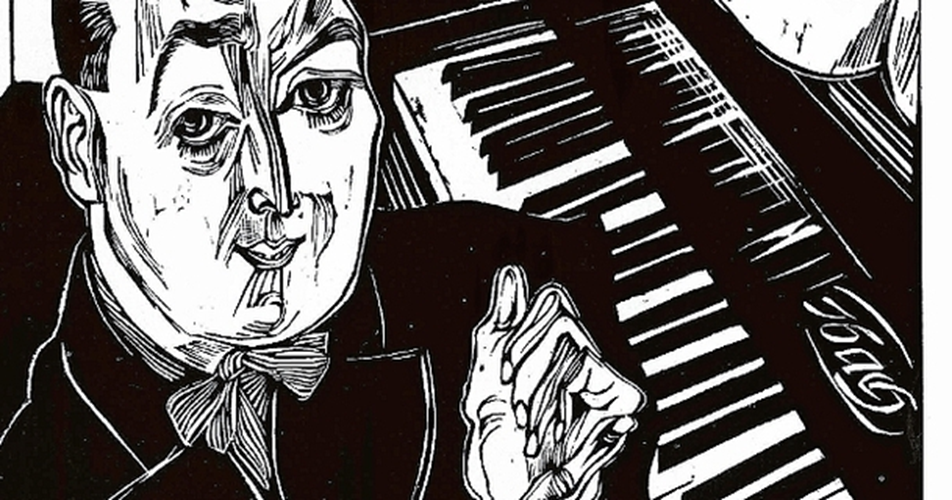

Erwin Schulhoff started his musical upbringing as a child prodigy in Prague, where he once played piano for renowned Czech composer Antonín Dvořák and was advised to pursue a career in music. This eventually led to Germany, where he studied composition with eminent composers Max Reger and Claude Debussy, who had deep roots in tonality and modality.  These studies were interrupted in 1914 by World War I, when he was conscripted into the Austro-Hungarian army. At the end of the War, Schulhoff moved to Dresden, where he associated himself with the Dada movement and other purveyors of the avant-garde, including painters Otto Dix and George Grosz, and embraced flippancy and expressive extremes in his works. 

The Five Pieces for String Quartet are emblematic of the rebellious artistic ecosystem that he inhabited when he composed them in 1924. The suite begins with an off-kilter Waltz written in a spuriously even 2/2 meter. The second movement is a coldly ominous Serenade. This is followed by an energetic dance, drawing from the Czech folk music of his homeland. The fourth movement is a sensual tango. The set ends with a mischievous and frantic Tarantella.

Schulhoff continued his successful career as a composer and pianist in Germany throughout the 1920’s. This ended when the Nazis took power and blacklisted him due to his Jewish heritage and classification as a “degenerate” artist. He resettled in Prague, and became increasingly involved in leftist politics. After the Nazis invaded in 1939, he began to perform under a pseudonym and obtained a Soviet passport. Before he could flee the country, Schulhoff was arrested following the Nazi invasion of the Soviet Union in 1941. He died of tuberculosis in a Nazi concentration camp in June 1941.

Five Pieces for String Quartet (1924)
By Erwin Schullhoff (1894-1942)

Conrad Felixmüller’s Woodcut of the composer Erwin Schulhoff, Prague 1924


Erwin Schulhoff started his musical upbringing as a child prodigy in Prague, where he once played piano for renowned Czech composer Antonín Dvořák and was advised to pursue a career in music. This eventually led to Germany, where he studied composition with eminent composers Max Reger and Claude Debussy, who had deep roots in tonality and modality.  These studies were interrupted in 1914 by World War I, when he was conscripted into the Austro-Hungarian army. At the end of the War, Schulhoff moved to Dresden, where he associated himself with the Dada movement and other purveyors of the avant-garde, including painters Otto Dix and George Grosz, and embraced flippancy and expressive extremes in his works. 

The Five Pieces for String Quartet are emblematic of the rebellious artistic ecosystem that he inhabited when he composed them in 1924. The suite begins with an off-kilter Waltz written in a spuriously even 2/2 meter. The second movement is a coldly ominous Serenade. This is followed by an energetic dance, drawing from the Czech folk music of his homeland. The fourth movement is a sensual tango. The set ends with a mischievous and frantic Tarantella.

Schulhoff continued his successful career as a composer and pianist in Germany throughout the 1920’s. This ended when the Nazis took power and blacklisted him due to his Jewish heritage and classification as a “degenerate” artist. He resettled in Prague, and became increasingly involved in leftist politics. After the Nazis invaded in 1939, he began to perform under a pseudonym and obtained a Soviet passport. Before he could flee the country, Schulhoff was arrested following the Nazi invasion of the Soviet Union in 1941. He died of tuberculosis in a Nazi concentration camp in June 1941.