Antonín Dvořák
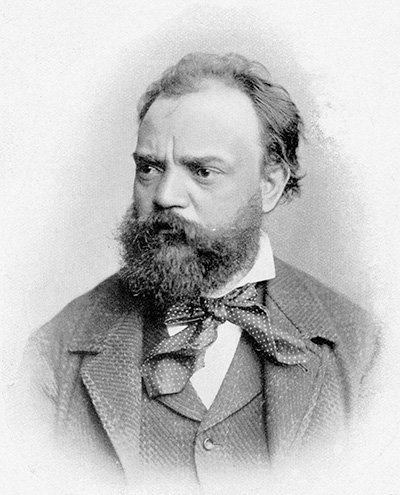
Born: September 8, 1841, Nelahozeves, Czechia
Died: May 1, 1904, Prague, Czechia
The Golden Spinning Wheel, Op. 109
- Composed: 1896
- Premiere: October 26, 1896, Hans Richter conducting the London Symphony Orchestra
- Instrumentation: 2 flutes (incl. piccolo), 2 oboes, English horn, 2 clarinets, 2 bassoons, contrabassoon, 4 horns, 2 trumpets, 3 trombones, tuba, timpani, bass drum, crash cymbals, suspended cymbals, triangle, harp, strings
- CSO Notable Performances: First and Most Recent: February 1957, Thor Johnson conducting
- Duration: approx. 22 minutes
The Golden Spinning Wheel falls into the genre of symphonic poem, a type of orchestral programmatic music evoking literary and poetic ideas. Antonín Dvořák came to this genre late in his compositional career, but the folklore and literature from which he drew had influenced his work throughout his life. Dvořák’s compositional style evolved over the course of his career, shifting through phases that resonated with contemporary German influences and phases that foregrounded classicism and Slavonic folkloric elements. By the 1890s, he was well known as a successful Czech composer significant for his nationalistic style. Due to this reputation, Dvořák was invited to the United States to help develop a national style of American music. He worked in the U.S. from October 1892 to April 1895, a fruitful “American period” that further bolstered his reputation.
After returning to Bohemia, Dvořák took on the symphonic poem genre. He had dabbled in programmatic music earlier in his career, most notably in his 1891 trilogy of overtures, Nature, Life and Love: In Nature’s Realm, Op. 91; Carnival, Op. 92; and Othello, Op. 93. Elements of programmatic music also appeared as evocative titles and extra-musical associations in his American compositions, such as his String Quartet No. 12, The American, and his Symphony No. 9, From the New World.
In 1896, Dvořák composed his first four symphonic poems: Vodník (“The Water Goblin”) Polednice (“The Noon Witch”), Zlatý kolovrat (“The Golden Spinning Wheel”), and Holoubek (“The Wild Dove”). These symphonic poems are based on ballads of the same titles by Karel Jaromír Erben (1811–1870), a Czech poet, historian and folklorist. Erben’s collection of Czech folk ballads was published in 1853 as Kytice z pověstí národních (“A Bouquet of Folk Legends”), also known simply by the short title Kytice (“Bouquet”). Dvořák admired Erben’s writing, which inspired the composer’s creative work and influenced the Slavonic folklore elements he incorporated into his music. Long before composing his symphonic poems, Dvořák used Erben’s text to compose songs and a choral work. Writing compositions based on Czech subjects was an important way for Dvořák to pay homage to his heritage, and turning to the genre of the symphonic poem allowed him to give life to traditional folklore in his music in a new way.
The ballads in Erben’s collection have dark subjects, poetic settings and dramatic themes that Dvořák translated into his music. He allowed the stories to drive the musical form and content, capturing the characters and their moods in musical motifs and expressing the plot through the structure and progression of the music. The Golden Spinning Wheel takes the form of a free rondo, with the main theme reappearing at the beginning of important episodes in the narrative. Dvořák also relied on Erben’s text in the creation of his musical motifs, using the declamation of Erben’s verses to guide the rhythms of the motifs in a style of “speech-melody.”
The Golden Spinning Wheel begins with a low ostinato in the cello and bass, repeating a rhythm evoking the churn of a spinning wheel. A horn fanfare enters, representing the hunting party of the king on horseback. This fanfare is the main theme that reappears throughout the piece, providing structure to the musical story. As he rides through the countryside, the king comes across the beautiful maiden Dornička working at her spinning wheel in her cottage. He asks her for a drink of water, and she complies. Their meeting appears in the music as the woodwinds gently introduce a dialogue between the spinning wheel motif in the English horn and a flowing violin solo. The tranquil music proceeds as the king and Dornička continue their exchange and fall in love. Finally, as the music becomes more animated, the king declares his love for Dornička through an impassioned violin melody.
The king’s fanfare theme reappears, announcing the next episode of the story in which the king confronts Dornička’s stepmother and demands that she bring Dornička to his castle. The stepmother is upset that the king has chosen Dornička and not her own daughter, who looks identical to Dornička. A low ominous line in the cellos and bass leads into a faster section of the step-mother, stepsister, and Dornička entering the forest to journey to the castle. While in the forest, the stepmother and stepsister kill Dornička and take her hands, feet and eyes. After a tense build-up in the strings, the music slows to a grand fanfare of the king greeting the women when they arrive at the castle. Mistaking the stepsister for Dornička due to their identical appearances, the king takes the stepsister as his bride, celebrating the wedding with spirited music in the woodwinds. A slower section follows, a love scene during which the king tells his new wife that he will soon have to leave for battle.
In the meantime, a mysterious magical hermit finds Dornička’s body in the forest and resolves to bring her back to life. He sends a page to the castle three times to get Dornička’s missing body parts from the stepsister. First, the lad asks for the feet in return for a golden spinning wheel. He then requests to trade the hands for a golden distaff, and finally he asks for the eyes in exchange for a golden spindle. These trades unfold slowly and successively in the music: three times, the trombones state the hermit’s instructions, followed by flute solos that represent the page presenting the requests to the stepsister. Desiring the golden items, the stepsister gives Dornička’s hands, feet and eyes to the boy, and the magical hermit restores the body parts to the body and brings Dornička back to life.
The king returns from battle, announced by the reappearance of his fanfare theme. He asks his wife to spin on the new golden spinning wheel. As the wheel turns, it churns a song that reveals the deception of the stepmother and stepsister and the murder they committed. The king runs to the forest to find Dornička alive and well, accompanied by the music of the earlier love scene but now fuller with the joy of reunion. The impassioned music of their first meeting and the king’s initial declaration of love follows, as the king and his true bride return to the castle. Although Erben’s ballad concludes with a bloody punishment for the stepmother and stepsister, Dvořák concludes the piece with a final statement of the king’s fanfare and the triumphant joy of the two lovers.
—©Dr. Rebecca Schreiber