Bedřich Smetana
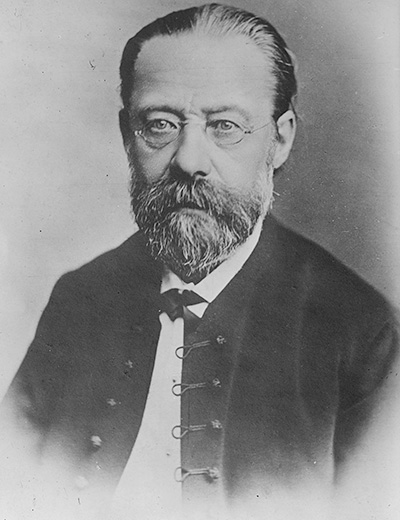
Born: March 2, 1824, Litomyšl, Bohemia [now Czech Republic]
Died: May 12, 1884, Prague, Czechia
Vltava (“The Moldau”), No. 2 from Má vlast
- Composed: 1874
- Premiere: April 4, 1875, Prague, Adolf Čech leading the Orchestra of the Prague Provisional Theatre.
- Instrumentation: 2 flutes, piccolo, 2 oboes, 2 clarinets, 2 bassoons, 4 horns, 2 trumpets, 3 trombones, tuba, timpani, bass drum, crash cymbals, suspended cymbals, triangle, harp, strings
- CSO Notable Performances: Most Recent: November 2016, Santtu-Matias Rouvali conducting. Other: September 2024 as part of a Pops subscription concert, John Morris Russell conducting
- Duration: approx. 12 minutes
The most important ambition of Czech composers in the 19th century was to give their music a Czech national character. This, as musicologist Michael Beckerman has pointed out in an influential essay, involved a lot more than merely using Czech folk music as a source of inspiration. “Czechness” was an explicitly stated artistic program shared by all composers working in the country who wanted their works to be understood as being rooted in Czech history, culture and landscapes. In the process, they strove to reduce the German influence on their works as much as possible. This endeavor was, in turn, part of a general movement known as the Czech National Revival, which sought to promote all aspects of Czech culture, including language, literature and folklore — all part of the struggle for national independence. Until the end of World War I, the Czech lands were part of the Austro-Hungarian Monarchy. Independence finally came in 1918, when Bohemia and Moravia, formerly under Austrian rule, were united with Slovakia, which had belonged to Hungary, itself part of the monarchy. Thus, the Republic of Czechoslovakia was created.
Like many members of the Czech middle class, Bedřich Smetana, the founder of the Czech national school of composers, spoke German as his first language. He learned to speak and write the Czech language correctly only later in life. His exceptional talent as a pianist and composer was apparent at a young age and he received early encouragement from Franz Liszt. Yet recognition as a composer did not come easily, and he had to accept a teaching position in Gothenburg, Sweden, where he remained for five years, before returning to Prague in 1861.
He was 42 when he scored his first great success with his operatic debut, The Brandenburgers in Bohemia in Prague; his next stage work, The Bartered Bride, finally established his international reputation. As the music director of the Provisional Theater in Prague since 1866, he became one of the most influential musicians in the country, widely admired as the “father of Czech music.” However, he had to resign in 1874 when he suddenly lost his hearing in both ears. Battling poor health during the last decade of his life, he nevertheless continued to compose prolifically, completing several more operas, as well as the cycle of six symphonic poems titled Má vlast (‟My Country”), in which he paid tribute to the natural beauty and heroic history of Bohemia. He also wrote his last three operas after the collapse of his health. After 1879, he began to show signs of mental illness, and he died in a lunatic asylum, barely 60 years old.
Vltava (“The Moldau”) is the second tone poem in the Má vlast cycle. At the end of the manuscript, Smetana noted: “Finished on December 8, 1874, [written] in 19 days, being completely deaf.”
The composer provided the following outline to the contents of the composition:
The work depicts the course of the river Vltava (Moldau), beginning from the two small sources, the cold and warm Vltava, the joining of both streams into one, then the flow of the Vltava through forests and across meadows, through the countryside where gay festivals are just being celebrated; by the light of the moon a dance of water nymphs; on the nearby cliffs proud castles, mansions, and ruins rise up; the Vltava swirls in the St. John’s rapids, flows in a broad stream as far as Prague, the Castle Vyšehrad appears, and finally the river disappears in the distance as it flows majestically into the Elbe.
Each of these episodes, indicated in the score, is clearly audible in the music. The two streams out of whose confluence the river is born are represented by a pair of flutes and a pair of clarinets, respectively. At the moment when the cold and the warm Vltava unite, we hear the iconic main theme, which “flows” through the entire piece, for the first time. This melody, which has become indissolubly linked to the Czech national river in the consciousness of all music lovers, is in fact an internationally known tune. First documented in 16th-century Italy, it was known in many countries. Smetana may well have heard it in Sweden, though the melody is also known as a Czech children’s song. The Hatikvah, the Israeli national anthem, is closely related in its melodic line as well.
In the symphonic poem, the famous theme grows and grows in intensity as the river traverses the countryside. Traveling downstream, we notice some hunters in the nearby forest, announced by their lively horn signals. Immediately afterward, we hear the sounds of a village band playing a lively Czech dance tune at a peasant wedding. Then we suddenly, and unexpectedly, leave reality to join the world of fantasies; as night falls, the place of the peasants is taken by the wood nymphs, who dance by the moonlight to the delicate sounds of high woodwinds, strings and harp. The orchestration gradually intensifies, and soon we are back to the main Vltava theme as we continue our journey. Before long, we reach St. John’s Rapids, where the music takes on a distinctly “wild” character. As the river approaches the capital city of Prague, the melody reappears in all its grandeur, and in the major mode instead of minor. We briefly glimpse the historic fort of Vyšehrad, and Smetana quotes the opening from his symphonic poem of that title from the Má vlast cycle. Vyšehrad, the one-time seat of the medieval Kings of Bohemia, is a symbol of the country’s ancient glory, and it is here that the symphonic poem reaches its emotional climax. But the piece doesn’t end there: the fanfare gradually fades away, and the music almost comes to a standstill when two energetic chords suddenly bring it to an end.
The first performance of Vltava took place in Prague in April 1875, under the direction of Adolf Čech, who was an indefatigable champion of Czech national music, especially that of Smetana and Dvořák. It quickly became one of Smetana’s most popular works, not only in Bohemia but abroad as well.
—©Peter Laki