Sergei Prokofiev
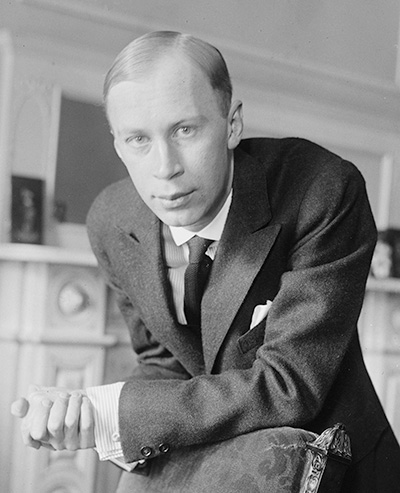
Born: April 23, 1891, Sontsivka, Ukraine
Died: March 5, 1953, Moscow, Russia
Concerto No. 1 in D Major for Violin and Orchestra, Op. 19
- Composed: 1917
- Premiere: October 18, 1923, Paris, Serge Koussevitzky conducting the Paris Opera Orchestra, Marcel Darrieux, violin
- Instrumentation: solo violin, 2 flutes (incl. piccolo), 2 oboes, 2 clarinets, 2 bassoons, 4 horns, 2 trumpets, tuba, timpani, snare drum, tambour de Basque, harp, strings
- CSO Notable Performances: First: November 1926, Fritz Reiner conducting; Lea Luboshutz, violin. Most Recent: April 2018, Louis Langrée conducting; Karen Gomyo, violin
- Duration: approx. 22 minutes
When a pianist-composer writes a violin concerto, we must expect something unusual. After all, the composer is putting his or her own instrument aside to explore the “other”: whether the goal is to oblige an esteemed colleague, to fulfill a commission or simply to try something new, the challenge to conquer a “foreign” medium often propels a composer’s stylistic evolution in new directions.
Prokofiev was 24 years old when he first sketched the romantic violin melody that would open his D major concerto. He probably didn’t realize then that the “ultra-left idiom” of his first two piano concertos, the Scythian Suite and the piano cycle Sarcasms would begin to change and a “softening of temper” would occur (the words in quotation marks are Prokofiev’s own). The Classical Symphony, on which he worked more or less simultaneously with the violin concerto, would soon confirm this new tendency.
The violin’s propensity to play beautiful lyrical melodies inspired Prokofiev to develop a “romantic” sound we don’t often hear in the “ultra-left” works, which project more of a “daredevil” image. Not that the concerto lacks virtuosic brilliance. On the contrary, it contains plenty of harmonics, double and triple stops and other challenging techniques. Yet one always feels that Prokofiev wanted to delight his listeners rather than stun them, even though he occasionally teased his audience with manifestations of his enfant terrible persona.
Since August 1914, Russia was embroiled in World War I, but Prokofiev did not let that get in the way of his feverish compositional activity. He and his mother retreated to a small village in the Caucasus mountains, where he became involved in a secret romance with a girl named Nina Meshcherskaya. Her wealthy family, however, refused to have anything to do with a young Bohemian artist like Prokofiev, and they broke off the relationship.
Despite the war, Prokofiev managed a trip to Italy in 1915 at the invitation of the legendary impresario Sergei Diaghilev, who had begun to promote the young composer’s music. After an adventurous return to Russia, Prokofiev wrote his ballet The Buffoon for Diaghilev and his opera The Gambler for the Mariinsky Theater in St. Petersburg (it was not performed due to the war and the revolutions). He finally returned to the violin concerto in 1917, after the February revolution put an end to czarist rule. Determined to be as far removed from the turmoil as possible, Prokofiev took a long steamboat trip along the Volga and Kama rivers, venturing into distant tributaries near the Ural Mountains. It was on the boat that he wrote and orchestrated most of the concerto.
Prokofiev initially wanted to write only a short “concertino” (presumably in a single movement) on the theme jotted down in the Caucasus. In the end, he expanded the original concept to a full-fledged three-movement concerto, but the opening melody still plays a central role, figuring prominently both at the beginning and at the end of the work. It first appears in a dreamlike fashion (Prokofiev wrote sognando, “dreaming,” in the score), with the solo violin over soft tremolos (fast repeated notes) in the violas. At the end of the movement, the same theme returns in a shimmering orchestration, with the melody taken over by the flute as the solo violin and the harp add their magical filigrees. In between comes an extended virtuoso section, starting with a theme marked narrante (“telling a story”). Starting quietly, the music builds up considerable momentum until an unaccompanied violin passage, all in double stops, leads back to the opening melody.
The second-movement Scherzo (Vivacissimo) shows the author of Sarcasms at his most sarcastic. The “wild” Prokofiev is back, with a combination of relentless rhythmic ostinatos (“obstinately” repeated figures), spicy harmonies and a level of technical difficulty bordering on the impossible. The “lyrical” Prokofiev then makes his return in the last movement which, contrary to expectations, is only moderately fast in tempo and primarily melodic in inspiration. The introductory theme, first played by the bassoon, later returns in the brass. The solo violin has some lyrical melodies of its own, and the brilliant embellishments of those melodies, often using the uppermost register of the instrument, present undiminished technical challenges to the soloist. At the climactic moment, there is a quite audible scene change — the effect is as if an inner curtain had suddenly been raised on the stage — and we are back to the lyrical opening of the concerto: we hear the initial melody again, in an iridescent setting very close to the one that ended the first movement.
Prokofiev’s “lyrical” and “sarcastic” voices are easily distinguishable throughout the concerto. The composer himself, discussing his own style in his autobiography written late in life, identified no fewer than four distinct strands. In addition to the lyrical side, he mentioned the “innovative,” which more or less covers what the world has perceived as “wild,” “barbaric” or “sarcastic.” In addition, the composer listed the “toccata-like” character, which involves driving motoric rhythms, and the “classical,” as developed most fully in the Classical Symphony. All four strands can be readily discerned in the First Violin Concerto. The different ways of writing introduced here would echo through Prokofiev’s music for years to come — not least in the Second Violin Concerto, written 20 years later.
Because of the revolutionary events and Prokofiev’s subsequent departure from Russia, the First Violin Concerto could not be performed at the time. It received its premiere in Paris on October 18, 1923, with violinist Marcel Darrieux as the soloist. The conductor was Serge Koussevitzky, who had been a champion of Prokofiev’s music since both were still in Russia. Darrieux was the concertmaster of Koussevitzky’s orchestra at the time. Koussevitzky was also responsible for the concerto’s American premiere, given by the Boston Symphony on April 24, 1925, with BSO concertmaster Richard Burgin as soloist. Back in Russia, the work was played just three days after the Paris premiere by two 19-year-old musicians, Nathan Milstein and Vladimir Horowitz, who played the orchestral accompaniment on the piano.
—©Peter Laki