Margaret Allison Bonds
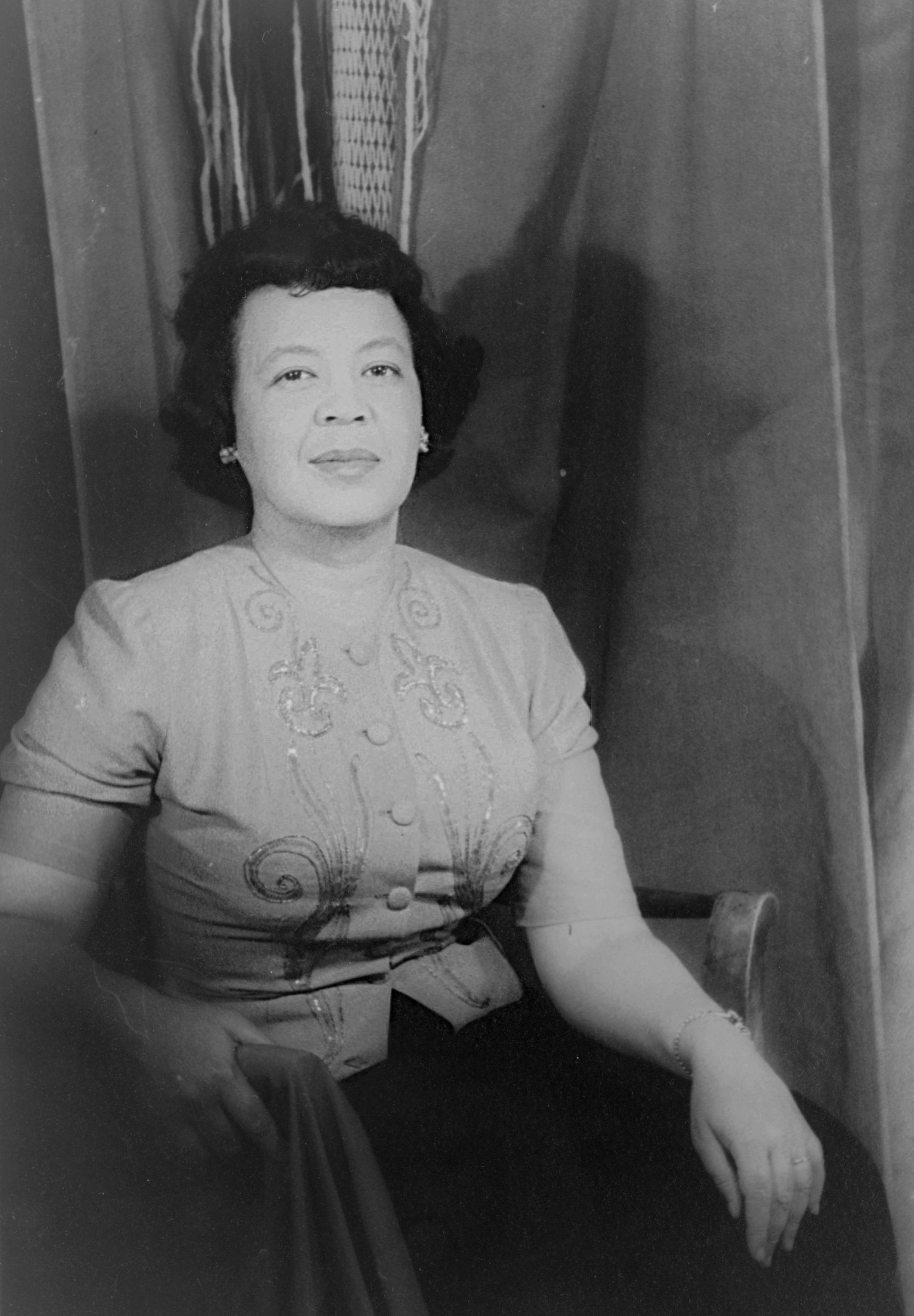
Born: March 3, 1913, Chicago, Illinois
Died: April 26, 1972, Los Angeles, California
The Montgomery Variations
- Composed: 1963–64
- Premiere: unknown
- Instrumentation: 3 flutes (incl. piccolo, alto flute), 2 oboes, English horn, 3 clarinets (incl. bass clarinet), 2 bassoons, contrabassoon, 4 horns, 3 trumpets, 3 trombones, tuba, timpani, cymbals, drum, hand cymbals, tambourine, triangle, wood block, harp, strings
- CSO notable performances: These are the first CSO performances of Bonds’ Montgomery Variations.
- Duration: approx. 16 minutes
Margaret Allison Bonds was no stranger to the type of intellectual activism and cultural work that underscored the mid-century Black civil rights struggle. She was born on March 3, 1913 in Chicago to Dr. Monroe Majors and Estella C. Bonds. Majors was a noted physician, writer and activist whose activities drew the attention of the Ku Klux Klan on many occasions, while Bonds was a highly respected teacher and musician whose home at 6652 Wabash Avenue became one of the intellectual centers for Chicago’s Black renaissance movement during the 1920s and 1930s.
In the decades that followed World War II, Bonds’ compositions exemplified how the Black renaissance movement intersected with the emerging Black civil rights struggle. Her compositional approaches differed from her contemporaries in that she advanced a sound identity that conflated neo-romanticism with elements of gospel, blues and jazz, while simultaneously promoting the liberation ideologies and cultural nationalism that permeated the intellectual circles she engaged with in New York and Los Angeles. With longtime friend and collaborator Langston Hughes, Bonds produced works that projected new understandings of Black life and Black identity. Most notable are the cantatas The Ballad of the Brown King and Simon Bore the Cross. These works, along with Montgomery Variations and Credo, are emblematic of how a number of Bonds’ compositions from this period aligned with other repertoires of protest music that were inspired by and used to advance the ideological scope of the Black civil rights struggle.
Montgomery Variations is one of the few orchestral works found in Bonds’ vast catalog. She began working on the composition in 1963, after touring the Deep South with vocalist Eugene Brice and the Manhattan Melodaires. While the composition’s title references the Montgomery civil rights movement, its programmatic framework extends beyond it. Instead, Bonds sonically depicts the sites, sentiment, sounds and activity that defined the first two chapters of the mid-century Black civil rights movement.
The programmatic framework of Montgomery Variations follows the chronology of 1955 to 1963, which correlates with the initiation of the Montgomery Bus Boycott, the rise of Dr. Martin Luther King, Jr. and the initiation of non-violent direct-action campaigns throughout the South. The work culminates with the bombing of the 16th Street Baptist Church in Birmingham, Alabama, which killed four little girls — and the aftermath of grief.
Margaret Bonds described the work as a “group of freestyle variations based on the Negro spiritual theme, ‘I Want Jesus to Walk with Me’.” The spiritual is emblematic of how these melodies, along with gospel hymns and R&B songs, became the basis of a repertory of protest songs employed by activists during the direct-action campaigns of the early 1960s. Her compositional approach was similar to “how Bach constructed his partitas — a bold statement of the theme, followed by variations of the theme in the same key — major and minor.” The listener is guided through each of the seven movements, or variations, by descriptive narratives penned by Bonds.
The first movement, titled “Decision,” captures the beginning of the Montgomery Bus Boycott following the arrest of Rosa Parks in 1955. It opens with two short timpani rolls that anticipate the statement of the spiritual melody by the brass. Once complete, the strings enter with a varied form of the melody, which is subsequently picked up by the woodwinds. The brass returns, offering musical responses that, along with the strings, build the emotional tension that resolves with the return of the melody.
“Prayer Meeting” takes the listener into the Black Church, one of the important cultural sites that has been at the center of the long struggle for racial and social equality. The prayer meeting was the predecessor of the mass meetings that served as the central means of mobilizing communities. In the program that accompanies the original manuscript, Bonds describes this variation as follows:
Trut [sic] to custom prayer meetings precedes their action. Prayer meetings start quietly with humble petitions to God. During the course of the meeting, members seized with religious fervor shout and dance. Oblivious to their fellow worshippers, they exhibit their love of God and their faith in deliverance by gesticulation, clapping, and beating their feet.
This variation begins with the strings playing a low tremolo that is accompanied by the tambourine. The sound invokes the humming or murmuring that preceded prayer in many Baptist and Holiness churches. Humming was employed to create an ethos of reverence, facilitating communal dialogue with God. The oboe enters with a plaintive melody that is soon joined by the flutes. The bassoons and clarinets offer responses that mirror the communal nature of Black worship practices. This activity is broken up with the entrance of a varied form of the spiritual melody played by the strings. The motive is immediately taken up by the horns, marking a shift in the energy and spirit of the gathering. As the Holy Spirit falls within the midst of the congregants, the polyphony of voices crying out to God is underscored by the polyrhythmic movement of feet and bodies and the clapping of hands. This is represented in a series of syncopated and punctuated rhythmic patterns, introduced first by strings, timpani and tambourine and later adopted by the woodwinds and brass. The spiritual melody rings out boldly over this musical dialogue. The heightened wave of ecstatic worship reflected in the section soon gives way to quiet reverence as the opening melody played by the oboe and flutes returns.
In the movement titled “The March,” Margaret Bonds portrays the spirit of defiance and perseverance that sustained the Montgomery Bus Boycott. This variation begins with the timpani and basses marking the marching of feet. The bassoons enter with the melody, which is subsequently taken up by the cellos. The spiritual melody is then passed to the violins, and then the English horn. This is followed by a sequence of countermelodies that push both the rhythmic and emotional energy of this movement to a heightened level. Just as you think the emotional peak has been reached, the melody played by horns and trombones breaks forth, reflecting the resilience of the unified community. As the timpani marks out the steps of the marchers, the bassoons enter with a portion of the melody that anticipates the final chord. The final variation, “Benediction,” begins conveying a contemplative mood exemplified through motivic interplay between the strings and woodwinds. A cymbal crash signals a shift in the ethos and mood, turning the emotive prayer into a statement of the determination and undeterred hope that underscored the continuous fight for social justice.
—©Tammy L. Kernodle, PhD, Park Creative Arts Professor of Music, Miami University