Samuel Barber
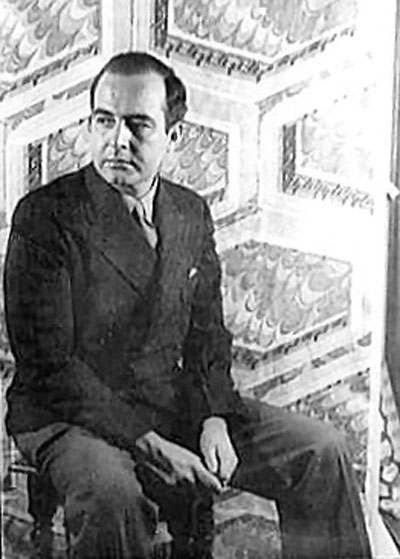
Born: March 9, 1910, West Chester, Pennsylvania
Died: January 23, 1981, New York, New York
Adagio for Strings, Op. 11
- Composed: 1936, originally as the second movement of String Quartet, Op. 11
- Premiere: November 5, 1938, New York City, Arturo Toscanini conducting the NBC Symphony Orchestra
- Instrumentation: narrator, strings
- CSO notable performances: First: October 1948, Thor Johnson conducting. Most Recent: September 2020, conducted by Louis Langrée as part of a digital-only concert. Most Recent live, in-person performance: April 2017, David Robertson conducting.
- Duration: approx. 10 minutes
Samuel Barber’s Adagio for Strings begins in an elemental way with a single held note. Soon, listeners become attuned to the full breadth of this music as more voices of the ensemble join, simultaneously individual in their shifting roles — melody, harmony, accompaniment — yet unified in purpose. Over time, this opening gesture has taken on a rare capacity for immediate listener recognition, likely a consequence of its use in so many circumstances and at so many important historical moments. It has been performed at the funerals of Franklin Delano Roosevelt, John F. Kennedy, Princess Grace and Albert Einstein, and American conductor Leonard Slatkin led the work with the BBC Symphony Orchestra at the Proms, in memoriam to lives lost on September 11, 2001, just days after the disaster. Filmmakers have also adopted it to great effect, perhaps most famously David Lynch for The Elephant Man (1980) and Oliver Stone in Platoon (1986). In all these cases and more, Barber’s music has been freighted with gravity and poignancy as a kind of retrospective “memory space.” In other contexts, though, it has exhibited an optimistic adaptability, as in several techno music samplings and remixes like Dutch artist DJ Tiësto’s uplifting 2005 Trance version. Composer and critic Virgil Thomson even heard the Adagio as a love scene.
Since its conception, the Adagio has been amenable to adaptation and accommodated wide-ranging interpretations. Barber composed the music in 1936 as the slow second movement of his String Quartet, Op. 11. He originally intended the quartet for a traditional Beethovenian four movements, but he ultimately excised the last movement, opting instead for a balanced three movements. In this form, the first and third movements act as grounded ends of an arch, mirroring one another from opposing sides of the middle movement. These outer movements are assertive, rhythmically on edge, distinctive foils to the middle Adagio, which, not lacking energy or frisson, is staid and unfailingly self-possessed; it has affinities to the fantasias of Henry Purcell that Barber had been studying not long before he began work on the quartet.
Barber capitalized on the work to create two additional versions of the quartet’s second movement himself. The first is the Adagio version for string orchestra, scored in 1936 for a larger ensemble of the same instruments plus added contrabass that deepens and enriches the sound. Much later, in 1967, he adapted the music for a choral setting of the Agnus Dei from the Christian Mass ordinary. Others have also found inspiration in the piece, arranging it variously for organ, clarinet choir, woodwinds and violin plus piano. Its wide-ranging cultural uses and its evidently gratifying adaptability suggest something innate, if difficult to articulate, in the music, reminiscent of the enduring success of Johann Sebastian Bach’s music when it is performed in varied circumstances by sometimes unexpected ensembles — it is a special quality for a single piece of music to “work” well when played by nearly any instrument. History has thus more than validated Barber’s sense upon completing the piece that “it is a knockout!”
When Arturo Toscanini enthusiastically chose Barber’s music for a 1938 broadcast of the NBC Symphony Orchestra, premiering both the orchestral Adagio and the first Essay for Orchestra, it seemed the composer’s career was in unbridled ascent. But not everyone agreed with Toscanini’s choice. Composer and critic Ashley Pettis wrote to The New York Times that year, lamenting the Italian conductor’s choice of this American composer’s music over other, allegedly more authentic and modern composers like Aaron Copland, Roy Harris and Roger Sessions. This set off a pamphlet war during the following couple of years over values of new versus old music and of American classical music’s status and trajectory. Prominent figures like Gian Carlo Menotti, Alexander Kelberine and Harris, among others, contributed arguments, some supporting Barber, others more ambivalent, and some agreeing with Pettis. Pettis’ observations may not be entirely unmerited; the two Barber pieces hardly lead the avant-garde, and indeed the Adagio projects a reverential classicism. Yet, Toscanini admired the work enough to perform it over the following years, even on tours, and posterity has rendered Pettis’ judgement effectively moot.
From the piece’s opening note, its characteristic sound derives in part from Barber’s use of antique-sounding modal scales closely associated with music from before the 18th century, often music composed for liturgical purposes. These scales might be understood as being in the same color families of the familiar major or — more closely related to the Adagio’s sound — minor scale modes, but of a slightly different hue. In this case, the piece is built around the so-called Phrygian scale, a minor-related scale that has historically been associated with somberness and sobriety, as in the hymn Ralph Vaughan Williams used for his Fantasia on a Theme by Thomas Tallis, a piece strikingly similar in tone and mood to Barber’s Adagio. This scale choice may contribute to the widely held impression of Barber’s piece conveying an almost inexorable pathos. The music is visceral but not overwhelmingly loud (with no brass or percussion), almost entirely comprising patient, even-sounding rhythms and exceedingly smooth melodic lines that seem to unfold in spirals, as one London reviewer wrote in 1937. The sum invokes ancient liturgical music, but it does not simply duplicate it, imitating Giovanni Pierluigi da Palestrina’s sacred choral music, for instance. Instead, it is unfailingly original and distinctive, key to its recognizability. Aural kinship with Renaissance choral polyphony may explain the success of Barber’s Agnus Dei arrangement of the work. In construction, like the middle movement of the mirror-like, three-movement quartet, the Adagio itself presents a kind of arching form. After its incipient and subdued opening in the strings’ lower registers, it strives ever upward to its climax approximately three-quarters of the way through. This moment, at which players push their instruments to their limits of volume and range, is contrasted by a breathtaking drop-off to the opposite end of the sonic spectrum, low in volume and low in register. The effect seems to encapsulate the full range of human emotion in just a few strokes of the composer’s pen.
Few pieces of music in the American repertoire have achieved the status of Barber’s Adagio for Strings. Fewer still have exerted a power of such deep meaning in so many ways to so many people.
—©Jacques Dupuis