Traditional
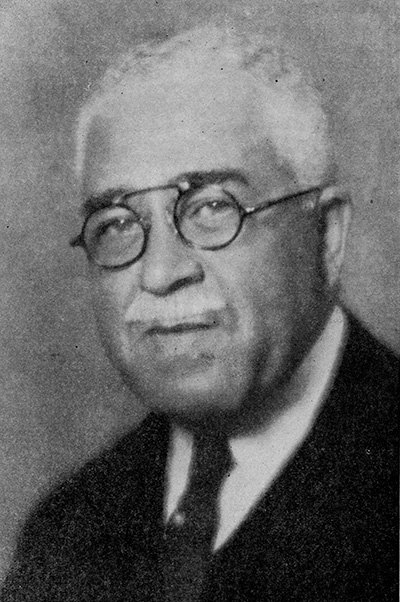
arr. Harry T. Burleigh
Born: December 2, 1866, Erie, Pennsylvania
Died: September 12, 1949, Stamford, Connecticut
Deep River
- Composed: 1916
- Instrumentation: solo vocalist, flute, oboe, 2 clarinets, bassoon, 2 horns, trumpet, trombone, timpani, harp, strings
- CSO notable performances: These are the first CSO performances of “Deep River.”
- Duration: approx. 3 minutes
The melodies of the Negro Spiritual hold a unique space within the context of American music. Born out of the conversion of enslaved Africans to an American context of Christianity during the Second Great Awakening, these songs reflected a radical worldview and spiritual intelligence that often goes unrecognized. Although often characterized as sorrow songs, these melodies expressed more. Spirituals were songs of resistance. Enslaved Africans constructed narratives that focused on deliverance over Pharaoh, faith that triumphed over lions' dens and fiery furnaces, and Jordan rivers that served as pathways to freedom. In Reconstruction-era America, the Fisk Jubilee Singers’ performances of these songs shifted them from the insularity of Black communal spaces onto America’s concert stages. This aesthetic of jubilee singing developed into a prominent form of popular culture during the last decade of the 19th century. Forty-five years later, Harry T. Burleigh reimagined these songs as a new idiom of vocal music that situated the spiritual as an exemplar of American music.
Born in Erie, Pennsylvania, in 1866, Harry T. Burleigh, Jr. learned spirituals and other Black folk song idioms from his maternal grandfather, Hamilton Waters, a former slave who purchased his freedom in 1835. The young man not only inherited his grandfather’s affection for these folk songs but also his rich baritone voice.
During his formative years, Burleigh’s musical consciousness expanded to include classical music. His mother, Elizabeth, worked for Mrs. Elizabeth Russell, who regularly hosted recitals in her home. Recognizing her son’s passion for music, Burleigh’s mother asked Mrs. Russell to allow her son to serve as the doorman for her concerts. Through his exposure to these concerts, Burleigh’s musical skill developed exponentially. He sang in school but was also hired as a soloist at a few churches in Erie.
In 1892, he enrolled at the National Conservatory in New York. The conservatory’s curriculum and Burleigh’s engagement with faculty considerably shaped his perspectives on music and unlocked his potential as a composer. He served as librarian of the orchestra, which brought him in contact with composer Antonín Dvořák. Burleigh eventually became the composer’s copyist, which shaped his understanding of harmony, form and compositional approaches. In return, he introduced Dvořák to spirituals, which promoted the idea that these folk melodies could serve as the basis of an American nationalistic sound.
In the years following his graduation from the National Conservatory, Burleigh immersed himself in various intellectual and creative circles. He became the first Black soloist hired at St. George Episcopal Church and later at the prestigious Temple Emanu-El. This brought him in proximity to New York’s wealthy elite. Through his connections with Dvořák and the composer Edward MacDowell, he engaged with New York's white café culture.
While these interactions shaped his musical awareness, Black intellectual circles, which included activists like W.E.B. Du Bois and Booker T. Washington, as well as composers Samuel Coleridge-Taylor, R. Nathaniel Dett and Will Marion Cook, influenced his racial consciousness. Burleigh was a strong advocate of the New Negro ideology, which grew in prominence during the last decade of the 19th century. Described as a type of Black intellectual reconstruction, the New Negro Movement attempted to circumvent the racist images promoted through minstrelsy that precipitated the enactment of policies that disenfranchised Blacks. In these circles, he found individuals who shared his beliefs in the cultural importance of the spiritual. Between 1900 and 1915, he toured with activist Booker T. Washington, performing spirituals to raise funds for Tuskegee Institute. His lectures on, and performances of, these melodies were acclaimed as exemplars of a modern aesthetic that foreshadowed the Harlem Renaissance.
Much discussion has been given to how Dvořák influenced Burleigh’s development as a composer, but Edward MacDowell proved to be just as important. It was MacDowell who persuaded Burleigh to create settings of spirituals that would make them accessible to all musicians. As a result, Burleigh began reimagining these melodies as art songs. In 1901, he published his earliest adaptations of these songs written for piano and violin in the collection Plantation Melodies, Old and New.
"Deep River" appeared in Burleigh’s 1916 collection Jubilee Songs of the USA. It is one of his most acclaimed and performed spiritual settings. Rather than create elaborate settings, Burleigh retained much of the original melody, underscoring its beauty and simplicity with subtle, but harmonically rich, piano accompaniment. These arrangements not only provided repertoire for his performances but also for the generation of Black and white concert artists. In particular, Roland Hayes, Marian Anderson and Paul Robeson elevated these songs as part of their standard repertory, programming them alongside German lieder, French mélodie and Italian arias.
—©Tammy L. Kernodle, University Distinguished Professor and the Park Creative Arts Professor of Music at Miami University