Margaret Allison Bonds
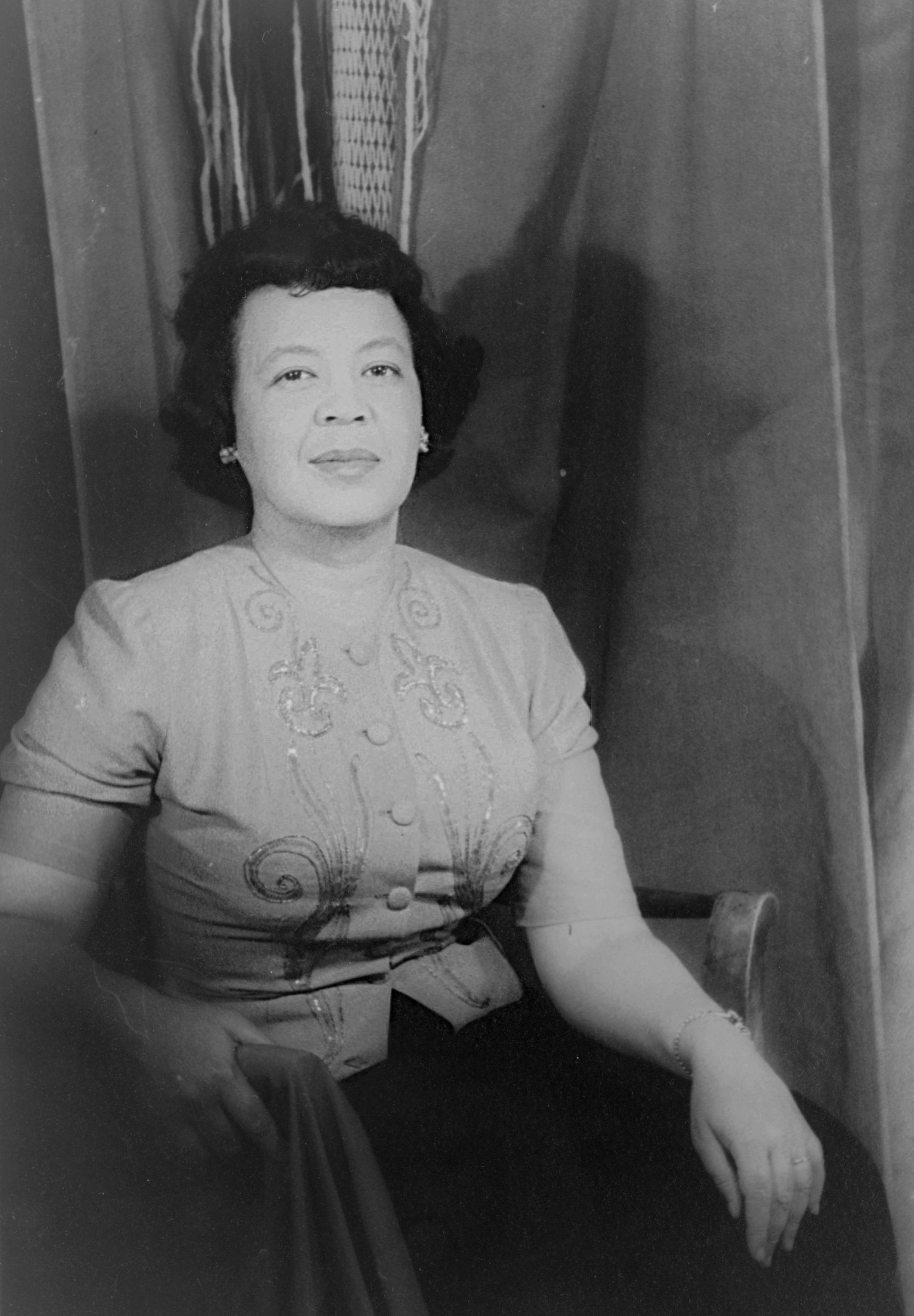
Born: March 3, 1913, Chicago, Illinois
Died: April 26, 1972, Los Angeles, California
"I, Too, Sing America" from Three Dream Portraits
- Composed: 1959
- Instrumentation: solo vocalist, flute (incl. piccolo), oboe, clarinet, bass clarinet, bassoon, 2 horns, trumpet,. trombone, timpani, crotales, snare drum, suspended cymbals, triangle, glockenspiel, harp, strings
- CSO notable performances: These are the first CSO performances of “I, Too.”
- Duration: approx. 2 minutes
By the time the Civil Rights movement commenced in 1955 with the Montgomery Bus Boycott, Margaret Bonds had already emerged as part of a Black intellectual vanguard that was using their intellectual and cultural labor as a means of advancing social change.
Margaret Allison Bonds’ early years were defined by her engagement with the community of Black intellectuals and artisans that defined Chicago’s Black elite. Bonds was identified early on as a musical prodigy, first receiving piano lessons from her mother, Estella Bonds. Her musical development, however, was jettisoned by her more direct engagement with the Black churches, conservatories and social and arts-based organizations that sustained Chicago’s Black classical music scene. Also important was the intellectual activity that took place in her mother’s home at 6652 Wabash Avenue. During the 1920s and 1930s, Estella Bonds’ home served as the epicenter of Chicago’s budding Black renaissance. It was one part boarding house, one part food pantry and one part cultural salon, where aspiring artisans engaged with composers such as Will Marion Cook, Noble Sissle and William Dawson; concert artists Lillian Evanti and Abbie Mitchell; and noted writers, painters and sculptors.
By the late 1920s, Black Chicago was already uttering premonitions of a promising career as a concert pianist for Margaret Bonds. However, the young woman’s aspirations extended much further. She aspired to be a composer. So, Bonds briefly studied harmony with Florence Price and arranging with William Dawson. Her compositional voice developed significantly during her years at Northwestern University, but her experiences with racism at the institution shifted her worldview. The University offered no on-campus housing for its few Black students, and they were unable to use student facilities. Daily, Bonds made a multi-hour trip from Chicago’s Southside to Evanston. It was also during these moments that Bonds’ racial consciousness began to take shape. She would later assert that it was the writings of Langston Hughes that inspired her and provided the mental strength needed to complete her studies.
Throughout the 1940s and 1950s, Bonds worked in many different musical circles. As a pianist, she continued to concertize, but found substantial work writing pop songs, producing jazz arrangements and writing for theater productions. The eclecticism of sound that framed these different professional settings provided some of the key elements that mark Bonds’ compositional voice — beautiful melodies, sensitive settings of poetry, complex rhythmic ideas, and the employment of rich and colorful harmonic settings.
The diversity of these professional spaces also brought Margaret Bonds into diverse social and intellectual circles that came to include poet and activist Langston Hughes, who significantly shaped her perceptions about the social responsibility of Black creatives and intellectuals. The alignment of Bonds’ music with the progressive political activity that became the mid-century Black civil rights movement can first be traced back to her professional connections with the Negro Theatre Project in Chicago and the infamous nightclub Café Society in New York. It was in these environments that Bonds’ radical consciousness surrounding blackness blossomed, and she gradually morphed into the persona of an artist-activist. In the 1950s, when some Black composers struggled to couple Black idioms with atonality and serialism, Bonds continued to nest Black cultural narratives in neo-Romantic settings tinged with harmonies, rhythms, and nuances drawn from gospel, blues and jazz. Prominent examples include her settings of spirituals like “He’s Got the Whole World in His Hands,” “You Can Tell the World,” and her signature solo piano work, The Spiritual Suite, as well as the art song “The Negro Speaks of Rivers” and the song cycle Three Dream Portraits.
“I, Too, Sing America” is the last of the three songs that make up the Three Dream Portraits song cycle, which draws its text from Hughes’ 1932 poetry collection, The Dream Keepers and Other Poems. Bonds began writing Three Dream Portraits in December 1955, so it is not difficult to believe that key events from that year were not on her mind when she began setting the poetry. That summer, 14-year-old Emmett Till was kidnapped, beaten and tortured in Money, Mississippi, for allegedly offending a white woman. His mother, Mamie Till, refused to allow the lynching of her son to quietly fade into obscurity. She had an open casket funeral to illustrate the fragility of democracy for Black Americans and the brutality of racism and lynching. Then, there was the arrest of Rosa Parks in Montgomery, Alabama, for refusing to move to the back of the bus to accommodate white passengers. These events illuminated the paradox that existed between America’s promotion of itself as the protector of democracy in the midst of the Cold War with Russia, while turning a blind eye to the racialized violence that was growing exponentially. Bonds’ Three Dream Portraits represented the continuum of struggle, hope and perseverance that underscored the Black experience in America. By the time she completed the work in 1959, the mid-century Black civil rights movement initiated by the events of 1955 had developed into a series of anti-segregation campaigns that spread throughout the southern United States.
When considered in the social and political milieu of mid-century America, “I, Too, Sing America” reads not as a song of melancholy, but as a bold proclamation of the resilience exhibited by Blacks long denied a space at the table of democracy. This is strongly conveyed at the beginning when the piano introduction [an orchestration by Joseph Trefler is used for these performances instead of piano] shifts from fluid melodic lines to two punctuated chords that anticipate the voice entering in a declamatory manner with the words, “I too sing America.” The remainder of the song is an interplay between piano and voice, where at times the former imitates the latter. Bonds, in her signature way, constructs an intricate and complex accompaniment that does not overshadow the voice but establishes the shifting mood of the text. There is a certain level of poignancy and optimism for social change reflected in Bonds’ decision to omit the final line of Hughes’ poetry and end the song with the phrase “they'll see how beautiful I am. And be ashamed.”
—©Tammy L. Kernodle, University Distinguished Professor and the Park Creative Arts Professor of Music at Miami University