Wynton Marsalis
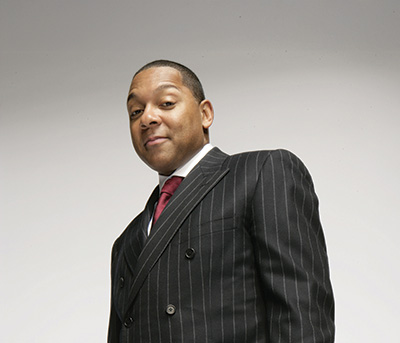
Born: October 18, 1961, New Orleans, Louisiana
Blues Symphony
- Composed: 2009, revised in 2014
- Premiere: November 19, 2009 by the Atlanta Symphony Orchestra, Robert Spano conducting; revised version premiere February 4, 2025, Music Center at Strathmore in North Bethesda, Maryland, Jan Wagner conducting the Shenandoah Conservatory Symphony Orchestra
- Instrumentation: 3 flutes (incl. 2 piccolos), 3 oboes (incl. English horn), 3 clarinets (incl. bass clarinet), 3 bassoons (incl. contrabassoon), 4 horns, 3 trumpets, 3 trombones, tuba, timpani, agogo bells, anvil, bass drum, blastix, bongo bell, brake drum, cabasa, china cymbal, claves, congas, cowbells, crash cymbals, field drum, glockenspiel, guiro, hand cymbals, high hat, marimba, pandeiro, piccolo snare drum, police whistle, ride cymbal, sizzle cymbal, small bass drum, small cymbal, small gong, snare drum, splash cymbals, suspended cymbals, tambour de Basque, temple blocks, timbales, tom-toms, triangle, tubular bells, washboard, whistle, wood blocks, xylophone, strings
- CSO notable performances: These are the first CSO performances of these movements from Blues Symphony.
- Duration: approx. 36 minutes
Wynton Marsalis, the second of six sons born to Ellis Marsalis, one of New Orleans’ foremost jazz pianists, received his first trumpet when he was six, as a gift from Al Hirt. At age eight, he joined a children’s marching band led by banjoist-guitarist Danny Barker, and he soon started playing traditional jazz with Barker’s Fairview Baptist Church Band. Marsalis did not begin formal trumpet study until he was 12, but then he was trained in both classical and jazz styles, and within two years he had performed Haydn’s Trumpet Concerto with the New Orleans Philharmonic. In 1978, he studied at the Berkshire Music Center at Tanglewood, receiving the Shapiro Award for Outstanding Brass Player at the end of the summer; he was 17. A scholarship to The Juilliard School followed. Marsalis gathered a wide range of performing experiences in New York, playing in salsa and top-40 bands, Broadway shows and the Brooklyn Philharmonic. By 1980, he was touring with Art Blakey and the Jazz Messengers and performing in a quartet with Herbie Hancock, Ron Carter and Tony Williams. He made his first recording as a featured performer in 1981, and the following year he formed a quintet with his brother, saxophonist Branford. In 1983, Marsalis was the first performer to win Grammy Awards in the same year for recordings of both jazz (Think of One) and classical music (Haydn, Hummel and Leopold Mozart trumpet concertos). He repeated that feat the following year with Hot House Flowers and a disc of Baroque works, and he has since won five more Grammys, including Best Spoken Word Album for Children (Listen to the Storytellers, 2000), as well as the Grand Prix du Disque, an Edison Award and the Louis Armstrong Memorial Medal.
In 1987, Marsalis co-founded a jazz program at New York’s Lincoln Center to nurture performance and education; in 1995, Jazz at Lincoln Center became a full member of that influential arts center’s constituent organizations and, in 2004, moved into its own home at the Frederick P. Rose Hall at Columbus Circle, the world’s first concert hall built specifically for jazz. Marsalis continues as artistic director of jazz at Lincoln Center and conductor of the Lincoln Center Jazz Orchestra, which he leads in performances in New York and on tours around the world.
Wynton Marsalis has traveled widely as a teacher and spokesperson for jazz, giving masterclasses, concerts and lectures to foster the performance and appreciation of the art among young people. His devotion to education resulted in the 1995 Sony Classical production of Marsalis on Music for PBS and the 1996 Peabody Award-winning series Making the Music for NPR. He has written six books for both children and adults on the history and appreciation of jazz, delivered a series of six lectures titled Hidden in Plain View: Meanings in American Music at Harvard, and, from 2015 to 2021, served as an A.D. White Professor at Cornell University. Marsalis has also lent his voice and talent to many non-profit organizations seeking to meet various social needs; notable among these efforts is his advocacy for the victims of Hurricane Katrina by organizing relief programs for New Orleans’ musicians and cultural organizations and by playing a leading role with the Bring Back New Orleans Cultural Commission.
Marsalis is also highly regarded as a composer for small and large jazz ensembles, ballet, film and concert — Blood on the Fields, his epic “jazz oratorio” based on the theme of slavery and celebrating the importance of freedom in America, won the 1997 Pulitzer Prize in Music, the first jazz composition to be so honored. His many other distinctions include the National Medal of Arts; honorary degrees from Columbia, Yale, Brown, Princeton, Harvard, Juilliard and more than 35 other leading academic institutions; appointment as an International Messenger of Peace in 2001 by the United Nations; Frederick Douglass Medallion for Distinguished Leadership from the New York Urban League; the rank of Chevalier dans l’Ordre des Arts et des Lettres from the French Ministry of Culture; and the National Humanities Medal, presented to him in 2015 by President Barack Obama.
“The Blues Symphony,” Marsalis wrote, “is a seven-movement composition that gives a symphonic identity to the form and feeling of the blues. It utilizes the language and form of the blues across regions and genres regionally to convey the basic attitude of the blues as music: ‘Tragic circumstances accepted, better times should be pursued and can always be found.’
“This piece is intended to further the legacy of Gershwin, James P. Johnson, Bernstein, John Lewis and others who were determined to add the innovations of jazz to the vocabulary of the symphonic orchestra. I believe there is an organic and real connection between all Western traditions regardless of instrumentation and that the symphonic orchestra can and will swing, play the blues and feature melodic improvisation.
“Swimming in Sorrow begins on the open seas of the Middle Passage, utilizing the florid melodic language of Afro-American parlor music of the 19th century as a way to access cresting waves of orchestral dynamics. A pastoral interlude of brass and woodwinds is followed by the trombone preaching the gospel with a choir of French horns as elder deacons, in recognition of the centrality of church music to the blues and jazz. The trombone usually calls the beginning of New Orleans funerals and is considered the instrument closest to the voice of an exhorting preacher. In a reversal of roles, the clarinet actually leads us in a funeral march, and its solitary cry is answered by the introspective memory of tambourine and closely voiced woodwinds.
“A final clarinet cadenza brings us to the washboard and two-beat country shuffle of the slave and rural fiddler, with an organic evolution into the swing violin of masters like Claude Williams and Stéphane Grappelli. This movement requires the orchestra to identify the meaning of spirituals, of New Orleans funereal music and of the gospel-preaching tradition. It calls on the string sections to pursue the American fiddle and international swing traditions in order to play with a disciplined looseness and unforced naturalness. After a brief return to the opening seaborne theme, the French horn sings a spiritual. It is followed by a reprise of the clarinet dirge on cello with the introspective answer now becoming an exotic groove. The final call is a spiritual nocturne delivered by the trumpet with English horn response. The trumpet cry, as in the playing of 'Taps,' is often the final sound for the deceased. So the movement concludes with a repeated blues cry on the English horn above a sustained trumpet note sounded with respect to Dvořák’s Ninth Symphony, ‘From the New World.’
“Reconstruction Rag begins in the world of circus waltzes and parlor music — New Orleans circa 1890. It features wide melodic leaps and clarinets making the sound of riverboat calliopes. Then it’s off into the world of ragtime with the breaks and call and responses idiomatic to early jazz. We hear from the trumpet, clarinet and trombone playing through the breaks in time that Jelly Roll Morton said were essential to jazz. These three instruments are the front line of a New Orleans Jazz ensemble and are pictured in the earliest-known portrait of a jazz group drawn around the same time.
“After a trio section featuring flute, clarinet and bassoon, we hear from the wa-wa mutes, swooping clarinets, whooping French horns and tom-toms, which bathe the music in American clichéd African mystique. The closely voiced and rhythmically complex woodwind soli above the drums and Chinese cymbal lead back to a romping New Orleans trumpet solo and ragtime ensemble statement … then … the train.
“That train symbolizes freedom. Once the train pulls into the station, we have a long coda based on permutations of the harmonic turnaround that concludes Jelly Roll Morton’s King Porter Stomp. As versions of this progression repeat, the orchestra expands in size, intensity and groove, eventually becoming one big train that stomps to a halt with a New Orleans-cymbal-choke tag.
“Danzón y Mambo, Choro y Samba begins with New Orleans/Cuban concert music feel and a male–female dialogue between violin and cello, followed by the danzón and the mambo with cha-cha bell and swooping strings. This movement places a lot of responsibility on the percussion section to learn the subtleties of Latin percussion. A woodwind interlude leads into a Charanga-inflected flute solo in honor of Alberto Soccaras from Cuba, who played the first jazz flute solo in 1927. Mr. Soccaras was an ear-training teacher of mine in 1979–80, and I had no idea who he was.
“We get deeper in the groove and then trumpets with bell tones end the mambo. After another contrapuntal woodwind interlude comes the habanera, the most universal Afro-Latin rhythm. A transparent orchestral treatment of sultry themes is counter-stated by aggressive French horns and celli, with trumpets and trombones punctuating the groove. A brief bossa nova interlude leads to the ragtime of Brazil, the choro. Choro and samba bring us home, and the movement ends with a bossa nova tag.”
—©2025 Dr. Richard E. Rodda