Bohuslav Martinů
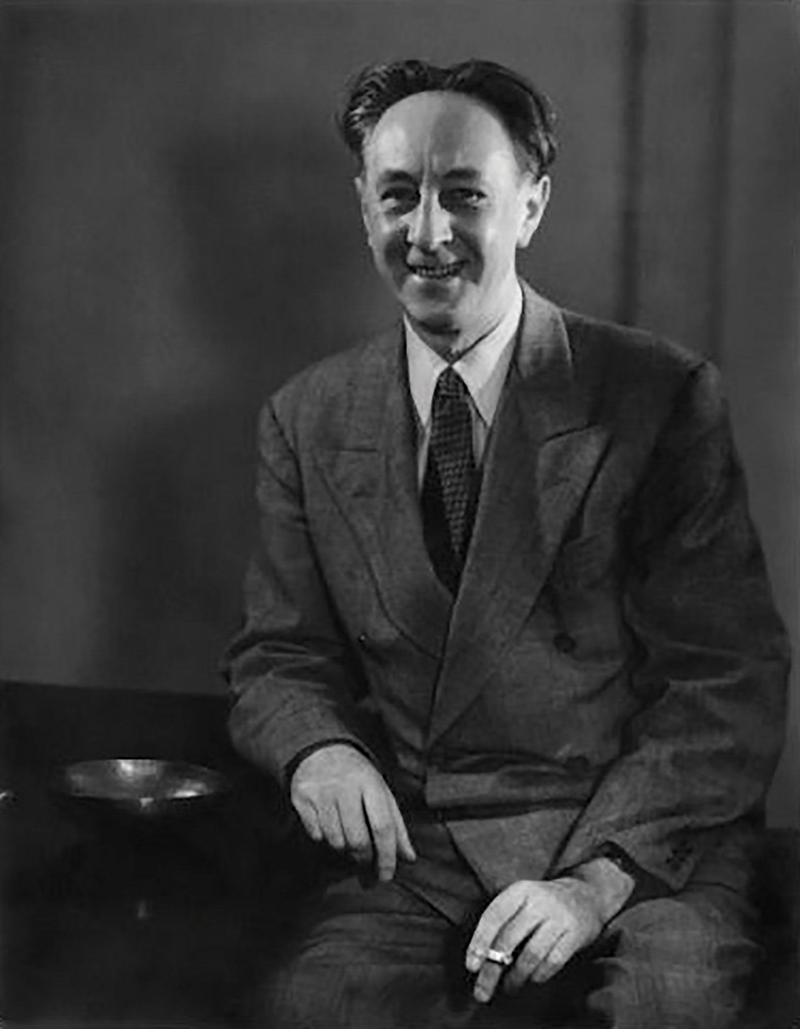
Born: December 16, 1770, Bonn, Germany
Died: March 26, 1827, Vienna, Austria
String Quartet No. 4, H. 256
- Composed: 1937
- Premier: June 1938, at the home of Čestmír Puc and his wife, Helena
- Duration: approx. 21 minutes
Bohuslav Martinů’s affinity for the string quartet was evident since childhood: his first surviving work, written in 1902 when he was just 12 years old, was a quartet titled Three Horsemen. The boy learned to play the violin and soon was able to play quartets himself. Later, he spent three years as a member of the second violin section of the Czech Philharmonic Orchestra under the baton of the great conductor Václav Talich, who was to become a major champion of his works.
One of the most prolific composers of the 20th century, Martinů completed an astonishing 384 works in all genres, including 15 operas, 14 ballets, six symphonies and numerous other orchestral, choral and chamber works, among them seven string quartets (not counting the above-mentioned early essay and a few other unpublished works). The official String Quartet No. 1 was written when Martinů was still living in Prague. The Second and Third date from the first years after his move to Paris, representing a major breakthrough and announcing the composer’s first maturity. The Fourth and Fifth were written closer to the end of the Paris period, while the last two quartets are products of Martinů’s time in the United States.
Martinů’s extraordinarily voluminous oeuvre is quite diverse in style as well: the composer built on the Czech national tradition he had inherited, but, having absorbed the influence of jazz as well as the music of Igor Stravinsky (among others), he soon developed a voice (or, indeed, several voices) of his own. He became known as one of the most prominent representatives of neo-classicism, bringing the Baroque Concerto grosso idea into the 20th century.
It was hardly surprising that Martinů should have gravitated toward Paris in the 1920s. The French capital was one of the most important centers of contemporary art, a place where writers, painters and musicians from the entire world converged, exchanged ideas and mutually influenced one another. Martinů made friends with three other immigrant composers, all three younger than himself: Conrad Beck of Switzerland, Tibor Harsányi of Hungary and Marcel Mihalovici of Romania. Together they formed what came to be called the Groupe des Quatre — the foreigners’ answer to the Parisian Groupe des Six.
Martinů composed the Fourth Quartet soon after one of his masterpieces, the opera Juliette, and followed it with the influential Concerto grosso for chamber orchestra. The 47-year-old Martinů was at the height of his creative powers, yet his financial situation was still far from stable. He continued to benefit from the friendship and support of Czech expats living in Paris, such as the art historian Václav Nebeský and his wife, Božena, or the wealthy businessman Čestmír Puc and his wife, Helena. The present quartet was written for the latter and was premiered at their home in June 1938 by the Lejeune Quartet from Belgium, who also recorded the work the following day. Yet there seemed to be no further performances, and the quartet was presumed lost until Martinů’s biographer Miloš Šafránek discovered the manuscript at Mrs. Puc’s home in 1956. However, the public premiere did not take place until 1960 — a year after the composer’s death — when the Novák Quartet, a prominent Czech group, performed it in what was then West Germany. The work was subsequently published in Prague in 1963.
Harry Halbreich, the author of the complete catalog of Martinů’s works (and of the “H” numbers used to identify Martinů’s works), heard the voice of the “French Martinů” in the Fourth Quartet, and pointed out similarities between Martinů’s scherzo and the corresponding movement in his former teacher Albert Roussel’s string quartet of 1932. At the same time, there are also echoes of “Czechness” in the piece, especially in the last movement, which reworks some Bohemian folk-dance motifs in unexpectedly novel ways.
The quartet is in the standard four movements, with the scherzo coming second and the slow movement third. But it is not only the general outline that follows classical models: the form of each movement is also mostly traditional. Each movement contains extensive literal or near-literal recapitulations (repeats of previously heard music), emphasizing Martinů’s firm roots in the past; yet there is a great deal that is new in the rhythms and harmonies. In a further innovative move, each movement is in a different key, and some of the movements end in different keys than where they began.
The first movement’s opening theme features an intriguing asymmetrical rhythm and a melody alternating between the major and the minor modes — giving the music a certain quicksilver quality right at the outset. The second theme features a long lyrical line moving in small steps, and the third consists of rapid-motion 16th notes (including, at one point, a near-quotation from Stravinsky’s The Soldier’s Tale). The recapitulation brings back only two of these themes; instead of the third, Martinů expands on the lyrical theme to give the movement a soft, nostalgic ending.
The principal section of the energetic scherzo is made up of scurrying 16th-note figures, playful jumps and, once again, rapid switches between major and minor. Then a dolce cantabile theme appears, fulfilling the function of the conventional Trio section. In the last part of the movement, the two sections appear side by side, and the last word belongs to the Trio melody, concluding on a gentle note.
A heartfelt viola solo opens the third movement Adagio and is enriched by expressive chromatic harmonies in the course of its development. The cello takes over in the middle section, subsequently imitated by the other instruments. When the recapitulation gets underway, Martinů adds some ornamental embellishments to the melody, following an age-old tradition. Like the first two movements, this one, too, ends pianissimo.
The finale opens with a playful dance tune, developed brilliantly in combination with a singing second theme and some exciting ostinato (“obstinately” repeating a single rhythmic figure) passages. The recapitulation flows into a vigorous coda in a faster tempo.
Halbreich described the entire work as “cheerful, spirited music written for the joy of playing [Spielmusik], full of refinement and witty points.”
©Peter Laki