Franz Joseph Haydn:
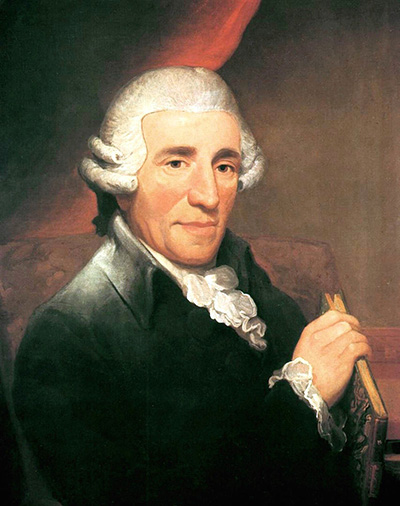
Born: March 31, 1732, Rohrau, Austria
Died: May 31, 1809, Vienna, Austria
Symphony No. 103 in E-flat Major, Drumroll
- Composed: 1795
- Premiere: March 2, 1795, King’s Theatre, London, Haydn conducting
- Instrumentation: 2 flutes, 2 oboes, 2 clarinets, 2 bassoons, 2 horns, 2 trumpets, timpani, strings
- CSO Notable Performances: First: November 1940, Eugene Goossens conducting. Most Recent: September 1997, Jesús López Cobos conducting.
- Duration: approx. 27 minutes
When Joseph Haydn arrived in London on New Year’s Day 1791, he was surprised to discover how famous he was. For decades he had worked in obscurity for his wealthy patron in the Hungarian countryside. Meanwhile, unbeknownst to him, his string quartets, symphonies and piano works had circulated among upper class dilletantes in London for years, making him a celebrity in his absence. He wrote to his Viennese friend Marianne von Genzinger:
My arrival caused a great sensation throughout the whole city, and I was sent on rounds to all the newspapers for three days in a row. Everyone seems anxious to meet me. I have already dined out six times, and I could be invited out every day if I chose; but I must first and foremost consider my health, and then my work. Except for nobility, I admit no visitors until two o'clock in the afternoon, and at four o'clock I dine at home with Salomon. I have neat, comfortable lodgings, but very costly.
He had been lured to England by Johann Peter Salomon, a violinist and businessman, who hounded him for several years to come to London. When Salomon saw news of the death of Prince Esterházy, Haydn’s employer, he rushed off to Vienna, cornered the composer and brought him back to London. Salomon wrote a legal contract promising Haydn 100 gulden for each of 12 new works, 3000 gulden for a new opera to be produced at The King's Theatre and 200 pounds for a benefit concert. He then arranged a series of subscription concerts at the most popular concert venue, the Hanover Square Rooms, and Haydn set about composing.
Haydn soon encountered a distinctly modern relationship between money, media and music. The financial success of his concerts was threatened when a rival organization hired his former pupil, Ignaz Pleyel, in direct competition for both publicity and ticket profits. The pressure mounted and Haydn was forced to work at a furious pace. Haydn wrote:
There isn’t a day, not a single day, in which I am free from work.… [Pleyel] arrived here with a lot of new compositions, but they had been composed long ago; he therefore promised to present a new work every evening. As soon as I saw this, I realized at once that a lot of people were pitted against me, and so I announced publicly that I would likewise produce 12 different new pieces. In order to keep my word, and to support poor Salomon, I must be the victim and work the whole time.
The cutthroat nature of London’s entertainment industry is reflected in the attention-grabbing gimmicks scattered throughout the final 12 symphonies Haydn composed in that city: sound effects, histrionic contrasts and bait-and-switch harmonic gestures, to name a few. The nicknames attached to many of these works, such as Surprise, Drumroll, Clock or Military, isolated the most sensational moments in the compositions and served to generate “buzz” — excitement and anticipation in social discourse — which was later useful for commodifying the symphonies in newspaper advertisements, critical commentaries and sheet music piano arrangements to be purchased and played in the home.
By 1795, the enterprise had moved to the King’s Theatre Room, an unusually large performance space measuring 48 x 97 ft. with room for nearly 800 spectators. The basic orchestra was expanded to 60 players, reflected in the scope and scale of Haydn’s final three symphonies. Chamber music works were eliminated from the series and the proportion of opera excerpts was increased, but it was still Haydn’s orchestral music that dominated each program: the symphony was always performed immediately after intermission. On March 2 of that year, the composer led the premiere of his Symphony in E-flat, whose opening timpani solo and atmospheric introduction “excited the deepest attention” according to The Morning Chronicle.
The nickname “Drumroll” is not Haydn's own, but rather refers to the unusual opening of the symphony: a single timpani note with a fermata, labeled “Intrada.” There is no dynamic indication in the composer’s manuscript, and the ambiguity of the notation has led to a range of interpretations, both in volume and in freedom for the timpanist to improvise. The lugubrious six-bar theme that follows in the lower strings blooms upward before settling back on a unison, punctuated with foreboding sforzandi. A bouncy dance in 6/8 breaks into paired phrases that imply question and answer. An accented chromatic transition presents the transformed theme from the opening, now set to a new rhythm. Without warning, the opening timpani solo introduces the Adagio theme once again, before the quick, spirited dance tune abruptly returns to close off the movement.
In the second movement, Andante più tosto allegretto, Haydn juxtaposes two contrasting tunes, one in C major and the other in C minor, to bring about a double set of variations. The themes and their subsequent transformation are tinged with an exoticism echoing Hungarian and Croation folk tunes. A cheerful violin solo gives way to a military march, which in turn leads to a triumphant fanfare, propelled by the timpani.
Like the previous movements, the third has a strong folk element, flavored with appoggiaturas and stomping accents in the winds and horn that suggest a working-class Ländler much more than the minuet of the nobility. The trio takes on a tone in the string section that conjures the intimacy of chamber music before the minuet returns.
The final movement, Allegro con spirito, opens with a horn call before breaking into a Croatian tune. In this movement as well, the timpani play a crucial role in driving the tension that leads to the rousing finale.
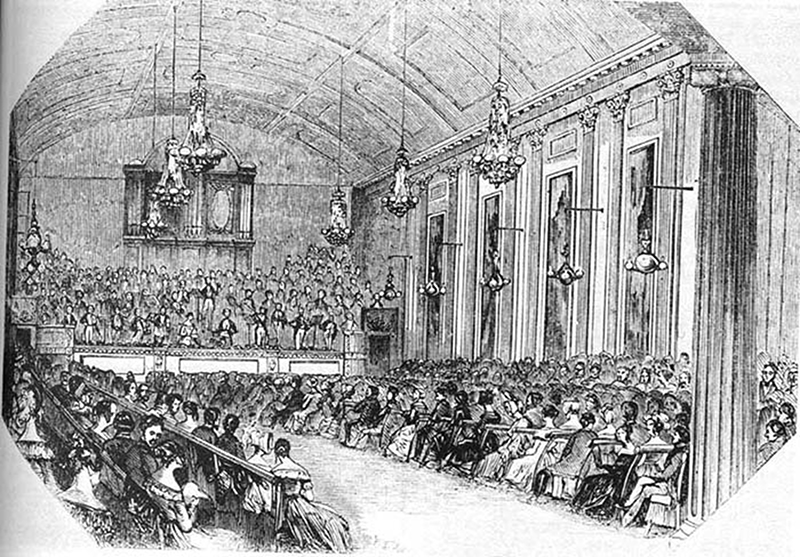
The Hanover Square Rooms in London, original home of Haydn’s subscription series
Haydn’s Symphony No. 103 in E-flat Major is often regarded as a companion work to his following one, the Symphony No. 104 in D Major. Both display rapid changes in mood and tonality, transformation and literal restatement of the slow introduction of the opening movement, prominence of folk melodies and a broad, expressive palette, all of which anticipate the Romanticism of the following century.
© Scot Buzza