Wolfgang Amadeus Mozart
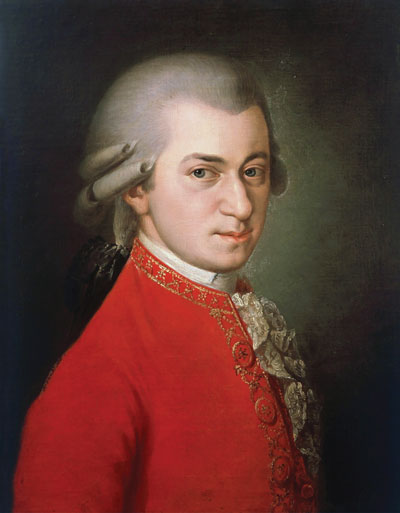
Born: March 10, 1892, Le Havre, France
Died: ANovember 27, 1955, Paris, France
Concerto No. 3 in G Major for Violin and Orchestra, K. 216, Strasbourg
- Composed: 1775
- Premiere: 1775, Mozart likely was soloist and conductor
- Instrumentation: solo violin, 2 flutes, 2 oboes, 2 horns, strings
- CSO Notable Performances: First CSO Subscription: October/November 1958, Max Rudolf conducting; Joseph Fuchs, violin. Most Recent: March 2021, Louis Langrée conducting; Melissa White, violin.
- Duration: approx. 24 minutes
In 1756, the same year as Wolfgang Amadeus Mozart’s birth, Leopold Mozart, Wolfgang’s father, published a treatise on the fundamental principles of violin playing, a text that became an influential resource during his lifetime and beyond. Leopold enjoyed a long career as a court musician for the Archbishop of Salzburg and taught violin lessons as a way to supplement his income. He was highly regarded as a teacher and devoted much of his time toward giving his children a comprehensive musical education. He was also a businessman who capitalized on the talents of his offspring, once he observed how quickly they were both becoming prodigies.
Wolfgang Amadeus Mozart was born the youngest of seven children, five of whom died in infancy. He grew up with his older sister, nicknamed Nannerl, and began picking out tunes on the piano at the age of 3 after watching Nannerl’s music lessons. By the time Mozart was 6 years old, the siblings were a touring sensation, performing together at the imperial courts in Munich and Vienna. Leopold managed the tours and touted his young son as a miracle from God for his immense talent at improvising and composing.
In addition to his skills as a pianist, Mozart briefly followed in his father’s footsteps as a violinist. He became a court musician in Salzburg at the age of 17 and spent four years working for Archbishop Colloredo as a performer and composer. Colloredo was an unpopular figure in Salzburg and his reforms diminished the once thriving musical life of the city. The university theater that had produced operas since the 17th century closed, church Masses were shortened and performances of purely instrumental music were limited. Mozart grew increasingly frustrated with his position, feeling confined by the low pay, restrictions on his freedom and mounting ire directed at him by his employer. Despite these tensions, Mozart wrote prolifically during this time, producing several Masses, a keyboard concerto and a dozen symphonies.
While employed in Salzburg, Mozart composed five violin concertos in a row, completing them all between April and December of 1775. The concertos were written for use in the court and Mozart likely premiered the works himself, filling the roles of soloist and conductor. Mozart once commented that playing the violin was an “unpleasant chore.” When he left Salzburg to eventually settle in Vienna, he stopped playing the violin and never composed another concerto for the solo instrument; the stunning Sinfonia Concertante for violin and viola, written in 1779, was his final work to feature violin.
Of the five violin concertos, the third has become the most popular due to its simultaneously bold spirit and intimate beauty. Although Mozart wrote the Concerto No. 3 when he was only 19 years old, its depth of melodic lines, charming character and adventurous treatment of classical structure hint at his later works. The orchestra provides a light and airy backdrop to the intricate solo violin part, making the work a showcase for the soloist’s technical prowess and virtuosity.
The first movement begins with a theme that Mozart had already used in his most recent opera, Il re pastore (“The Shepherd King”), which premiered in Salzburg a few months before the concerto was finished. It was rare for Mozart to recycle his own music, yet the melody, originally for voice, translates seamlessly to the noble nature of the violin and gives the movement an operatic flare. The theme comprises three boisterous chords, each immediately followed by quicker and softer moving notes. The sudden contrast in dynamics and the two beats of silence that end the phrase create a striking effect, both in the orchestral introduction and again when the soloist enters with the same theme.
The melody of the second movement Adagio unspools delicately. In another subtle yet remarkable moment, the melody’s first five notes are played alone, as if suspended in midair. The accompaniment enters with pizzicato and muted strings halfway through the first measure, like an exhalation that gives momentum to the solo line. Mozart uses flutes throughout this movement, instead of the oboes that appear in the first and last movements, to add a softer quality to the sound. Alfred Einstein, the noted Mozart scholar, called this movement “an adagio that seems to have fallen straight from heaven.”
The finale is innovative in its multiple tempo changes. The movement begins with an upbeat dance in triple meter and is interrupted by an episode in duple meter featuring a slower melody and a move to a minor key. Sustained oboes and pizzicato strings add a melancholy tone to the orchestra. A second episode immediately follows with a faster tempo and a raucous folk tune with drones in the accompaniment, reminiscent of a bagpipe. This is the melody that gives the concerto its nickname, as the tune is believed to have originated from Strasbourg, France. It is unknown how Mozart came to include this folk melody in his concerto, but in a letter to his father two years after completing the work, he refers to it by this nickname, writing about a recent concert: “In the evening at supper I played my Strasbourg Concerto, which went very smoothly.”
The first theme returns once more before the work makes its cheerful way to the finish line. In keeping with the unconventional nature of the movement, Mozart forgoes the expected ending of a grand orchestral gesture and instead uses the woodwinds to conclude delicately with an uplifting phrase that floats away gently into the air.
© Catherine Case