Bedřich Smetana
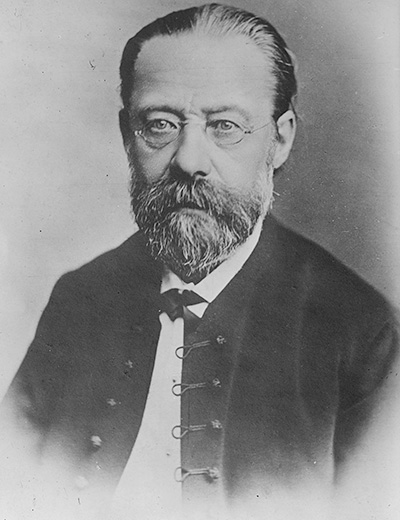
Born: March 2, 1824, Litomyšl, Bohemia [now Czech Republic]
Died: May 12, 1884, Prague, Czechia
String Quartet No. 1 in E Minor, From My Life
- Composed: 1876
- Premiere: Private premiere: April 1878 at the home of Josef Srb-Debrnov (Antonín Dvořák was violist). Public premiere: March 29, 1879, Prague. Ferdinand Lachner and Jan Pelikán, violins; Josef Krehan, viola; Alois Neruda, cello.
- Duration: approx. 30 minutes
As a public figure, Bedřich Smetana devoted his entire life to the creation of a Czech national idiom in music, a goal he pursued with his operas and symphonic poems. When it came to expressing his innermost personal feelings, on the other hand, he turned to chamber music, like so many great composers both before and after him. When his daughter Bedřiška died at the age of four, he wrote his dark and tempestuous Piano Trio in G Minor. And when, at the height of his creative powers, he suddenly lost his hearing and was forced to withdraw from conducting, he composed the string quartet Z mého života (“From My Life”). Then, shortly before his death, he wrote an enigmatic Second Quartet, which many commentators have interpreted as another portrayal of his deteriorating health.
In an often-quoted letter to his friend, music historian Josef Srb-Debrnov (1836–1904), Smetana described the program of his string quartet From My Life in some detail:
The first movement depicts my youthful love of art, my romantic moods, an indescribable longing for something which I could not express in words, and a foreboding of unhappiness to come…
The second movement is like a polka and reminds me of the happy days of my youth, when I composed dance tunes and was known as a passionate lover of dancing. The middle “trio” section brings back memories of aristocratic circles in which I used to move many years ago.
The Largo sostenuto recalls my first love and happiness with the girl who later became my first wife.
The finale describes my joy in discovering that I could treat elements of Bohemian national music in my work. My joy in following this path was checked by the terrible catastrophe of my sudden deafness.… The long, insistent note is the fateful ringing in my ears of the high-pitched tones which announced the beginning of my deafness. I permitted myself this little joke because it was so disastrous to me. It left me with the outlook of a sad future, only a passing hope of recovery, a brief reminder of my love and art, and finally a sensation of nothing but pain and regret.
What Smetana called a “little joke” is actually the most famous, and the most tragic, moment of the piece: that sustained high “E” that replicates the ringing of the composer’s ears as the first sign of his illness. The only reason he could call this devastating moment a “joke” was because it disrupted so suddenly what, up to that point, had been a happy and fairly conventional movement.
The quartet opens with a lengthy and quite dramatic viola solo, suggesting the “foreboding of unhappiness” mentioned in the composer’s description. The melodious secondary theme, on the other hand, expresses the “longing” and the “youthful love of art.” The entire movement oscillates between those two opposite emotions; the usual contrast between the themes of the sonata movement becomes quite extreme.
The second movement, too, takes something to the extreme, in this case the idea of the dance. (It is well known that Smetana loved to dance and was quite accomplished on the ballroom floor when he was a young man.) This is not simply a polka but a kind of “polka-fantasy,” with intentionally exaggerated melodic and rhythmic gestures. A fanfare-like melody is marked pointedly as quasi Tromba (“like a trumpet”). The middle section (the melody of which returns later in the movement) is as tender as the main section is boisterous.
Smetana drew an affectionate portrait of Kateřina, his first wife, in the slow movement. An exquisite cello solo introduces an intensely lyrical melody played by the first violin. The tragic accents that appear later allude to Kateřina’s death from tuberculosis at age 32, after 10 years of marriage, during which three of the couple’s four children had also died.
The finale opens with a string of melodies in turn exuberant and jovial, signaling unrestricted happiness and contentment for the first time in the piece. It is this radiant outpouring of joy that is cruelly interrupted by the aforementioned high “E” note, followed by a recapitulation of the two main themes of the first movement — the first, in its original dramatic form; the second, transformed from idyllic to despondent, bringing the work to its utterly dark conclusion. As the first major string quartet to be based in its entirety on an extra-musical program, From My Life is a historically important work, since the chamber genres as practiced by Schumann or Brahms were generally considered to be the province of “absolute” music — and this in spite of the “Convalescent’s Holy Song of Thanksgiving” in Beethoven’s quartet Op. 132. Smetana’s work is an exact contemporary of Tchaikovsky’s third string quartet, written in memory of violinist Ferdinand Laub (who was, incidentally, from Prague). The Czech composer’s innovation opened some doors for others: Arnold Schoenberg based his string sextet Transfigured Night (1899) on a poem, and Smetana’s fellow countryman Leoš Janáček drew inspiration from Tolstoy’s short novel in his first string quartet (Kreutzer Sonata, 1923), and from his love for a much younger woman in his second (Intimate Letters, 1928). In 1960, Dmitri Shostakovich composed his own autobiography in the form of a string quartet, his Eighth.
The emotional richness of Smetana’ From My Life prompted the great conductor George Szell to orchestrate the work in 1939–40. And that high “E” figures prominently in the biopic released for the 200th anniversary of Smetana’s birth in 2024, as a kind of leitmotiv symbolizing the tragedy that befell the composer. The film Smetana, directed by Marek Najbrt and starring Václav Neužil in the role of the composer, ends with an image of the deaf and mentally disturbed master standing in a box at the new National Theater in Prague, receiving a standing ovation from a capacity audience as the “Father of Czech Music.”
© Peter Laki