Ludwig van Beethoven
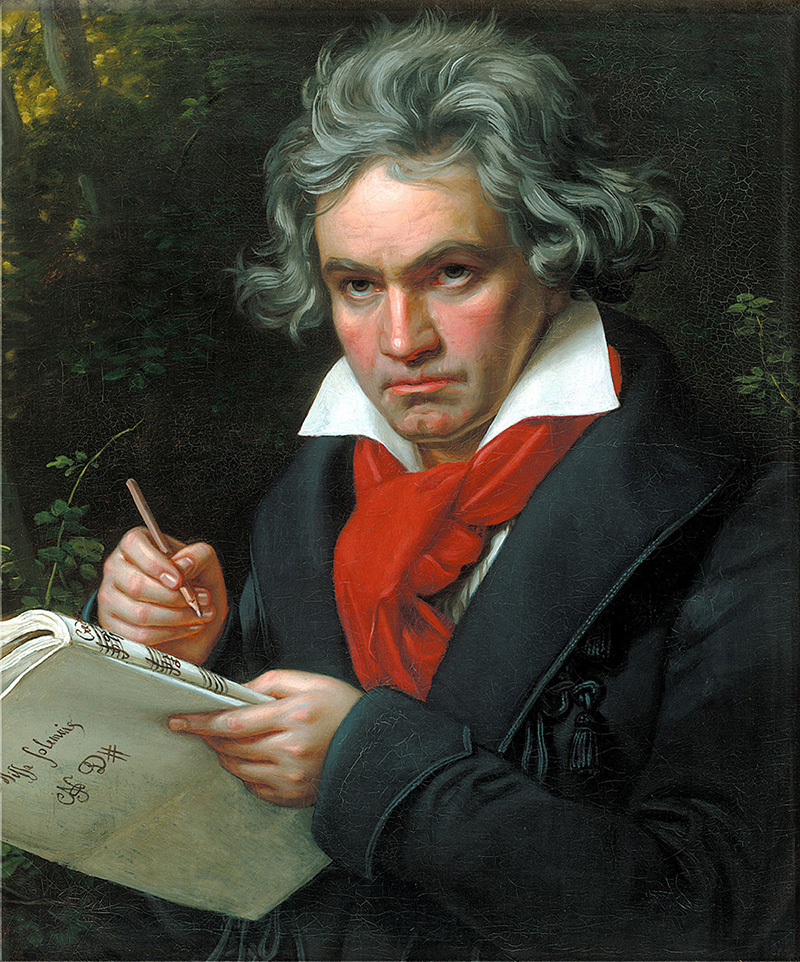
Born: Baptized December 17, 1770, Bonn, Germany
Died: March 26, 1827, Vienna, Austria
String Quartet No. 10 in E-flat Major, Op. 74, Harp
- Composed: 1809
- Premiere: 1809 at the home of its dedicatee, Prince Lobkowitz
- Duration: approx. 30 minutes
In 1792, the 22-year-old Beethoven left his hometown of Bonn, Germany, for the culturally rich city of Vienna, in hopes of gaining more opportunities and broader recognition as a composer and performer. He was given a travel stipend by the Elector of Bonn to study music with the venerable Joseph Haydn, who was considered the greatest living composer at the time. The student and teacher had a strained relationship, and, when Haydn moved to London in 1794, Beethoven effectively lost his mentorship and was expected to return home. At the same time, the French Revolution was spreading across Europe and Bonn fell to France in October of that year. With the Elector ousted, Beethoven’s financial support was gone, leaving him no reason or obligation to return to Germany. He chose to stay in Vienna and earned an income teaching music lessons while continuing to develop his reputation as a composer.
When Beethoven first moved to Vienna, he was already well established as a brilliant pianist and was often compared to Mozart when it came to his talent at improvising during performances. The Viennese aristocracy placed great value on music and took pride in learning to play instruments and hosting concerts in their homes. These nobles welcomed Beethoven as Mozart’s natural successor and many of Mozart’s patrons were early supporters of the young Beethoven.
During these early years in Vienna, Beethoven took on the string quartet, displaying a deep understanding of the genre by composing the six quartets that comprise his opus 18. The string quartet had once been considered light entertainment meant for parlors but was gaining traction as a more sophisticated and respected art form with the help of Haydn and Mozart. With his first quartets, Beethoven pushed the emotional and structural boundaries even further, bringing a new seriousness to the genre that was better suited to concert halls.
In the beginning of 1809, the possibility for financial stability finally presented itself. Beethoven was offered a job by Napoleon’s youngest brother, Jérôme Bonaparte, to serve as Kapellmeister of Westphalia, where Jérôme had been installed as King. Beethoven was flattered but had no desire to leave Vienna. Instead, he used the job offer to negotiate a steady salary provided by three wealthy noblemen that allowed him to stay on in Vienna without the continual stress of living month-to-month.
This stability was shaken in May of that year when Napoleon’s ongoing quest for control over Europe reached Vienna. His army invaded and occupied the city for months. Members of the Austrian Imperial Court, including Beethoven’s patrons, fled to the countryside. Beethoven chose to stay home and took shelter in his brother Kaspar’s cellar during the worst of the fighting, covering his ears with pillows to protect his already failing deafness. In a letter to his publisher in Leipzig on July 26, he wrote, “What a destructive, disorderly life I see and hear around me…nothing but drums, cannons and human misery in every form.”
Beethoven managed to finish his Tenth String Quartet during the summer of 1809, and it was premiered at the home of Prince Lobkowitz — one of his three benefactors and the quartet’s dedicatee — in the fall. By that time, the French had moved on, leaving the city in disarray but allowing the nobility to return home and begin the work of rebuilding the cultural life of Vienna.
Despite the political turmoil, and perhaps with a desire to return to normalcy, Beethoven chose a gentle and playful mood for his String Quartet No. 10. Unlike his other quartets from this period, which audiences considered difficult to grasp for their innovation and seriousness, the “Harp” quartet is a warm and optimistic work. The quartet opens with a slow introduction made up of small phrases that build tension with creeping chromaticism and uncertain tonality. Two chordal outbursts interrupt the otherwise serene mood. The rest of the movement is in sonata form with a buoyant melody introduced in the violin and quickly passed to the cello. The use of pizzicato, or plucked strings, is a prominent feature in the movement and it is this harp-like effect that gave the work its nickname. Beethoven had no part in providing the moniker; it was added later by a publisher. The development section is a flurry of exuberant activity that ends with a series of softly plucked arpeggios that wander between sustained chords. The arpeggios build in strength and burst into the recapitulation with the return of the main melody. The first violin breaks out in a soloistic moment of virtuosity during the coda but reunites with the group to end the movement on a joyous note.
The slow movement Adagio is a tender and elegant rondo with a lyrical theme. The main melody is repeated three times, each with different embellishments yet all gentle in expression. The final iteration features a lovely contrapuntal line in the second violin and more pizzicato in the viola. The fantasia-like quality of the variations and the moments that wander into a darker, minor key hint at the emotional depths Beethoven would achieve in his late quartets. The movement ends in hushed chords of utter calm.
The Scherzo that follows snaps out of the revery and recalls the rhythmic motives of his famous Fifth Symphony with its quick, four-note repeated figure that bursts forth with volatile energy. The cello leads a second section in a flurry of rapid-fire scales that create a whirlwind of sound. Throughout this movement, the music is imbued with uncontainable momentum until, fully exhausted, it comes to a soft landing and glides seamlessly into the final movement.
Unlike the Scherzo of the Fifth Symphony, which segues into a bold and powerful finale, this Scherzo flows directly into a final movement full of delicate grace structured around a theme and variations. The theme is a series of short phrases and the variations alternate between lively exchanges and lyrical passages. After six variations, a coda extends the theme, growing in urgency and excitement until it stops short and delivers an astonishing ending of quiet brevity.
© Catherine Case