Felix Mendelssohn
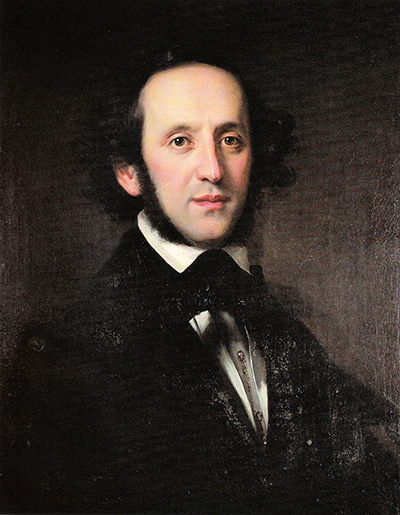
Born: February 3, 1809, Hamburg, Germany
Died: November 4, 1847, Leipzig, Germany
Symphony No. 3 in A Minor, Op. 56, Scottish
- Composed: 1841–1842
- Premiere: March 3, 1842, Leipzig Gewandhausorchester, Felix Mendelssohn conducting
- CSO Notable Performances:
- First: April 1895, Henry Schradieck conducting.
- Most Recent: November 2021, Roderick Cox conducting.
- Instrumentation: 2 flutes, 2 oboes, 2 clarinets, 2 bassoons, 4 horns, 2 trumpets, timpani, strings
- Duration: approx. 40 minutes
A gifted prodigy, Felix Mendelssohn is remembered as one of the great German composers of the 19th century. Along with his talented sister Fanny, Felix demonstrated musical genius as a child, playing piano and violin, singing and skillfully practicing music theory and composition. He came into his own as a composer in the 1820s, fully launching his career just as Beethoven’s career ended. Well-known for his orchestral, choral and pianistic writing, Mendelssohn’s musical style reflects the clarity of the Classical forms he studied as well as the dramatic musical aesthetics of Romanticism. One of his most frequently performed works, the Scottish Symphony No. 3, demonstrates his masterful skill in composing.
Much of Mendelssohn’s early life was spent in Berlin, where he received musical and general education from tutors and private teachers. Around 1819, he entered into an apprenticeship with Carl Friedrich Zelter, the director of the Berlin Singakademie, who taught the young Mendelssohn theory and compositional techniques. Mendelssohn soon pursued increasingly larger composition projects, including piano works, chamber music, choral works and Singspiels. He wrote his first symphony in 1824, and he composed his well-known Overture to A Midsummer Night’s Dream in 1826.
In 1829, Mendelssohn decided to travel to England, Italy and France in a grand tour of conducting, performing and composing. This tour would also prove to be important for Mendelssohn to establish relationships and reunite with musical friends in the various cities he visited, bolstering his career and professional connections. He traveled to London in the spring of 1829 before returning to Berlin in December. He embarked for Italy in the spring of 1830, passing through Munich and Vienna before proceeding to Venice, Florence and finally Rome. After several months, he set out again, passing through several cities before arriving in Paris in December 1831. Mendelssohn returned to London in April 1832 and finally returned to Berlin in June.
Having completed his grand tour, Mendelssohn contemplated career prospects. He took on a position as the Düsseldorf music director in October 1833, but he grew dissatisfied and pursued other opportunities. In September 1835, he began a new position as the municipal music director of Leipzig and conductor of the Gewandhaus Orchestra. This transition proved to be a positive move, as Mendelssohn would maintain his affiliation with Leipzig for the rest of his life. In 1840, Friedrich Wilhelm IV succeeded his father as King of Prussia, and, as part of his plan to revive arts in Berlin, he appointed Mendelssohn as Kapellmeister. For the next several years, Mendelssohn traveled back and forth between Berlin and Leipzig, overseeing various aspects of musical life in Berlin, continuing his duties with the Gewandhaus and establishing a new conservatory in Leipzig. In May 1847, he learned the devastating news of his sister Fanny’s death. A few months later, his own health declined as he suffered a series of strokes, and he died in November 1847. A funeral service was held for Mendelssohn in Leipzig, and he was buried in Berlin next to Fanny’s grave.
Many great compositions make up Mendelssohn’s musical legacy, including the Scottish Symphony. Though published as Symphony No. 3, it was the last of the five symphonies Mendelssohn composed. A long period of time passed between his conception of the symphony and its completion. Mendelssohn decided to write his Scottish Symphony while visiting Scotland during his grand tour early in his career. When he traveled to London in 1829, Mendelssohn had free time after the Philharmonic Society’s season had ended, so he journeyed to Scotland with his friend, the poet Karl Klingemann. They visited Edinburgh, where the Holyrood Palace gave Mendelssohn the inspiration for the opening of his Scottish Symphony. Their tour of the Highlands sparked the creativity of both men, as Klingemann wrote poetry and Mendelssohn sketched the landscapes. Upon reaching the western coast, they caught their first glimpse of the Hebrides. Seeing the cluster of islands and visiting Fingal’s Cave on the island of Staffa inspired Mendelssohn to compose his Hebrides Overture, a picturesque orchestral overture that captures the beauty of the islands and the sound of the sea. From there, they traveled to Glasgow and then Liverpool, at which point Klingemann returned to London and Mendelssohn continued on to Wales. The memorable trip through Scotland provided Mendelssohn with the musical ideas and motivation to compose his Scottish Symphony, though he ended up setting his work aside for a while. He returned to working on the symphony in 1841, completing it while performing his duties in Berlin early in 1842 and premiering it in Leipzig a couple months later. Mendelssohn later premiered the symphony in London and dedicated the piece to Queen Victoria.
Although Mendelssohn often referenced his symphony as his “Scottish” or “Scotch” in his own writing and correspondence in 1829, he did not explicitly label it as such when he completed the work in 1842. He did not provide a descriptive title or program to accompany the symphony to suggest a Scottish narrative. Nevertheless, for many listeners, the history of the piece and its rich orchestration evoke the picturesque landscapes of Scotland. Mendelssohn’s Symphony No. 3 consists of four movements that are generally performed without pauses between the movements. The first movement begins with a slow introduction, the initial theme presented in the dark colors of the viola and low-register winds. A new section begins with the clarinet and violins presenting the second theme. It begins softly and gently but grows in intensity to a more agitated style. Rapid bursts of agitation balance with smoother and calmer sections. The first movement closes with pizzicato strings before continuing into the second movement, a scherzo, in which the music moves quickly and with spirit and a lively clarinet theme evokes the style of Scottish folk music, in a pentatonic scale and the rhythm of the Scotch snap. This energy continues through to the third movement, a much slower Adagio that begins softly, highlighting an expressive violin melody followed by a stately and somber march of dotted rhythms. The final movement, Allegro guerriero (“warlike”), restores the agitated energy of the first movement, introducing a skipping theme in the violin that is passed around among the instruments. Mendelssohn includes an innovative coda to close the fourth movement, which almost serves as a fifth movement. The coda introduces a new majestic theme in the key of A major. This broad sweeping theme resolves the tension of the symphony, closing the piece with what we might imagine to be a depiction of the pastoral Scottish landscape.
—©Dr. Rebecca Schreiber