Frédéric Chopin
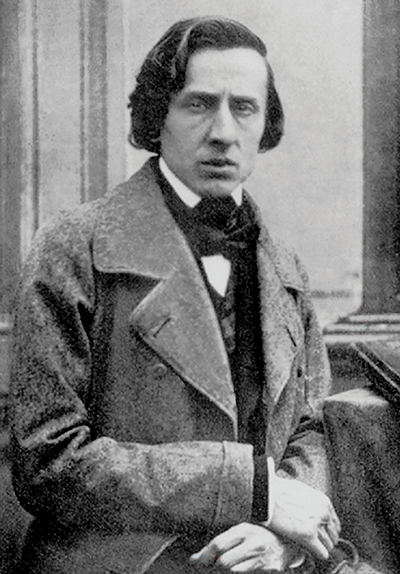
Born: March 1, 1810, Żelazowa Wola, Poland
Died: October 17, 1849, Paris, France
Concerto No. 2 in F Minor for Piano and Orchestra, Op. 21
- Composed: 1829
- Premiere: March 17, 1830, Warsaw, Poland (Warsaw National Theatre), Frédéric Chopin, piano
- CSO Notable Performances:
- First: December 1897, Frank Van der Stucken conducting; Richard Burmeister, piano.
- Most Recent: September 2014, Louis Langrée conducting, Emanuel Ax, piano.
- Instrumentation: solo piano, 2 flutes, 2 oboes, 2 clarinets, 2 bassoons, 2 horns, 2 trumpets, bass trombone, timpani, strings
- Duration: approx. 32 minutes
Success caught Frédéric Chopin off guard. On August 11, 1829, the 19-year-old gave a concert at the Kärntnertor Theatre in Vienna that featured an unpublished set of variations for piano and orchestra on the duet “Là ci darem la mano” (“There We Will Give Each Other Our Hands”), from Mozart’s Don Giovanni, and a free fantasy on operatic and Polish themes. The choice mix of exotic, theatrical and local fare won over the Viennese, as a bemused Chopin relayed to his family the day after: “As soon as I appeared on stage I received bravos; after each variation, there was so much applause that I couldn’t hear the orchestra. Once I had finished, there was so much clapping that I had to go out a second time and take a bow.” The reception was so positive that Chopin was induced to appear again a week later, performing (by popular request) the Mozart Variations and introducing another substantial piece for piano and orchestra, the Rondo à la Krakowiak. On August 20, 1830, encouraged by his surprise success and inspired by Vienna’s vibrant musical scene, Chopin left the city with hopes of conquering Europe as a virtuoso composer-pianist.
Although Chopin had substantial works for piano and orchestra in his compositional portfolio, he had yet to write a full concerto — an essential genre for any aspiring virtuoso. Remedying this situation was one of the first goals that Chopin set for himself following his return to Poland. Results came quickly: he presented the F Minor Concerto on March 17, 1830, as the anchor piece to his official public debut at Warsaw’s National Theatre, which also saw the premiere of his Potpourri on Polish Themes for piano and orchestra (later published as the Fantasia on Polish Airs, Op. 13). According to one newspaper report, over 800 people attended the event, and “it was agreed that he belongs among the greatest masters.” Chopin perceived the reaction differently, however, relaying to his close friend Tytus Woyciechowski that the concert “didn’t make the impression upon the masses that I had thought.” While the composer noted that the second and third movements of the concerto “made the greatest effect” on his listeners, the design of the first movement made it “accessible to a small number of people.” Less than seven months later, he was again on stage for a “farewell” concert that saw the premiere of another concerto, this time in E minor.
With two concertos in hand, Chopin planned a route established by many an aspiring virtuoso: impress Vienna (again), tour Italy and then aim for success in Paris and London. Yet, soon after arriving in Vienna in November 1830, a failed assassination attempt on Grand Duke Konstantin Pavlovich of Russia abruptly closed off the border to his homeland. With a return to Warsaw now impossible, Chopin found himself in Vienna alone and impoverished, cut off from the financial resources and professional networks that were essential to realizing his long-range plans. As a result, he had to rearrange much of his original itinerary, eliminating the Italian leg and instead proceeding, after many frustrating delays, to Paris by way of Munich and Stuttgart.
Despite an auspicious arrival in the French capital in October 1831 as a complete unknown, Chopin’s debut at the Salle Pleyel on February 25, 1832 was a musical triumph. The program included Chopin performing his Concerto in E Minor and “Là ci darem” variations, as well as joining Frédéric Kalkbrenner, Felix Mendelssohn, Ferdinand Hiller and two other pianists in a rendition of Kalkbrenner’s gimmicky Grande Polonaise for six pianos. In a review of the concert, the influential critic François-Joseph Fétis singled out “Mr. Chopin of Warsaw” as an artist of extraordinary (and refreshing) originality: “There is soul in his melodies, imagination in his passages, and originality throughout. […] If Mr. Chopin’s future works live up to this beginning, there is no doubt that he will earn a brilliant and well-deserved reputation.”
Yet, while the musical cognoscenti rallied around Chopin’s genius, the general press did not. Chopin’s anti-virtuosic style — intimate, introspective, inviting — clashed with the powerful, near-overwhelming personalities of Niccolò Paganini and Franz Liszt, whose onstage habits profoundly shaped the practice of modern public performance. With popular success unlikely, Chopin pivoted, building a studio of students drawn from some of Paris’ most elite families and offering a substantial back catalog of completed compositions to influential publishers. The piano concertos were among this first wave of compositions that Chopin released during his first years in Paris: the Piano Concerto in E Minor was published in June 1833 as Op. 11, while the Concerto in F Minor, although the first to be composed, appeared in 1836 as Chopin’s second.
Even if Op. 21 did not pave the way for Chopin’s superstardom, it marks a crucial inflection point in his stylistic development. The preeminent virtuosos of Chopin’s youth were Ignaz Moscheles, Ferdinand Ries, and especially Johann Nepomuk Hummel, all of whom practiced a compositional and performance style that posterity has labeled “brilliant.” Chopin’s F Minor Concerto shares much with the concerted works of these and other like-minded composer-pianists, but it also transcends them in several important ways. Whereas the “brilliant” school had used embellishment techniques as melodic window dressing, with Chopin they become essential tools for thematic development. For instance, after the piano’s dramatic entrance in the first movement, it dutifully takes up the principal theme. Yet the phrase destabilizes as it progresses, on account of increased ornamentation in the right hand. Chopin’s employment of this approach for the entire first theme group makes the transition to the next section nearly seamless, thus creating the impression of organic, continuous growth and change. Perhaps it is this novel element that caused Chopin to judge the movement “accessible to a small number of people.”
By contrast, the second movement owes its timeless appeal to an intensity of rhetorical expression shaped by an extraordinary array of melodic permutations and performative gestures. A sweeping pass through four-and-a-half octaves lands on an exposed, high E-flat, the first pitch of a melody long celebrated as an aria without words. The inspiration for such a dramatic scene came from the singer Konstancja Gładkowska, whom Chopin adored from afar for the better part of 1829 and into the early months of 1830 — that is, precisely during the concerto’s period of composition. A blend of nocturne and dramatic recitative, the second movement is notable for its juxtaposition of anguished lyricism and brash, defiant octave outbursts, almost as if the teenage Chopin is trying to articulate his authentic voice before a distant beloved.
If the second movement offers a glimpse of Chopin as (hopeless) romantic, the finale projects his national identity. The main theme is indebted to the Polish mazurka, albeit colored by elements typically associated with the cosmopolitan waltz. Chopin’s designation of “Rondo” is also a bit misleading, as he infuses the genre’s traditional sectional design with extended episodes that take on developmental functions, thus tipping the movement’s formal paradigm toward the sonata. Notable, too, are the subtle rhythmic transformations that characterize the fulsome middle section, the overdue opportunities for members of the orchestra to add meaningfully to the sonic palette (e.g., col legno strings [drawing the wood stick of the bow across the strings], horn fanfare), and the rambunctious hemiolas [rhythmic hiccups] and harmonic asides that characterize the piano writing. Taken as a whole, the concerto is an astonishing testament to Chopin’s youthful genius and a harbinger of his many innovations to come.
(Note: translations of Chopin’s letters come from David Frick’s edition; the translation of Fétis’ review is by the author)
— ©Jonathan Kregor, University of Cincinnati, College-Conservatory of Music