Gustav Mahler
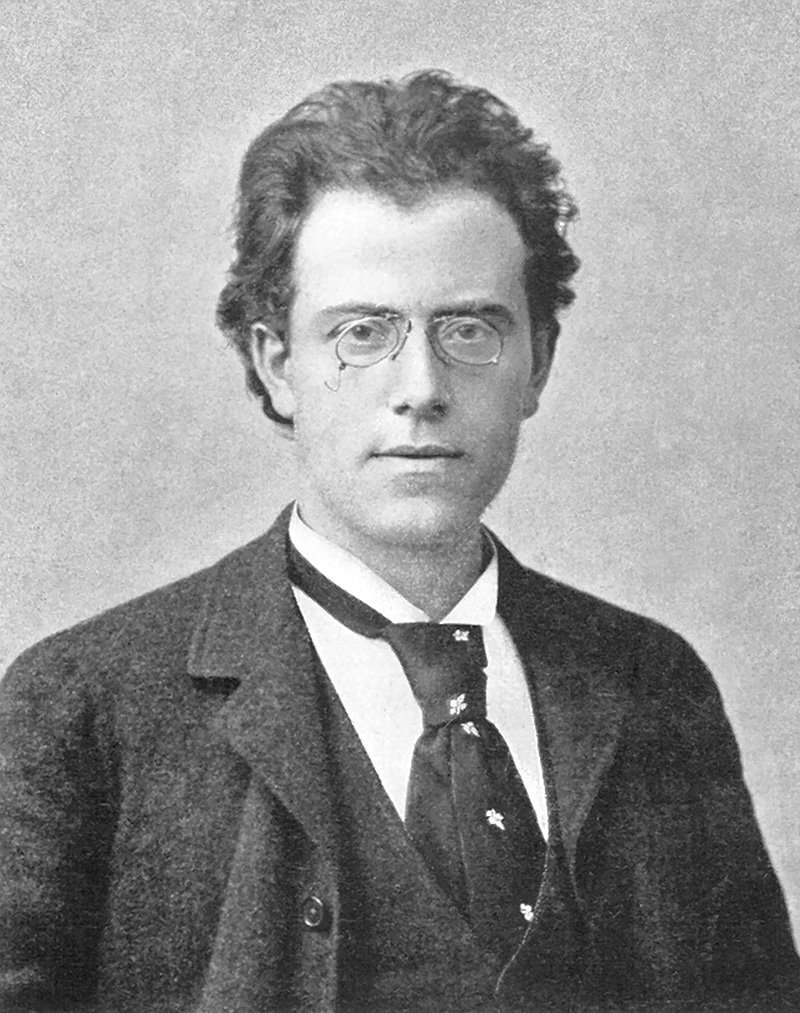
Born: July 7, 1860, Kalist, Bohemia
Died: May 18, 1911, Vienna, Austria
Totenfeier
- Composed: 1888
- Premiere: March 16, 1896, by the Berlin Philharmonic, Mahler conducting
- CSO Notable Performances:
- First: April 1991, Jesús Lopez Cobos conducting.
- Most Recent: October 2007, Paavo Järvi conducting.
- Instrumentation: 3 flutes (incl. piccolo), 2 oboes, English horn, 2 clarinets, bass clarinet, 3 bassoons, 4 horns, 3 trumpets, 3 trombones, tuba, timpani, bass drum, crash cymbals, tam-tam, triangle, harp, strings
- Duration: approx. 23 minutes
In August 1886, the distinguished conductor Arthur Nikisch, later music director of the Boston Symphony Orchestra, appointed the 26-year-old Gustav Mahler as his assistant at the Leipzig Opera. At Leipzig, Mahler met Carl von Weber, grandson of the German Romantic composer Carl Maria von Weber, and the two worked on a new performing edition of the elder Weber's virtually forgotten opera Die drei Pintos (“The Three Pintos,” two being impostors of the title character). Following the premiere of Die drei Pintos, on January 20, 1888, Mahler attended a reception in a room filled with flowers. That seemingly beneficent image played on his mind, becoming transmogrified into nightmares and waking visions, almost hallucinations, of himself on a funeral bier surrounded by floral wreaths.
Spurred by the startling visions of his own death (and almost immediately after completing his Symphony No. 1 in March 1888), he conceived a new work called Totenfeier (“Funeral Rite”). The name was apparently taken from a translation of Adam Mickiewicz's Polish epic Dziady by the composer’s friend Siegfried Lipiner; the translated work was titled Totenfeier and appeared just as work on the score was begun. (Mahler originally referred to the piece by the archaic usage Todtenfeier, perhaps to suggest its gravitas, perhaps to associate it with the early 19th-century German Romantics who sought inspiration in older, notionally simpler times.) Although he inscribed his manuscript Symphony in C minor/First Movement, Mahler had no clear idea at the time what sort of music would follow Totenfeier, and he considered allowing the movement to stand as an independent composition. He completed the score on September 10, 1888.
The next five years were ones of intense professional and personal activity for Mahler. He resigned from the Leipzig Opera in May 1888 to take a new post in Budapest. In 1891, he switched jobs again, leaving Budapest to join the prestigious Hamburg Opera as principal conductor. There he encountered the esteemed pianist and conductor Hans von Bülow, then director of the Hamburg Philharmonic concerts. Encouraged by Bülow’s admiration of his conducting, Mahler asked for his comments on the still-unperformed Totenfeier. Mahler described their encounter: “When I played my Totenfeier, Bülow fell into a state of extreme nervous tension, clapped his hands over his ears and exclaimed, ‘Beside your music, Tristan sounds as simple as a Haydn symphony!’ We parted in complete friendship, I, however, convinced that Bülow considers me an able conductor but absolutely hopeless as a composer.”
Mahler, who throughout his career considered his composition more important than his conducting, was deeply wounded by this behavior, but he controlled his anger out of respect for Bülow, who had extended him many kindnesses and become something of a mentor. Bülow did nothing to quell his doubts about the quality of his creative work, however, and Mahler, who had written nothing since Totenfeier three years before, was at a crisis in his career as a composer.
The year after Bülow’s withering criticisms, Mahler found inspiration to compose again in a collection of German folk poems by Ludwig Achim von Arnim and Clemens Brentano titled Des Knaben Wunderhorn (“The Youth’s Magic Horn”). He had known these texts since at least 1887 and renewed his creative self-confidence in 1892 by setting four of them for voice and piano. The following summer, when he was free from the pressures of conducting, he took rustic lodgings in the village of Steinbach on Lake Attersee in the lovely Austrian Salzkammergut, near Salzburg, and it was there that he resumed work on the Second Symphony, five years after Totenfeier had been completed. Without a clear plan as to how they would fit into the Symphony’s overall structure, he used two of the Wunderhorn songs from the preceding year as the bases for the internal movements of the piece then newly composed the Andante, added a setting of the anonymous poem Urlicht (“Primal Light”) for contralto solo and revised Totenfeier as the first movement. He retained almost all of Totenfeier's musical content and structure, but thoroughly revised its orchestration, nearly doubling its woodwind and brass contingents, augmenting the percussion and adding a second harp and off-stage trumpets and horns.
By the end of the summer of 1893, the first four movements of the Second Symphony were complete, but Mahler was still unsure about the work’s ending — the finality implied by the opening movement’s Funeral Rite seemed to allow no logical progression to another point of climax. As a response to the questions posed by the first movement, he envisioned a grand choral close for the work, much in the manner of the triumphant ending of Beethoven’s Ninth Symphony. Still, no solution presented itself.
In December 1892, Hans von Bülow’s health gave out and he designated Mahler to be his successor as conductor of the Hamburg Philharmonic concerts. A year later, Bülow went to Egypt for treatment, but died suddenly at Cairo on February 12, 1894. Mahler’s friend Josef Förster described the memorial service at Hamburg’s St. Michael Church:
Mahler and I were present at the moving farewell. ... The strongest impression to remain was that of the singing of the children’s voices. The effect was created not just by their singing of Klopstock’s profound poem [Auferstehen — "Resurrection"] but by the innocence of the pure sounds issuing from the children’s throats. Later I could not find Mahler, so that afternoon I hurried to his apartment. I opened the door and saw him sitting at his writing desk. He turned to me and said: "Dear friend, I have it!" I understood: Klopstock’s poem, which that morning we had heard from the mouths of children, was to be the basis for the finale of the Second Symphony.
On June 29, 1894, three months later, Mahler completed his monumental Symphony No. 2, Resurrection, six years after it was begun. He premiered the complete symphony with the Berlin Philharmonic on December 13, 1895; he conducted Totenfeier three months later, on March 16, 1896 in Berlin, as an independent work. The piece was not performed again until the score of the original version was published in 1988, the centenary of its composition.
Mahler wrote of Totenfeier:
We stand by the coffin of a well-loved person. His life, struggles, passions and aspirations once more, for the last time, pass before our mind’s eye. — And now in this moment of gravity and of emotion which convulses our deepest being, when we lay aside like a covering everything that from day to day perplexes us and drags us down, our heart is gripped by a dreadfully serious voice which always passes us by in the deafening bustle of daily life: What now? What is this life — and this death? Do we have an existence beyond it? Is all this only a confused dream, or do life and this death have a meaning? — And we must answer this question if we are to live on.
—©Dr. Richard E. Rodda