Igor Stravinsky
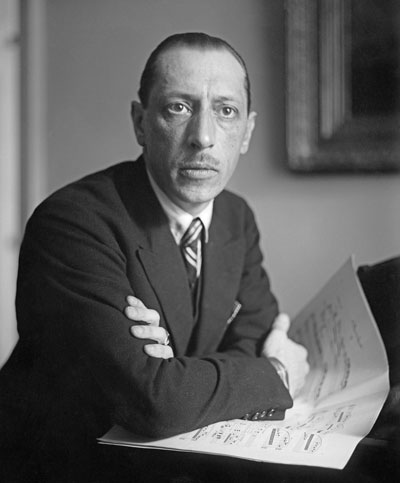
Born: June 17, 1882, Oranienbaum, near St. Petersburg
Died: April 6, 1971, New York City
L’Oiseau de feu (“The Firebird”), complete ballet
- Composed: 1910
- Premiere: June 25, 1910, Palais Garnier in Paris by the Ballets Russes
- CSO Notable Performances:
- First: (complete ballet) November 1945, at a special concert with The Russian Ballet.
- Most Recent: October 1981, Michael Gielen conducting.
- Other (suites): Igor Stravinsky conducted the CSO in the 1919 Firebird Suite in March 1925; several CSO performances of the various Firebird Suites (1911, 1919 and 1945) have occurred since 1920, with one notable performance in 1944, when Leonard Bernstein led the CSO in the 1919 Suite on tour in Parkersburg, West Virginia.
- Instrumentation: 3 flutes (incl. piccolo), piccolo, 3 oboes, English horn, 3 clarinets (incl. clarinet in D), bass clarinet, 3 bassoons (incl. contrabassoon), contrabassoon, 4 horns, 3 trumpets, 3 trombones, tuba, timpani, bass drum, bass drum with attached cymbal, chimes, crash cymbals, glockenspiel, orchestra bells, suspended cymbals, tam-tam, tambour de Basque, triangle, xylophone, 3 harps, celeste, piano, strings
- Duration: approx. 44 minutes
The Russian ballet impresario Sergei Diaghilev, equal parts dictator and devil, charmer and charlatan, had a reputation for eccentricity and remorseless ambition, yet his first season with the Ballets Russes, in 1909, at the height of the Parisian mania for all things Russian, dazzled audiences with breathtaking dancing and stunning visual designs. Only the music had come under criticism in the press for its lack of novelty, so Diaghilev went in search of a composer (four had already turned him down), working his way through the Who’s Who of Rimsky-Korsakov’s students before he found a willing volunteer: Igor Stravinsky. Stravinsky was a driven young man who had not yet established himself and stood to benefit from the opportunity and the recognition the impresario offered. Thus, in December of 1909, Stravinsky joined the production team.
Their choice of title for their new production was a brilliant marketing strategy, because it cashed in both on common perceptions of “Russian-ness” and associations with the avant garde in artistic circles. Prior to coming to Paris, Diaghilev had helmed one of St. Petersburg’s most prominent art journals, Mir Iskusstva (“The World of Art”), which championed an “art for art’s sake” philosophy that its critics declared decadent. It favored style and affect over realism, folktales over social critique, beauty and sensuality over virtue and raw emotion over reason. It sought to integrate music, theatre and visual design into an innovative form of expression that would reflect the essence of ancient Russia in a fresh, new way. Diaghilev chose the symbol of that movement as the title of his new ballet, a recognizable character from Slavic folklore that embodied magic, beauty and rebirth: Жар-птица, Zhar-ptitsa, translated into French as L'Oiseau de feu — “The Firebird.”
Like all the best theatrical works of the period, this Gesamtkunstwerk* relied on close collaboration among a team of creators. The plot was primarily crafted by the choreographer Michel Fokine (1880–1942), an exceptional young dancer who had trained under some of Russia’s most famous masters. He cut and pasted elements from several children’s fables into a pastiche calculated to appeal to Parisian orientalism, in which a Prince Charming figure, Ivan Tsarévich, engages the magical Firebird to help him win over Princess Nenaglyadnaya-Krasa (“Unearthly Beauty”) by freeing her and 12 other princesses from the evil sorcerer, King Kashchey-Bessmertnïy (“Kastchei the Immortal”).
Stravinsky worked one on one with Fokine, who, like many dance masters, insisted that the music be tailored to the choreography, rather than the other way around. He later recollected how Stravinsky …
…brought me a beautiful Russian melody for the entrance of Ivan-Tsarévich. I suggested not presenting the complete melody all at once, but just a hint of it, by means of separate notes, at the moments when Ivan appears at the wall, when he observes the wonders of the enchanted garden, and when he leaps over the wall …
… Stravinsky played, and I acted out the role of Tsarévich, the piano itself substituting for the wall. I climbed over it, jumped down off it, and crawled around in fear, looking around — my living room. Stravinsky, watching, accompanied me with patches of the Tsarévich melodies, playing mysterious tremolos as background to depict the garden of the sinister Kastchei the Immortal. …
As the least experienced member of the production team, Stravinsky had little license to assert his own ideas, and most of his early sketches for the ballet had to be discarded as the production developed. Yet, he had learned from his teacher and mentor, Rimsky-Korsakov, how to use music to help the audience distinguish the elements of the story. Exotic permutations of chromatic scales and harmonies represented supernatural forces, while simpler, white-key melodies and folk tunes depicted human characters.
This is apparent already from the first sepulchral notes of the introduction. A crescendo–decrescendo flutters through the orchestra as the Firebird flies through the garden, pursued by Ivan Tsarevich. The Firebird’s dance follows and ends in her capture (easily recognized from the suite Stravinsky published in 1919). A sensual dance with English horn and viola follows, punctuated with cellos and basses hitting their strings with the wood of the bow, col legno. The garden games of the 13 princesses follow, set to some of the most illustrative music of the ballet in the tremolo strings and cymbal.
A solo horn introduces the moment when Ivan reveals himself, followed by a round dance that quotes a Russian folk song. The kiss between Ivan and the youngest princess is interrupted by a trumpet call, and the timpani announce Kastchei’s entrance. The bass rumbles as Kastchei begins to turn Ivan into stone, but the fluttering music signals the return of the Firebird, who uses her power to make Kastchei and his henchmen leap and spin to harsh accents and disorienting syncopation.
Kastchei and his minions dance to exhaustion and fall into a deep sleep as the Firebird begins her lullaby, accompanied by an ethereal bassoon melody. The orchestra lurches as Ivan crushes the egg holding Kastchei’s soul and then builds to an electrifying finale. The brass section reiterates the Firebird’s leitmotif in broad, triumphant chords, bringing the story to its conclusion.
Although Diaghilev and Fokine dictated many of Stravinsky’s compositional choices throughout the creative process, Stravinsky reportedly won one battle. The original production ended with a remarkable tableau in which the corps de ballet stood on stage, motionless except for the slowly rising hand of Ivan Tsarévich, while the music — not the dancing — narrated the ending of the story for the audience.
One of the star dancers of the Ballets Russes, Vaslav Nijinsky, once wrote in his diary: “Diaghilev cannot live without Stravinsky, and Stravinsky cannot live without Diaghilev. They understand each other.” Indeed, even if the partnership between Igor Stravinsky and Sergei Diaghilev was ultimately a toxic one, it was nonetheless productive, producing monuments such as Petrushka, Les noces and Rite of Spring that would come to define the early 20th century.
—©Dr. Scot Buzza
*Gesamtkunstwerk means “total work of art“ or “synthesis of the arts.“ The term was developed by the German writer and philosopher K.F.E. Trahndorff in 1827, but the term was popularized in the field of music discourse through descriptions of Richard Wagner’s operas. The basic premise of Gesamtkunstwerk is that the work of art was conceived as a combination of different art forms into a single cohesive whole.
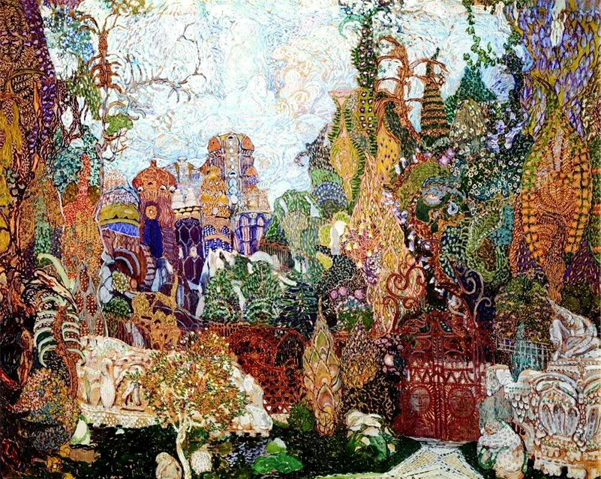
Sketch of scenery for The Firebird by Aleksandr Golovin, who designed the sets and co-designed costumes for the premiere production with Léon Bakst