Piotr Ilyich Tchaikovsky
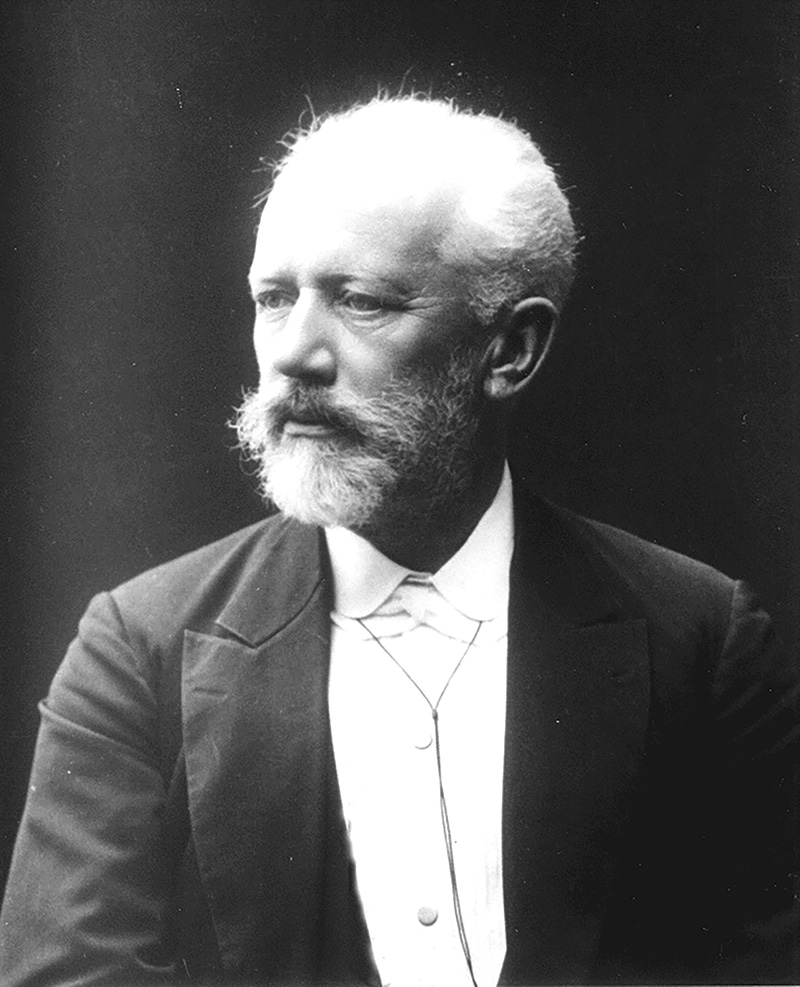
Born: May 7, 1840, Votkinsk, Russia
Died: November 6, 1893, St. Petersburg, Russia
Symphony No. 4 in F Minor, Op. 36
- Composed: 1877–1878
- Premiere: February 22, 1878, in Moscow, Nikolai Rubinstein conducting
- CSO Notable Performances:
- First: November 1896, Frank Van der Stucken conducting.
- Most Recent: October 2023, Ramón Tebar conducting.
- Instrumentation: 2 flutes, piccolo, 2 oboes, 2 clarinets, 2 bassoons, 4 horns, 2 trumpets, 3 trombones, tuba, timpani, bass drum, crash cymbals, triangle, strings
- Duration: approx. 44 minutes
The Fourth Symphony was a product of the most crucial and turbulent time of Tchaikovsky’s life — 1877, when he met two women who forced him into a period of intense introspection. The first was the sensitive, music-loving widow of a wealthy Russian railroad baron, Nadezhda von Meck. Mme. von Meck had been enthralled by Tchaikovsky’s music, and she first contacted him at the end of 1876 to commission a work. She paid him extravagantly, and soon an almost constant stream of notes and letters passed between them: hers contained money and effusive praise; his contained thanks and an increasingly greater revelation of his thoughts and feelings. She became not only the financial backer who allowed him to quit his irksome teaching job at the Moscow Conservatory to devote himself to composition, but also the sympathetic sounding-board for reports on the whole range of his activities — emotional, musical, personal. Although the two never met, her place in Tchaikovsky’s life was enormous and beneficial.
The second woman to enter Tchaikovsky’s life in 1877 was Antonina Miliukova, an unnoticed student in one of his large lecture classes at the Conservatory who had worked herself into a passion over her young professor. Tchaikovsky paid her no special attention, and he had quite forgotten her when he received an ardent love letter professing her unquenchable desire to meet with him. Tchaikovsky (age 37), who should have burned the thing, answered the letter of the 28-year-old Antonina in a polite, cool fashion, but did not include an outright rejection of her advances. He had been considering marriage for almost a year in the hope that it would give him both the stable home life he had not enjoyed in the 20 years since his mother died, as well as to help dispel the all-too-true rumors of his homosexuality. He believed he might achieve both those goals with Antonina. He could not see the situation clearly enough to realize that what he hoped for was impossible — a pure, platonic marriage without its physical and emotional realities. Further letters from Antonina implored Tchaikovsky to meet her and threatened suicide out of desperation if he refused. A welter of emotions gripped his heart when, just a few weeks later, he proposed marriage to her. Inevitably, the marriage crumbled within days of the wedding amid Tchaikovsky’s searing self-deprecation.
It was during May and June of 1877 that Tchaikovsky sketched the Fourth Symphony, finishing the first three movements before Antonina began her siege. The finale was completed by the time he proposed. Because of this chronology, the program of the symphony was not a direct result of his marital disaster. All that — the July wedding, the mere 18 days of bitter conjugal farce, the two separations — postdated the actual composition of the symphony by a few months, though the orchestration took place during the painful time from September to January when the composer was seeking respite in a half dozen European cities, from St. Petersburg to San Remo. What Tchaikovsky found in his relationship with this woman (who by 1877 already showed signs of approaching the door of the mental ward in which, still legally married to him, she died in 1917) was a confirmation of his belief in the inexorable workings of Fate in human destiny. He later wrote to Mme. von Meck, “We cannot escape our Fate, and there was something fatalistic about my meeting with this girl.” The relationships with the two women of 1877, Mme. von Meck and Antonina, occupy important places in the composition of this symphony: one made it possible, the other made it inevitable, but the vision and its fulfillment were Tchaikovsky’s alone.
After the premiere, Tchaikovsky explained to Mme. von Meck the emotional content of the Fourth Symphony:
The introduction [stentorian brasses heard immediately in a motto theme that recurs throughout the work] is the kernel of the whole symphony. This is Fate, which hinders one in the pursuit of happiness. There is nothing to do but to submit and vainly complain [the melancholy, syncopated shadow-waltz of the main theme, heard in the strings]. Would it not be better to turn away from reality and lull one’s self in dreams? [The second theme is begun by the clarinet.] But no — these are but dreams: roughly we are awakened by Fate. [The brass fanfare over a wave of timpani begins the development section.] Thus we see that life is only an everlasting alternation of somber reality and fugitive dreams of happiness. The second movement shows another phase of sadness. How sad it is that so much has already been and gone! And yet it is a pleasure to think of the early years. It is sad, yet sweet, to lose one’s self in the past. In the third movement are capricious arabesques, vague figures which slip into the imagination when one has taken wine and is slightly intoxicated. Military music is heard in the distance. As to the finale, if you find no pleasure in yourself, go to the people. The picture of a folk holiday. [The finale is based on the Russian folk song "A Birch Stood in the Meadow."] Hardly have we had time to forget ourselves in the happiness of others when indefatigable Fate reminds us once more of its presence. Yet there still is happiness, simple, naive happiness. Rejoice in the happiness of others — and you can still live.
—©Dr. Richard E. Rodda